
• Latest
  • Trending
  • All

IPv4 and IPv6 Converter: Decimal, Hex, Binary, Expanded and PTR Formats

May 31, 2026
WordPress Security Hardening Checklist: 34 Scored Controls with Copy-Paste Fixes - cover image

WordPress Security Hardening Checklist: 34 Scored Controls with Copy-Paste Fixes

June 3, 2026
Maximizing Website Speed with Image Optimization Techniques for 2026 - cover image

Maximizing Website Speed with Image Optimization Techniques for 2026

June 3, 2026
SSL certificate renewal manager - 8 ACME clients, expiry calculator and monitoring - cover image

SSL Certificate Renewal Manager: certbot, acme.sh, lego, Caddy, cert-manager

June 3, 2026
CORS policy generator - 14 server and framework configs with presets and live security review - cover image

CORS Policy Generator: Headers + Nginx, Apache, Express, FastAPI, Django Config

June 3, 2026
netsh wlan command reference - 72 commands with example output and copy - cover image

netsh wlan Commands: Windows Wi-Fi Cheat Sheet (Show Password, Profiles, Hotspot)

June 2, 2026
Fix: ESXi Host Not Responding / Disconnected in vCenter (2026) - cover image

Fix: ESXi Host Not Responding / Disconnected in vCenter (2026)

June 1, 2026
VMware ESXi Purple Screen of Death (PSOD): Diagnose and Recover (2026) - cover image

VMware ESXi Purple Screen of Death (PSOD): Diagnose and Recover (2026)

June 1, 2026
VMware PowerCLI command generator cover

VMware PowerCLI Command Generator: VM, Snapshots, Networking, esxcli

June 1, 2026
dd Command Generator: Write ISO to USB, Image Disks, Wipe Drives - cover image

dd Command Generator: Write ISO to USB, Image Disks, Wipe Drives

June 1, 2026
SSH Tunnel Command Generator: Local, Remote and Dynamic Forwarding - cover image

SSH Tunnel Command Generator: Local, Remote and Dynamic Forwarding

June 1, 2026
sed Command Generator: Build Substitute, Delete and Print Commands - cover image

sed Command Generator: Build Substitute, Delete and Print Commands

May 31, 2026
VMware Workstation and Hyper-V on the Same Machine (2026 Fix) - cover image

VMware Workstation and Hyper-V on the Same Machine (2026 Fix)

May 31, 2026
  • Online Tools
  • Network Tools
  • Developer Tools
  • Security Tools
Wednesday, June 3, 2026
  • Login
People Are Geek
  • Online Tools
  • Network Tools
  • Developer Tools
  • Security Tools
No Result
View All Result
People Are Geek
No Result
View All Result
Home Developer Tools

IPv4 and IPv6 Converter: Decimal, Hex, Binary, Expanded and PTR Formats

by People Are Geek
May 31, 2026
in Developer Tools, Network Tools, Online Tools
0
0
SHARES
30
VIEWS
Share on FacebookShare on Twitter

Local IP format utility

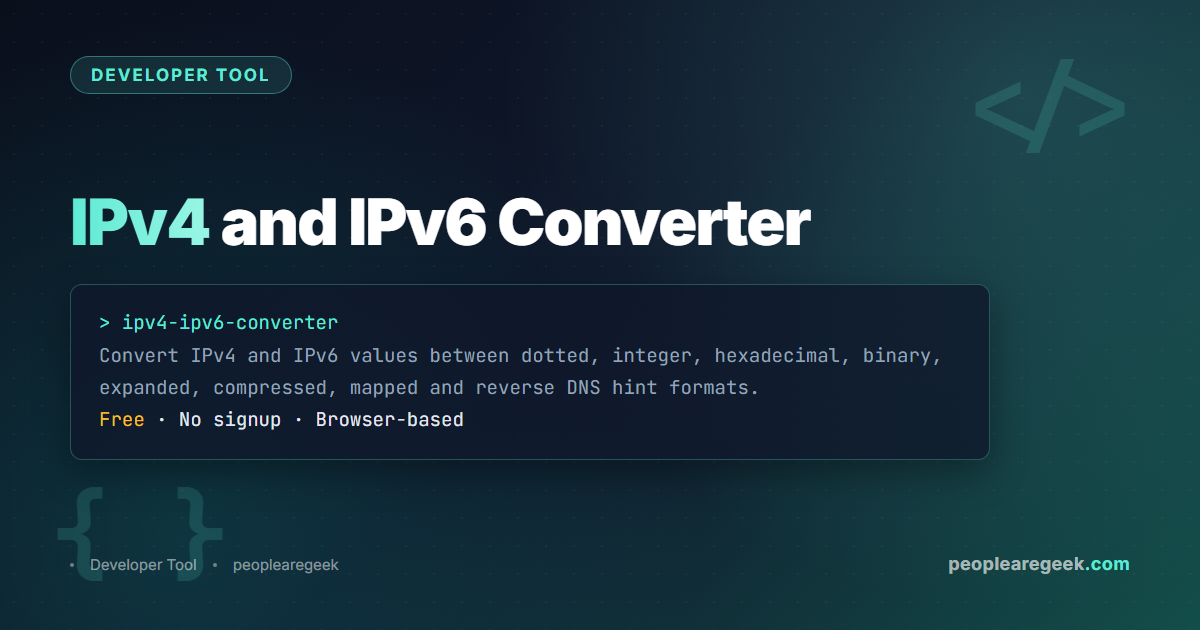
Convert IPv4 and IPv6 values into the forms that appear in logs, firewalls, databases, PTR zones and network documentation. The tool accepts dotted IPv4, IPv4 integers, IPv4 hexadecimal, IPv4 binary and normal IPv6 notation including IPv4-mapped IPv6 examples.

Conversion runs locally in the browser. IPv4-mapped IPv6 is a representation used by some systems; it does not create a native IPv6 route for an IPv4 address.

Why IP address conversion matters

An IP address rarely stays in one notation everywhere. A firewall ticket may show dotted IPv4. A database may store the same IPv4 value as an integer. A packet capture, ACL example or subnet lesson may show binary or hexadecimal. IPv6 adds compressed notation, expanded groups and much longer reverse DNS names. Converting between those views helps you verify that two systems are talking about the same address before you change a rule or close an incident.

This converter is made for that practical work. It shows human-readable forms and machine-oriented forms side by side. For IPv4 it gives decimal integer, hexadecimal, binary octets, PTR hint and an IPv4-mapped IPv6 representation. For IPv6 it shows compressed and expanded notation, 16-bit groups, full hexadecimal, decimal integer, binary groups, address-type hints and the ip6.arpa reverse name.

IPv4 and IPv6 are not interchangeable

IPv4 and IPv6 solve the same addressing problem with different protocols and address sizes. An IPv4 address is 32 bits. An IPv6 address is 128 bits. An IPv4-mapped IPv6 value such as ::ffff:192.168.1.42 can be useful inside software stacks and logs, but it is still a representation of an IPv4 endpoint. It does not mean the network has native IPv6 reachability.

How to read the formats

  • Dotted IPv4 is the familiar four-octet view used in most admin tasks.
  • IPv4 integer and hexadecimal forms are common in storage, APIs and low-level tooling.
  • Binary views expose bit boundaries when subnetting or reviewing masks.
  • Compressed IPv6 removes leading zeros and one longest zero run.
  • Expanded IPv6 shows all eight 16-bit groups for exact comparison.
  • Reverse DNS hints show the PTR lookup name, not a guarantee that a PTR exists.

Useful address-type clues

A conversion result should not only change notation. It should help you recognize what kind of address you are holding. Private RFC1918 IPv4 values are not public internet destinations. Loopback and link-local addresses are local in scope. IPv6 has its own important families such as loopback, link-local, unique local, multicast, documentation and global unicast. Those hints prevent small but common mistakes in firewall rules and support tickets.

Common questions

Why does IPv6 have several correct spellings?

Leading zeros inside a group can be omitted, and one consecutive run of zero groups can be compressed with ::. The expanded and compressed forms can describe the same 128-bit value.

Can I paste an IPv4 integer or hex value?

Yes. Auto detect understands decimal integers and values beginning with 0x. You can also force the input mode if a value is ambiguous.

Does the reverse DNS hint query the DNS record?

No. It builds the name that a PTR lookup would use. Run a reverse DNS lookup when you need the live PTR result.

Can every IPv4 address be written as IPv6?

Yes, via IPv4-mapped IPv6 notation such as ::ffff:192.168.1.1, used so IPv6 software can handle IPv4 connections. It is a representation, not a real migration.

What does the integer form of an IP represent?

An IPv4 address is 32 bits, so it equals a single number from 0 to 4294967295. The integer form is handy for storage and arithmetic; the dotted form is for humans.

Why is IPv6 written in hexadecimal?

IPv6 is 128 bits, far too long in decimal. Hexadecimal groups of 16 bits keep it compact, and runs of zeros can be collapsed with a double colon.

IP Subnet CalculatorReverse DNS LookupWhat Is My IPDNS Lookup
ShareTweetPin
People Are Geek

People Are Geek

I'm Stephane, a network and systems engineer with over 15 years of hands-on experience on production infrastructure, virtualization (ESXi, Proxmox), networking, and self-hosting. Earlier in my career I built and ran a Linux resource site that became a well-known reference for sysadmins. Today I focus on cybersecurity, and I also work as a technical trainer, teaching networking and security to people who do it for a living. Everything on People Are Geek comes from real-world practice, not theory. I build every tool on this site myself, and I write about what I've actually deployed, broken, and fixed. If it's here, I've used it.

People Are Geek

Copyright © 2017 JNews.

Navigate Site

  • About PeopleAreGeek
  • All Tools and Articles
  • Contact
  • Cookie Policy
  • Hyper-V Hub: Tools, Error Fixes and Lab Guides
  • Linux Hub: Cross-Distro Reference, Articles, Tools
  • Page de test Codex
  • Privacy Policy
  • Sample Page
  • Terms of Service
  • VMware vSphere & ESXi Hub: Tools, Error Fixes and Guides

Follow Us

Welcome Back!

Login to your account below

Forgotten Password?

Retrieve your password

Please enter your username or email address to reset your password.

Log In
No Result
View All Result
  • Online Tools
  • Network Tools
  • Developer Tools
  • Security Tools

Copyright © 2017 JNews.