AMD launched its Instinct MI400 GPUs and sixth generation EPYC Venice server CPUs at the Advancing AI 2026 keynote in San Francisco on Thursday, July twenty third, the clearest sign yet that the AI data center now has a credible second full stack. Chief executive Lisa Su walked through a lineup built to compete top to bottom, the MI455X for the heaviest AI work, the MI430X for scientific computing, Venice processors on a two nanometer process, the open ROCm software stack, and Helios, an integrated rack that ties it together. The headline for anyone who plans capacity, Anthropic committed to deploy up to two gigawatts of these GPUs. Here is what launched and why it matters.
The short answer
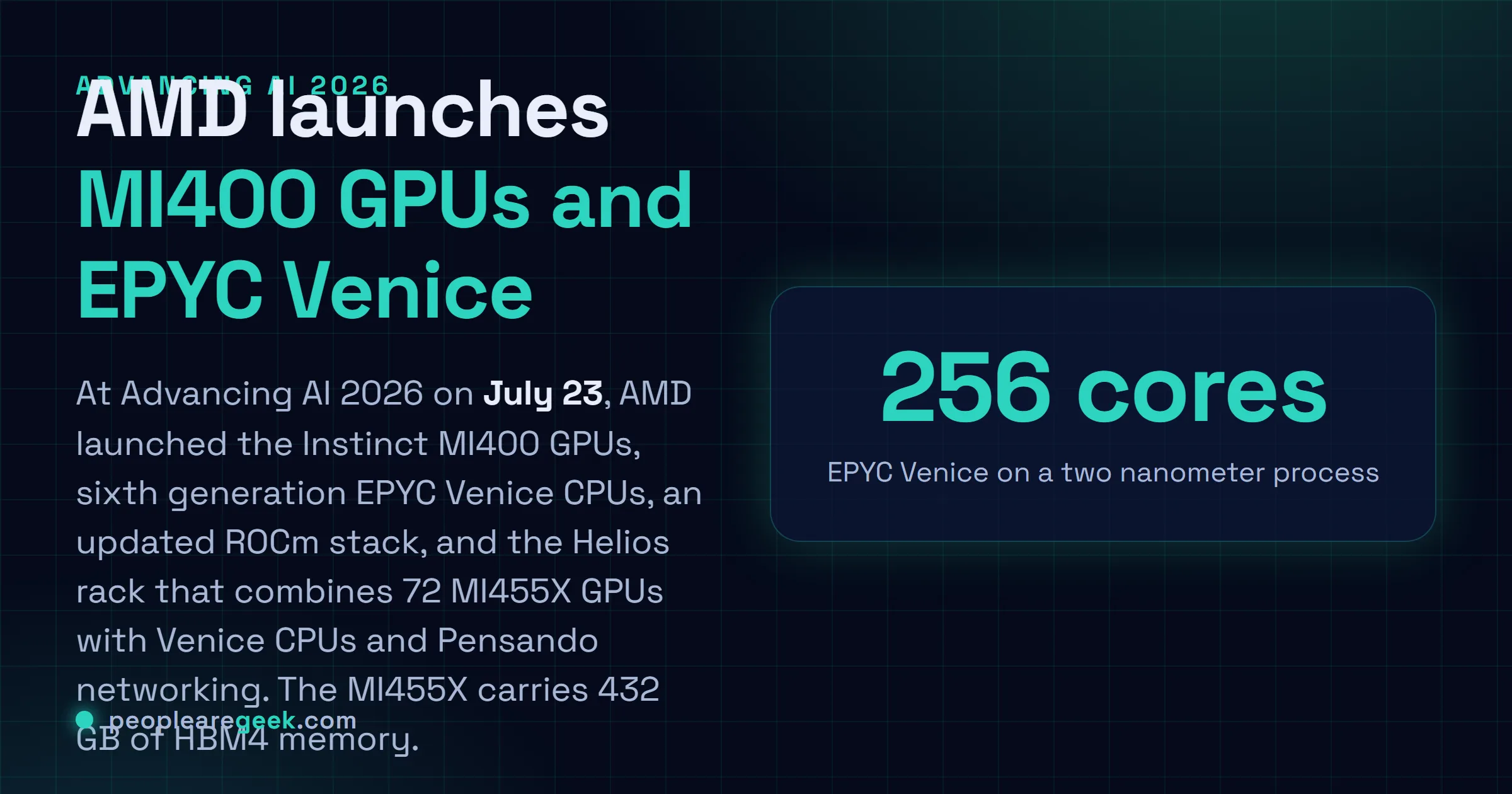
At Advancing AI 2026 on July twenty third, AMD launched the Instinct MI400 GPUs, sixth generation EPYC Venice CPUs, an updated ROCm stack, and the Helios rack that combines seventy two MI455X GPUs with Venice CPUs and Pensando networking. The MI455X carries 432 gigabytes of HBM4 memory, and Venice reaches up to two hundred fifty six cores on a two nanometer process. Anthropic committed to deploy up to two gigawatts of MI455X GPUs, OpenAI brings Helios online in the fourth quarter, and Oracle joined the customer list.
For years the AI data center ran on one company's GPUs and one company's software. At Advancing AI 2026 in San Francisco on Thursday, July twenty third, AMD put a full alternative on the table, new GPUs, new server CPUs, an updated open software stack, and a complete rack to run them in. Chief executive Lisa Su framed it as the whole industry needing to work together to meet AI demand, and the launch was AMD's bid to be the second half of that stack. For teams that plan infrastructure, a real second option changes the math.
The silicon, top to bottom
The launch spanned two chip families. On the AI side, the Instinct MI400 series leads with the MI455X, the flagship accelerator, which carries 432 gigabytes of HBM4 memory and is built for the heaviest training and inference. Alongside it, the MI430X targets high performance computing and sovereign AI, where sixty four bit precision matters more than AI throughput, delivering up to two hundred eighty eight teraflops of FP64 work. One chip chases scale, the other chases scientific accuracy.
On the CPU side, sixth generation EPYC Venice arrived on the Zen six architecture, scaling to two hundred fifty six cores per socket. AMD says it is among the first server processors to reach production on TSMC's two nanometer process, the current leading edge. For the host side of an AI cluster, or for dense virtualization and databases, more cores on a newer process is the lever that raises work per rack and per watt.
Helios, the rack as a product
The piece that ties the silicon together is Helios, AMD's integrated rack-scale system. Rather than shipping cards for operators to assemble, AMD ships a complete liquid cooled rack, seventy two Instinct MI455X GPUs, EPYC Venice CPUs, and AMD Pensando networking, engineered to work as one unit for training and serving frontier models. Reported pricing for a configured system runs from about five million to five and a half million dollars. The idea mirrors how the market buys the leading platform today, a rack you deploy rather than components you integrate yourself.
Software sits underneath all of it. AMD continues to push ROCm as an open stack, which is the strategic contrast with the closed software that dominates AI compute. For teams that want to keep workloads portable across accelerators rather than locked to one vendor, the openness is as important as the hardware.

The customers that make it real
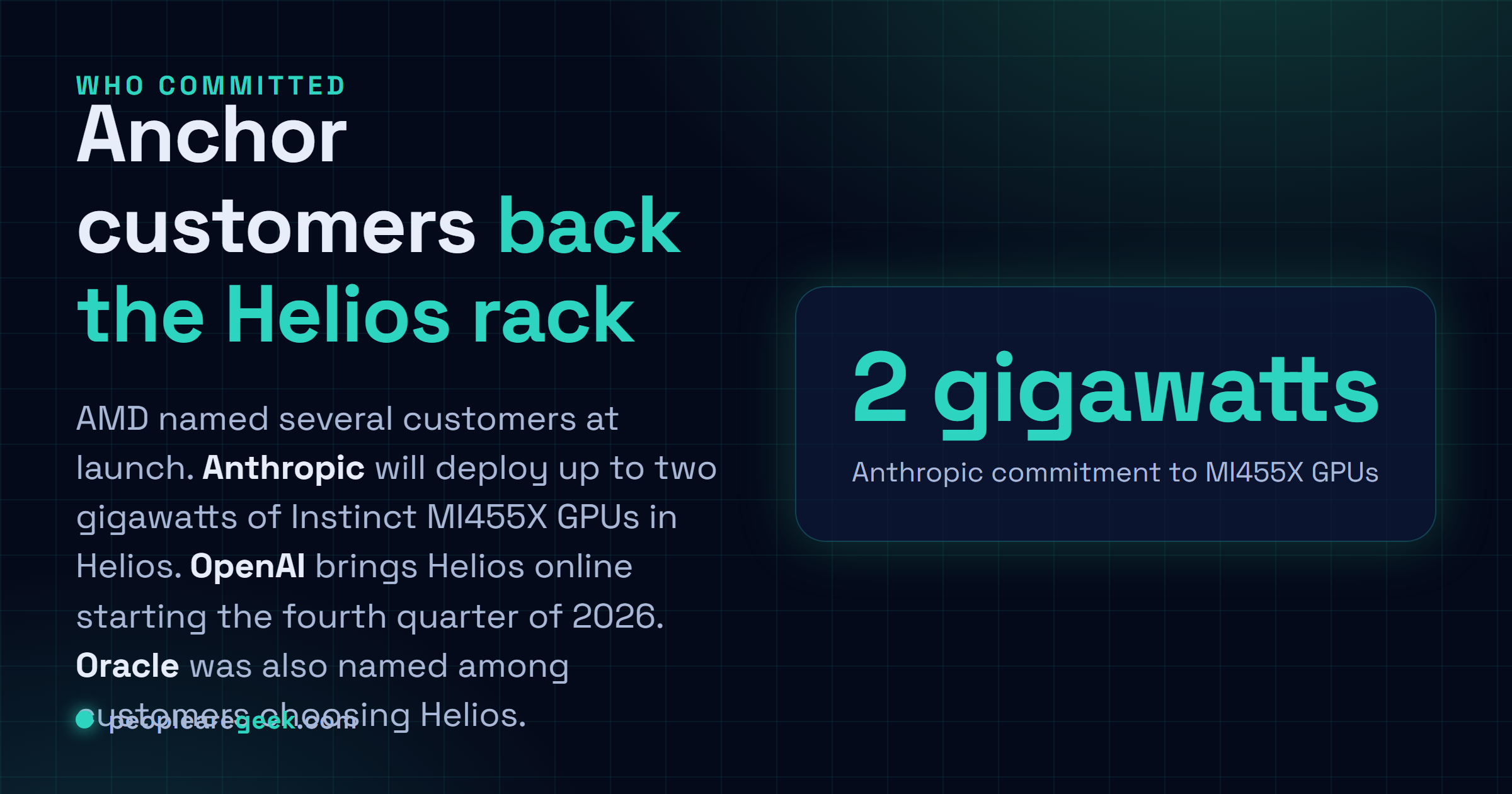
A launch is a claim until customers back it, and AMD brought several. Anthropic said it will deploy up to two gigawatts of Instinct MI455X GPUs in Helios systems under a multiyear plan, a commitment large enough to signal serious confidence in the stack. OpenAI expects to bring Helios online starting in the fourth quarter of 2026, with deployments scaling through 2027. Oracle was also named among the customers choosing Helios. Those are the numbers that turn a keynote into a supply story.
Why it matters for the people who run infrastructure
The interesting part is not any single specification, it is the shape of the market. Most large-scale AI compute still runs on one vendor's GPUs and one proprietary software stack. A credible, largely open alternative, backed by hyperscale commitments, gives the market a second path. Over time that tends to mean more supply, more pricing pressure, and a real reason to keep workloads portable. None of this is something you provision this week, the MI400 systems and Helios racks roll out over the coming quarters. Treat it as a roadmap signal worth tracking, and a reason to design for more than one accelerator.
Sources and further reading
- AMD investor relations: AAI 2026, AMD delivers full-stack compute for the agentic AI era
- HotHardware: AMD announces EPYC 9006 CPUs, Instinct MI400X GPUs, and more at Advancing AI 2026
- Phoronix: AMD EPYC 9006 Venice announced
- SiliconANGLE: AMD debuts next-generation AI infrastructure
Frequently asked questions
What did AMD launch at Advancing AI 2026?
At the keynote on Thursday, July twenty third, AMD launched the Instinct MI400 series of GPUs, the sixth generation EPYC Venice server processors, an updated ROCm open software stack, and the Helios rack-scale system. The MI400 family leads with the MI455X for large-scale AI training and inference and the MI430X for high performance computing. Venice is the new server CPU generation. Helios packages the GPUs, CPUs, and networking into a single integrated rack. Together they are AMD's full-stack answer to the dominant AI compute platform, spanning silicon, systems, and software.
What are the AMD Instinct MI455X and MI430X for?
The two chips target different jobs. The MI455X is the flagship AI accelerator, carrying 432 gigabytes of HBM4 memory and aimed at the heaviest training and inference workloads, where AMD says it leads on performance. The MI430X is tuned for high performance computing and sovereign AI, where sixty four bit floating point precision matters more than raw AI throughput, delivering up to two hundred eighty eight teraflops of that FP64 performance. So one chip chases AI scale, the other chases scientific accuracy.
Why does EPYC Venice matter?
EPYC Venice, the sixth generation EPYC line, is built on the Zen six architecture and reaches up to two hundred fifty six cores per processor. AMD says it is among the first server processors to reach production on TSMC's two nanometer process, which is the leading edge of chip manufacturing. For anyone running dense virtualization, databases, or the host side of AI clusters, more cores on a newer process usually means more work per rack and per watt, which is the metric that drives data center economics.
What is the Helios rack?
Helios is AMD's integrated rack-scale system, a complete unit rather than parts you assemble. It combines seventy two Instinct MI455X GPUs, EPYC Venice CPUs, and AMD Pensando networking into one liquid cooled rack designed to train and serve frontier AI models. The point is that the compute, the host processors, and the network fabric arrive engineered to work together, so operators deploy a rack as a unit. Reported pricing for a configured Helios system runs from about five million to five and a half million dollars.
Who committed to using AMD Helios?
AMD named several anchor customers at the launch. Anthropic said it will deploy up to two gigawatts of Instinct MI455X GPUs in Helios systems in a multiyear plan. OpenAI expects to bring Helios online beginning in the fourth quarter of 2026, with deployments growing through 2027. Oracle was also named among the customers choosing Helios. Those commitments matter because they turn a product launch into demonstrated demand at hyperscale, which is what gives a second GPU stack real staying power.