NetworkNews

Nvidia Holds the Lease in Anthropic's Lambda Cloud Deal

On this page
  1. Read the chain, not the total
  2. The timeline is the part people skip
  3. The question worth adding to your vendor review
  4. Sources and further reading

Anthropic has committed 35 billion dollars over six years to Lambda for roughly 350 megawatts of GPU capacity in Nueces County, Texas, reported by Bloomberg on August 31 and covered across the trade press on September 1, 2026. The number is large, but the structure is the part worth reading twice. Hut 8 builds the campus. Nvidia is reported to hold the lease on it. Lambda buys the Nvidia hardware, installs it and sells the cloud service. Anthropic consumes it. That is four companies in a chain where the chip vendor sits in the middle, and it is the second Nvidia backed provider Anthropic has signed in a month.

The short answer

Anthropic agreed a six year, 35 billion dollar cloud contract with Lambda for around 350 megawatts of capacity at a Hut 8 developed campus in Nueces County, Texas, reported August 31 and covered widely on September 1, 2026. Hut 8 builds and operates the site, Nvidia is reported to hold the lease, Lambda buys the Nvidia hardware and sells the cloud service, and Anthropic consumes it. The campus, Beacon Point, spans about 525 acres near Corpus Christi and targets initial energization in the first quarter of 2027 on the way to roughly 1 gigawatt. It is the second Nvidia backed provider Anthropic has committed to in a month, after a 45 billion dollar agreement with Nscale.

$35Bsix year Anthropic commitment to Lambda
350 MWcapacity in Nueces County, Texas
3 rolesNvidia plays: supplier, investor, lessee
Answer card: Anthropic committed 35 billion dollars over six years to Lambda for about 350 megawatts in Nueces County, Texas, on a Hut 8 campus where Nvidia is reported to hold the lease.
Four companies, one rack. The interesting number is not 35 billion. PNG

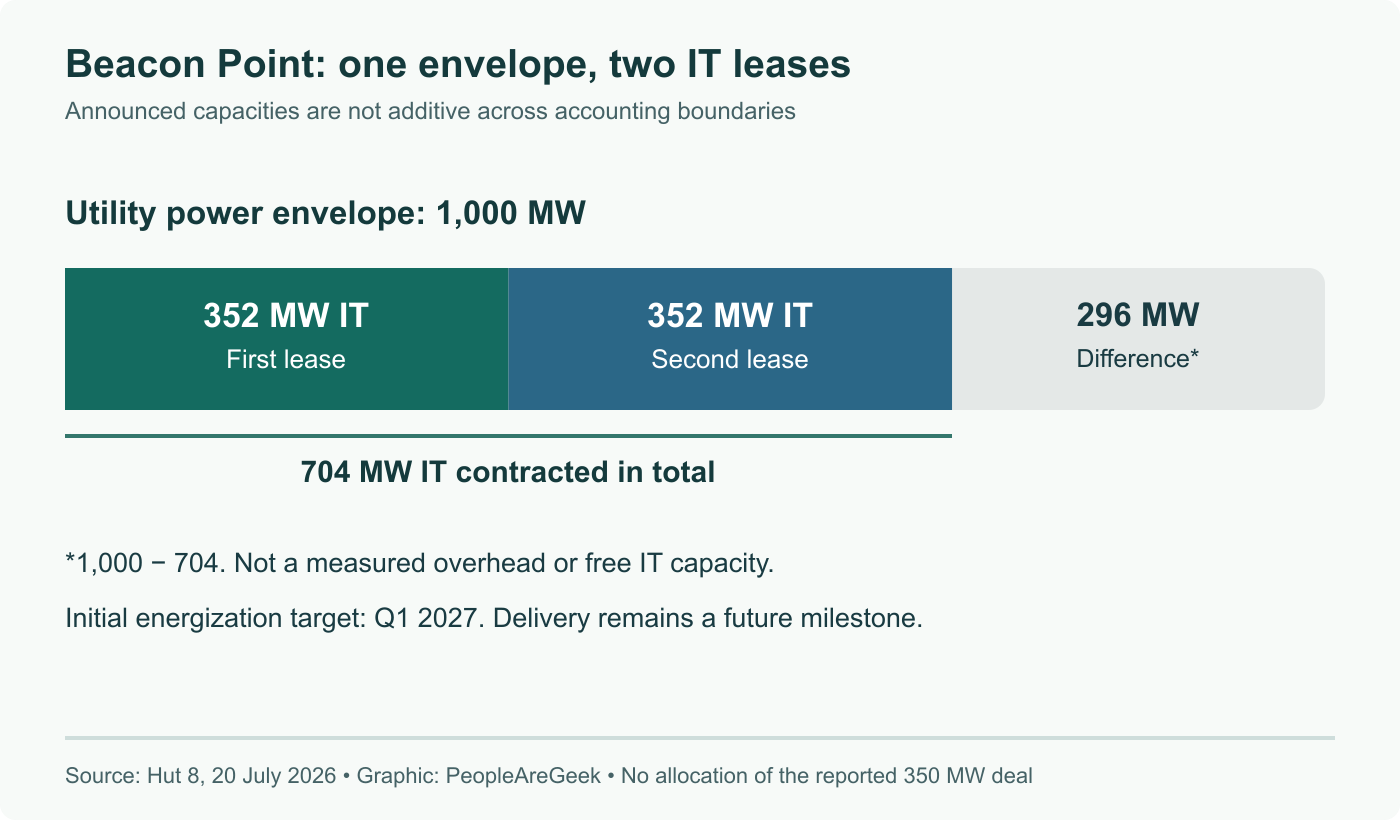
In July we wrote about Hut 8 fully contracting its Beacon Point campus in Texas, and the one thing the announcement would not say was who the tenant was. The language was "investment grade customer", 704 megawatts across two fifteen year leases, and nothing more. Reporting on the Anthropic agreement fills that gap: the party on the lease is Nvidia, and the workload that lands in the building is Claude.

That is a more interesting fact than the headline number.

Read the chain, not the total

The deal has four parties and each one holds a different piece.

Hut 8 develops and operates the campus. It is a company that spent years mining cryptocurrency and now builds AI data centers, which describes a fair share of the sites coming online in Texas this decade. Beacon Point covers roughly 525 acres near Corpus Christi and is targeted at about 1 gigawatt in total.

Nvidia is reported to hold the lease on the capacity in question. It does not run the servers and it is not selling the cloud service. It has taken the contractual commitment to the landlord, which is the position normally occupied by whoever intends to fill the building.

Lambda purchases the Nvidia hardware, installs it, operates it and sells access. Lambda raised more than 1.5 billion dollars last November and has reportedly been discussing a further round of up to 3 billion at a valuation above 12 billion. It previously agreed to supply Microsoft with tens of thousands of Nvidia processors, so this is not its first contract at scale.

Anthropic signs a six year agreement for the output and runs Claude on it.

Diagram of the four party structure: Hut 8 develops the Beacon Point campus in Nueces County Texas, Nvidia holds the lease and supplies the GPUs and holds equity in Lambda, Lambda buys the hardware and operates the cloud, and Anthropic buys six years of capacity for 35 billion dollars.
The same vendor appears at three points in the chain. That is the structural change. PNG

Mitch Ashley, a vice president at The Futurum Group, put the pattern plainly: this is the second Nvidia backed provider Anthropic has committed to this month, which puts the chip supplier between the model vendor and its own capacity. His advice to buyers was to understand their vendor capacity arrangements and ownership structures, which sounds like boilerplate until you try to answer those questions about your own stack and find that you cannot.

The timeline is the part people skip

Initial energization at Beacon Point is targeted for the first quarter of 2027. The contract runs six years. Neither of those numbers describes capacity anyone can use this month.

This is worth holding onto, because the announcements of 2026 have trained everyone to read a dollar figure as though it were a delivery. It is not. A 35 billion dollar commitment against a site that has not been energized is a reservation of future supply, priced now, on the assumption that demand for inference keeps climbing. Anthropic has attributed a good part of that demand growth to Claude Code and developer workloads, which is a category that consumes tokens continuously rather than in bursts.

For an infrastructure team the practical consequence is unglamorous. If frontier labs are booking hundreds of megawatts on six year horizons before the concrete is energized, the spot market for good GPU capacity is not about to get cheaper. Planning around a twelve month improvement in availability is planning around something nobody has committed to build.

The question worth adding to your vendor review

There is a concrete habit hiding in this story, and it costs nothing to adopt.

When you evaluate a model provider or a GPU cloud, add three questions to the review. Who owns the building. Who holds the lease. Who financed the operator. Two years ago those were trivia for people who read data center press. Today a single vendor can hold the chip supply, an equity position in the operator and the lease on the site at the same time, and that concentration is invisible from the API endpoint you are actually buying.

None of this is an argument that the arrangement is unsound. Nvidia using its balance sheet to secure capacity for customers who will ultimately consume its chips is a rational move for Nvidia, and Lambda getting anchored demand is a rational move for Lambda. It is an argument that the dependency graph under a model API now has more shared nodes than it used to, and that the shared node has a name. We made the same point when AWS and Nvidia scaled their own arrangement and when Anthropic signed with Nscale. This deal is the clearest illustration yet.

Sources and further reading

Frequently asked questions

What exactly did Anthropic sign?

A six year cloud computing agreement with Lambda worth about 35 billion dollars, covering roughly 350 megawatts of capacity at a data center campus in Nueces County, Texas. Bloomberg reported it on August 31, 2026 and the trade press picked it up on September 1. Anthropic is buying compute as a service here, not building or owning the facility. Lambda is the counterparty on the contract, it purchases the Nvidia hardware and it operates the infrastructure. The site itself is developed by Hut 8, and Nvidia is reported to hold the lease on the capacity Lambda uses.

Why does Nvidia appear three times in one deal?

Because it now plays three distinct roles. It is the chip supplier, since the racks Lambda installs are Nvidia systems. It is an equity investor in Lambda, so it holds a stake in the cloud provider reselling those chips. And it is reported to hold the lease on the Texas capacity, which makes it the party carrying the contractual commitment to the landlord. Each role on its own is ordinary. Together they mean the chip vendor sits between the model company and the physical capacity that model company depends on, which is a different risk profile than buying GPUs from a vendor and renting a rack from someone unrelated.

Where is the capacity and when does it come online?

Nueces County, Texas, near Corpus Christi, on the Hut 8 campus known as Beacon Point. The site spans about 525 acres and Hut 8 targets roughly 1 gigawatt of total capacity there, with initial energization targeted for the first quarter of 2027. That timeline matters for reading the 35 billion figure: this is not capacity Anthropic can schedule work on this quarter. It is a six year commitment against a site that has not been energized yet, which is how most of the very large AI compute contracts announced during 2026 have been structured.

How does this compare with the other Anthropic compute deals?

It is the second very large commitment in a matter of weeks. Anthropic agreed a 45 billion dollar arrangement with Nscale for capacity in West Virginia, and this Lambda agreement adds 35 billion more. Both providers are Nvidia backed. Mitch Ashley, a vice president at The Futurum Group, framed the pattern as putting the chip supplier between the model vendor and its own capacity, and advised teams to understand their vendor capacity arrangements and ownership structures. For anyone whose production workload runs on Claude, the practical reading is that Anthropic is contracting supply years ahead rather than buying spot capacity.

What should an infrastructure team take from this?

One concrete habit: when you evaluate a model provider or a GPU cloud, ask who owns the building, who holds the lease and who financed the operator. In 2024 those questions were trivia. In 2026 they describe your actual dependency chain, because a single vendor can now occupy the chip position, the equity position and the lease position at once. The second takeaway is about lead time. Roughly 350 megawatts energizing in early 2027 under a six year contract tells you that frontier inference capacity is being reserved on multi year horizons, so short term GPU availability at a good price is unlikely to improve quickly.