NetworkNews

Alibaba Cloud Opens Its First Region in South America

On this page
  1. What actually opened
  2. The part that affects your architecture
  3. Reading it as a market signal
  4. Sources and further reading

Alibaba Cloud announced on August 28, 2026 that it has opened its first cloud region in Brazil, built on two data centres in Sao Paulo. It is the company's first region anywhere in South America and its second in Latin America, after Mexico came online in February 2025. The launch takes the provider to 106 availability zones across 31 regions, and it lands with the usual full menu of compute, storage, container, networking, database and cloud native services, plus enterprise agentic AI services promised for the region. For anyone routing traffic or placing workloads in the region, the interesting details are the ones underneath the announcement.

The short answer

Alibaba Cloud opened its first South American cloud region on August 28, 2026, built on two new data centres in Sao Paulo. It is the provider's second region in Latin America after Mexico in February 2025, and it brings the global footprint to 106 availability zones across 31 regions, part of a stated fifty three billion dollar investment in AI infrastructure. The region carries compute, storage, container, networking, database, big data and cloud native services, with enterprise agentic AI services announced for it. At least one zone sits in an Ascenty facility, an operator that has also built for American hyperscalers.

2 data centresin Sao Paulo, forming one region
106 zonesacross 31 regions worldwide after the launch
Feb 2025when Mexico became its first Latin American region
Answer card summarising the Alibaba Cloud Brazil launch of August 28, 2026: two data centres in Sao Paulo forming the provider's first South American region, taking it to 106 availability zones across 31 regions.
What opened in Sao Paulo, and where it sits in the provider's global footprint. PNG

South America has spent a decade being served from somewhere else. Every new region on the continent is one fewer reason to accept a hundred and something milliseconds as the cost of doing business there.

What actually opened

Two data centres in Sao Paulo, operating together as one cloud region. That is the whole of it, and the wording matters because a region is not a building. It is a geographic location holding one or more availability zones, each a separate facility with its own power and cooling, joined by links fast enough that you can run a synchronous replica across them.

Alibaba Cloud says the region carries its standard portfolio: compute, storage, containers, networking, databases, big data and cloud native services, with enterprise agentic AI services announced for it. Allen Guo, who runs the company's Latin America business, described Brazil as "one of the world's most dynamic digital economies" in the announcement. At least one of the two zones is hosted by Ascenty, a Sao Paulo operator that has built for American hyperscalers as well, which is a normal arrangement for a first region in a new market and worth knowing if you are reasoning about physical diversity.

It follows Mexico, which opened in February 2025 as the company's first Latin American region, and it takes the global count to 106 availability zones across 31 regions.

The part that affects your architecture

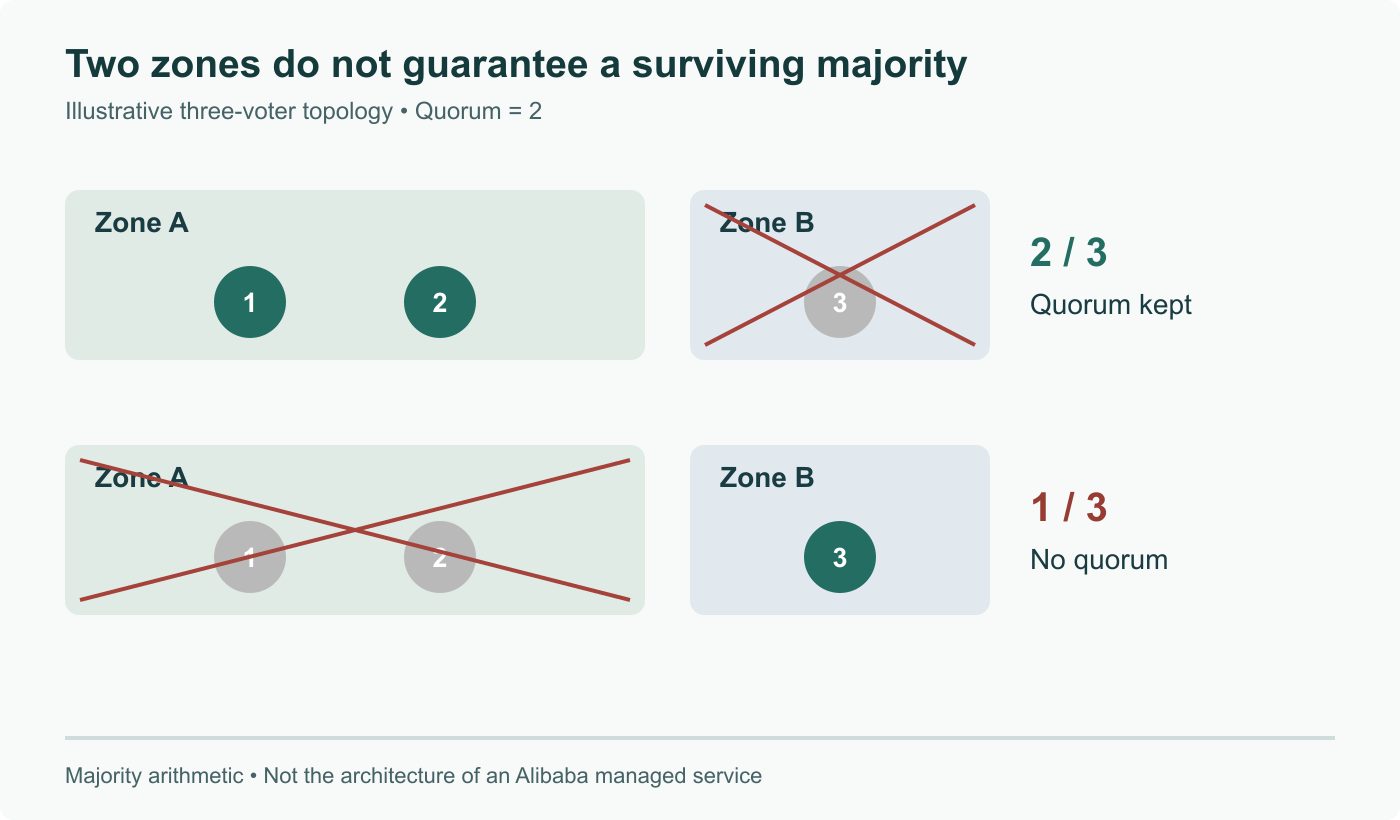
Two zones is two failure domains. Mature regions elsewhere commonly offer three or more, and the difference is not cosmetic. Quorum based systems, whether that is etcd, a Raft cluster, a ZooKeeper ensemble or a managed database using the same primitives underneath, want an odd number of failure domains so that losing one still leaves a majority. With two zones you either accept that a zone loss costs you write availability, or you extend the quorum outside the region and pay the latency.

Checklist for evaluating a newly launched cloud region: confirm the exact instance families and managed services, check quota ceilings, count availability zones for quorum planning, measure latency from real user locations, and verify infrastructure as code support for the region identifier.
Five things worth confirming before production goes into any brand new region. PNG

The second thing to check is the catalogue. A launch announcement lists categories, and categories are not SKUs. New regions routinely ship without the specific instance families, accelerator types, managed engine versions or quota ceilings that an existing deployment assumes, and those gaps close over months. The way to find out is to attempt to provision what your stack actually needs, in the region, before anything depends on it.

Then measure. Sao Paulo helps Brazilian users enormously and helps users in Santiago or Bogota far less, because they are still crossing regional links. A continent is not a latency domain. If your traffic is spread across Latin America, take real measurements from the places your users are rather than reasoning from a map.

Reading it as a market signal

The interesting number in the announcement is not two data centres, it is that a second Latin American region arrived eighteen months after the first. Providers do not build regions on optimism; they build them when there is enough committed demand to fill a floor.

That fits the wider pattern of the past year, where capacity commitments have run ahead of the hardware to fill them, from AWS lining up two million more Nvidia accelerators for 2027 and 2028 to investors funding data centres that can flex their power draw. Region counts are the visible surface of that. What they do not tell you is capacity per site, which is the constraint that actually bites when you ask for accelerator quota in a specific place and are told to wait.

For a Brazilian team, the practical upshot is simpler. There is one more local option than there was last week, it comes with the usual first region caveats, and the way to evaluate it is to provision something small and measure it rather than to read the press release.

Sources and further reading

Frequently asked questions

What exactly launched, and where?

A cloud region built on two new data centres in Sao Paulo. In cloud terminology a region is a geographic location containing one or more availability zones, which are separate facilities with independent power and cooling connected by low latency links. Two data centres therefore means a region with a small number of failure domains rather than the three or more that mature regions in Europe and North America typically offer. At least one of the zones is hosted by Ascenty, a Sao Paulo operator that has also built facilities for American hyperscalers.

What does this change for latency in South America?

Quite a lot if your users are in Brazil and your workload was previously served from North America. Round trip time from Sao Paulo to the United States east coast is typically well over one hundred milliseconds, and every extra round trip in a TLS handshake or a chatty API multiplies that. Serving from Sao Paulo removes the transatlantic and transequatorial legs for Brazilian users. It does less for users in Chile, Argentina or Colombia, who still traverse regional links, so measure from where your users actually are rather than assuming a continent is one place.

Is a new region immediately equivalent to an established one?

No, and this is the single most common planning mistake. New regions launch with a subset of the catalogue, and specific instance families, managed database engines, accelerator types and quota ceilings arrive later. The service list in a launch announcement describes categories, not the exact SKUs you depend on. Before committing, check availability of the precise instance types and managed services in your architecture, confirm quota limits, and verify that your infrastructure as code provider supports the region identifier.

What about data residency?

A local region means data can be stored and processed inside Brazil, which is what most residency requirements are asking for and is a large part of why providers build them. It does not, on its own, answer every governance question an organisation may have about its provider, and regulated sectors will run their own assessment against Brazilian data protection law regardless of which operator they pick. That work is the same exercise you would run for any foreign cloud provider entering a market.

How big is Alibaba Cloud globally after this?

One hundred and six availability zones across thirty one regions, which the company frames as part of a global investment of fifty three billion dollars in artificial intelligence infrastructure. Region and zone counts are useful for coverage but say nothing about capacity per site, which is where the real constraint sits during accelerator shortages. A provider can add regions and still be unable to give you the GPU quota you asked for in the one you want.