Cisco expanded its Secure AI Factory with Nvidia to a rack scale architecture on Tuesday, August twenty fifth, 2026, adding Supermicro liquid and air cooled compute and support for Vera Rubin NVL72 and HGX Rubin NVL8 platforms. The technically interesting part is the networking. Cisco Nexus One presents a single fabric architecture across two different switch silicons, its own Silicon One at the front end and Nvidia Spectrum-X at the back end. Cisco says it is the only Nvidia partner delivering a Cloud Partner compliant reference architecture built on its own networking systems. Orders open through channel partners in October 2026.
The short answer
Cisco announced a rack scale expansion of its Secure AI Factory with Nvidia on August 25, 2026, adding Supermicro liquid and air cooled compute and support for Vera Rubin NVL72 and HGX Rubin NVL8. Cisco Nexus One presents one fabric architecture across two switch silicons: Cisco Silicon One at the front end and Nvidia Spectrum-X at the back end. Cisco says it is the only Nvidia technology partner shipping a Cloud Partner compliant reference architecture built on its own networking systems. The target buyers are neoclouds, sovereign clouds and enterprises, with orders opening in October 2026.
Most vendor bundles are not worth writing about. This one has a detail that is: Cisco is shipping a fabric architecture that spans its own switch silicon and a competitor's, and treating that as the product rather than as an embarrassment.
Two networks, two jobs, historically two teams
An AI cluster runs two fabrics and they are genuinely different animals.
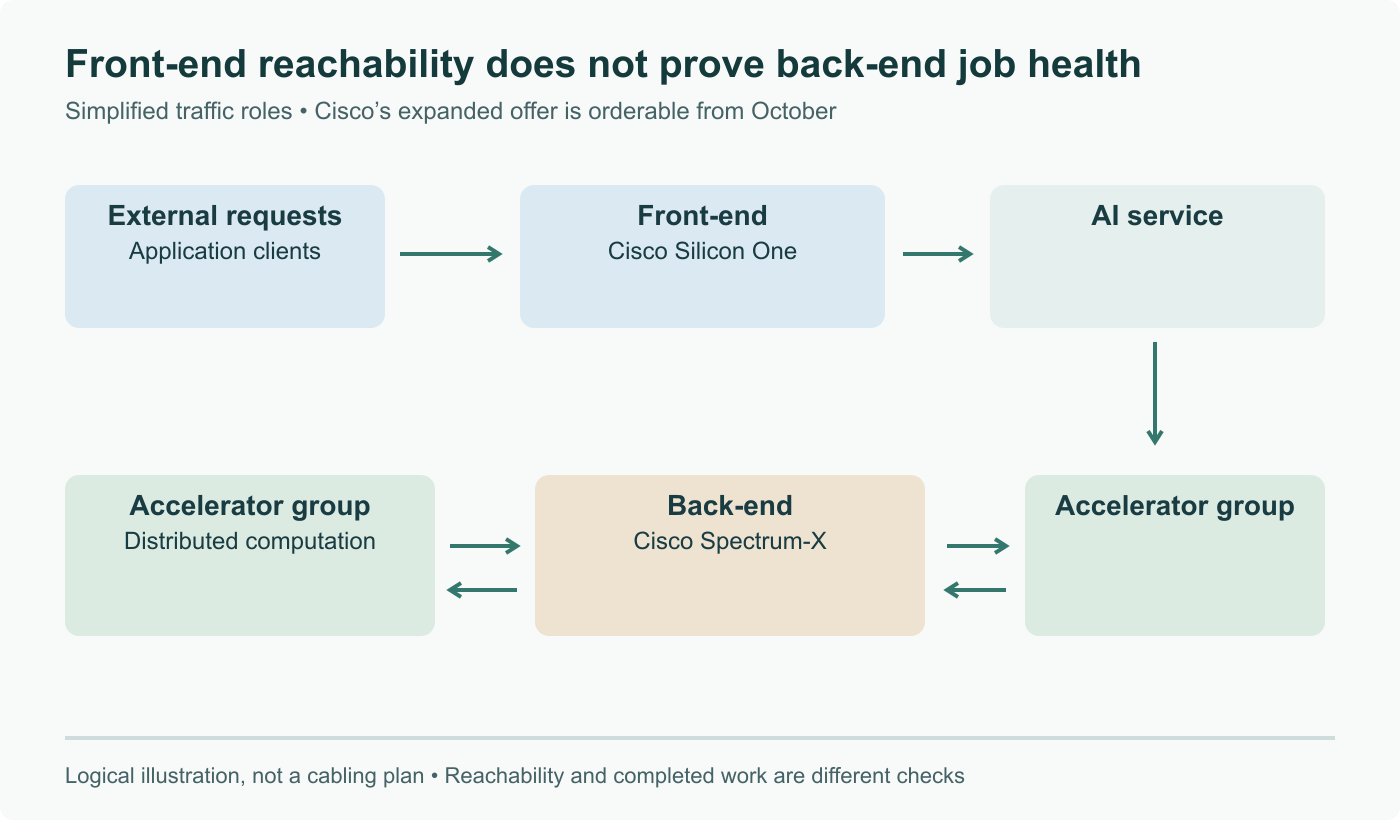
The back end connects accelerators to each other. It carries collective operations, all reduce and all gather traffic, in enormous synchronised bursts where one slow link stalls everything waiting on it. The traffic mostly never leaves the cluster. This is where RDMA lives and where fabric design has become a specialist discipline.
The front end connects the cluster to everything else: storage, management, the rest of the data centre, the outside world. It looks much more like normal data centre networking and it is where existing operational practice already applies.
Because these two have different requirements, they usually get built from different equipment, and a lot of AI deployments end up with two networks, two management planes and two sets of people who understand only one of them. That split is the operational tax nobody puts on the quote.
What Nexus One is for
Cisco's answer is to keep the two silicon choices and unify the layer above them. Nexus One presents a single fabric architecture with Cisco Silicon One switches at the front end and Nvidia Spectrum-X based switches at the back end.
That Cisco ships Spectrum-X in its own product is the part worth pausing on. Nvidia's networking position on the back end is strong, and customers ask for Spectrum-X by name, now including the Multiplane variant Nvidia detailed the same week. Cisco could refuse and lose deals, or ship it and defend something else.
What it is defending is the operating model rather than the ASIC. If Nexus One is the thing the network team actually operates, Cisco keeps the management layer, the support relationship and the front end whether or not it wins the back end socket. Conceding a component to hold the architecture around it is a very old infrastructure play and usually the right one.
The rest of the bundle
Supermicro provides the compute, liquid and air cooled, validated and sold inside Cisco's portfolio. The supported accelerator platforms are Nvidia Vera Rubin NVL72 and HGX Rubin NVL8. The stated range runs from trillion parameter training down to edge inference, which is broad enough to be marketing, but the platform list is concrete.
Cooling is where the deployment reality lives. Cisco describes rack to fabric liquid cooling, integrating its liquid cooled networking systems with Supermicro's liquid cooled servers. Read that carefully before you plan a room: the switches are in the liquid loop, not only the servers. That means facility plumbing, leak detection and operational procedures covering the network equipment as well as the compute. It is the correct direction given rack densities, and it is a bigger change to how a data centre is run than the slide implies. The power delivery side of the same problem is moving just as fast, which is why Infineon bought C2i Semiconductors for AI rack power last week.
Cisco's certification claim is that it is the only Nvidia technology partner delivering an NVIDIA Cloud Partner compliant reference architecture built on partner developed networking systems, spanning both Silicon One and Spectrum-X. For a neocloud, NCP compliance is not a badge, it affects what capacity can be certified and therefore sold.
Orders open through Cisco's authorised channel partners in October 2026.
Who this is for, and who it is not for
Cisco names neoclouds and sovereign clouds, and that targeting is honest.
Those buyers need certified, dense, liquid cooled capacity standing up quickly, and they do not have hyperscaler engineering depth. They are not going to design their own rack, write their own network transport or run their own conformance programme. A validated bundle with a single support relationship is genuinely worth paying for when the alternative is integrating four vendors yourself.
The contrast with the other end of the market was on display the same week. Meta published MetaRoCE, a clean sheet RDMA transport it designed because no existing one suited its scale. Organisations that build their own transport are not buying reference architectures. Everybody else is choosing between assembling the pieces and buying them assembled, and the AI fabric has become specialised enough that assembling them is no longer the obvious default.
What to ask before you sign
Three questions, in order of how likely they are to cause pain later.
First, cooling. Confirm what your facility actually supports and whether that covers switches as well as servers, because rack to fabric means both. Retrofitting a liquid loop is not a procurement decision, it is a building project.
Second, scope of certification. Establish precisely which elements are NCP certified and which are merely supported. Those are different commitments and the distinction matters most exactly when you are relying on it.
Third, support boundaries. This bundle has Cisco networking, Supermicro compute and Nvidia platforms in it. Find out, in writing, who owns a fault that sits between two of them. That answer is worth more than any figure on the datasheet.
Sources and further reading
- Cisco Expands Secure AI Factory with NVIDIA for the Rack-Scale Era, Cisco Newsroom, August 25, 2026
- Cisco expands rack-scale secure AI factory infrastructure for neocloud and sovereign clouds, SiliconANGLE, August 25, 2026
- Expansion of Cisco Secure AI Factory with NVIDIA to Rack-Scale Architecture, Cisco solution FAQ
- Cisco Announces New Silicon One G300 to Power and Scale AI Data Centers, Cisco Newsroom, February 2026
Frequently asked questions
What is a front end and a back end fabric, and why are they different?
An AI cluster runs two networks with different jobs. The back end fabric connects accelerators to each other and carries the collective operations that training and large scale inference generate: enormous, bursty, latency sensitive traffic between GPUs that mostly stays inside the cluster. The front end fabric connects the cluster to everything else, storage, management, the rest of the data centre and the outside world, and looks much more like conventional data centre networking. They have historically been built from different equipment with different operating models, which is why a lot of AI deployments end up with two networks and two teams. Cisco's Nexus One pitch is that you can keep the two silicon choices and still present one architecture over them.
Why would Cisco put a rival switch silicon in its own product?
Because the back end is where Nvidia's position is strongest and customers are asking for Spectrum-X specifically. Refusing to ship it would mean losing the deal rather than winning the silicon. What Cisco is defending is not the chip socket, it is the operating model: if Nexus One is what the network team runs, Cisco keeps the management layer, the support relationship and the front end regardless of whose ASIC sits in the back end racks. It is the same trade every infrastructure vendor eventually makes, conceding a component in order to hold the architecture around it.
What does NCP compliant actually mean for a buyer?
Nvidia Cloud Partner compliance is a reference architecture standard that specifies how a cluster must be built to be certified for Nvidia's cloud partner programme, covering the compute, the network topology, the management and the operational requirements. For a buyer it means the integration work has been done and validated rather than left as an exercise, which matters most for organisations building AI capacity to resell, since certification affects what they can offer. Cisco's specific claim is that it is the only Nvidia technology partner delivering an NCP compliant reference architecture built on partner developed networking systems, spanning both its own Silicon One and Nvidia Spectrum-X.
Who is this actually aimed at?
Neoclouds and sovereign clouds, which Cisco names explicitly, plus enterprises building substantial internal AI capacity. Those buyers have a specific problem: they need to stand up certified, dense, liquid cooled capacity quickly, and they do not have the engineering depth of a hyperscaler that designs its own racks and writes its own network transport. A validated bundle is worth paying for in that position. If you are large enough to design your own fabric, as Meta demonstrated this week with its own RDMA transport, you are not the customer for this.
When can I buy it, and what should I check before I do?
Orders open through Cisco's authorised channel partner ecosystem in October 2026. The things worth checking before signing are the unglamorous ones. Liquid cooling is the big one: rack to fabric liquid cooling means the network switches are in the liquid loop too, not just the servers, so your facility needs the plumbing, the leak detection and the operational procedures for both. Then confirm exactly which parts of the reference architecture are certified versus merely supported, because those are different commitments. And be clear about who you call when the fault sits between the Supermicro compute, the Cisco fabric and the Nvidia platform.