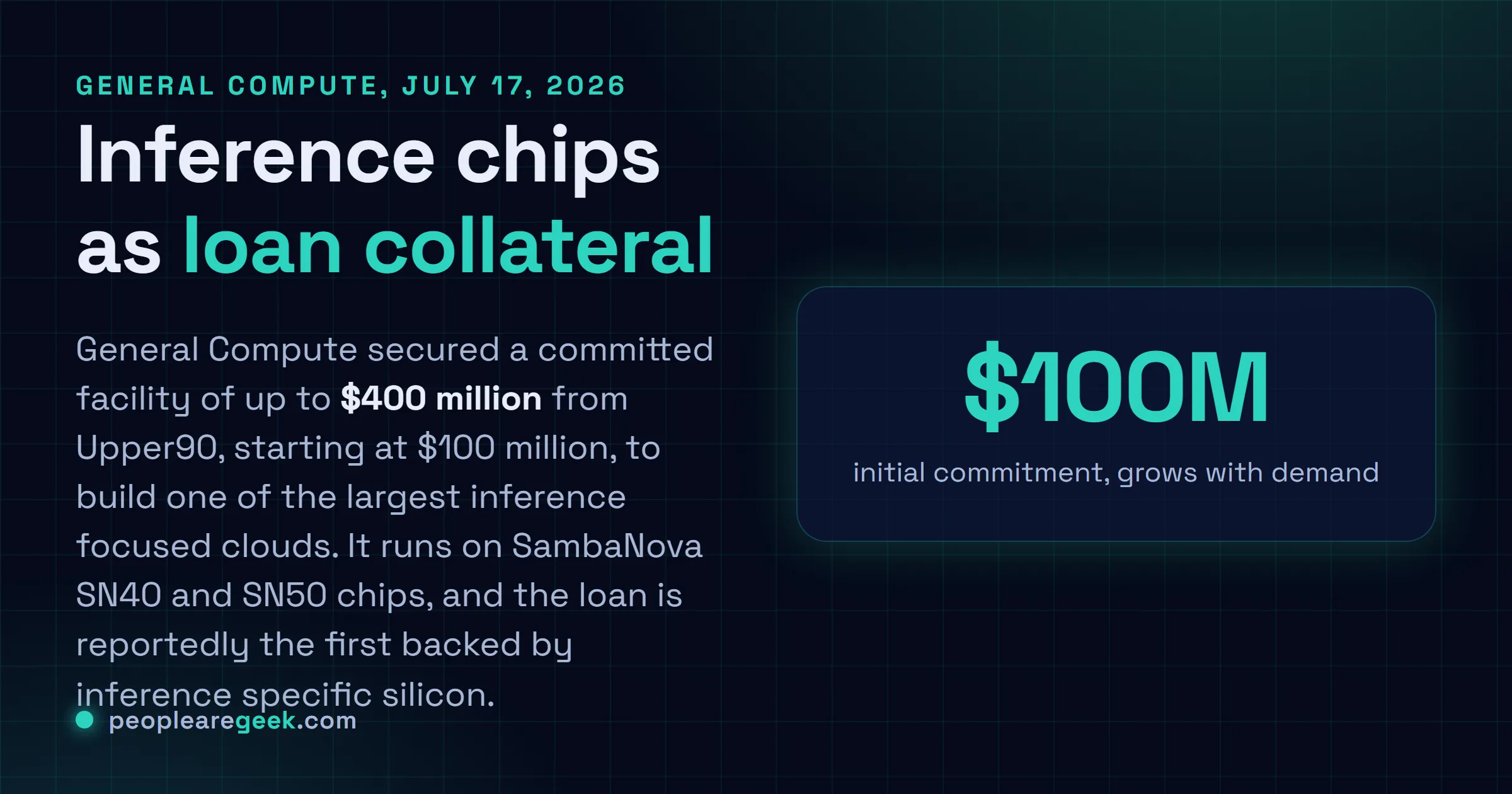
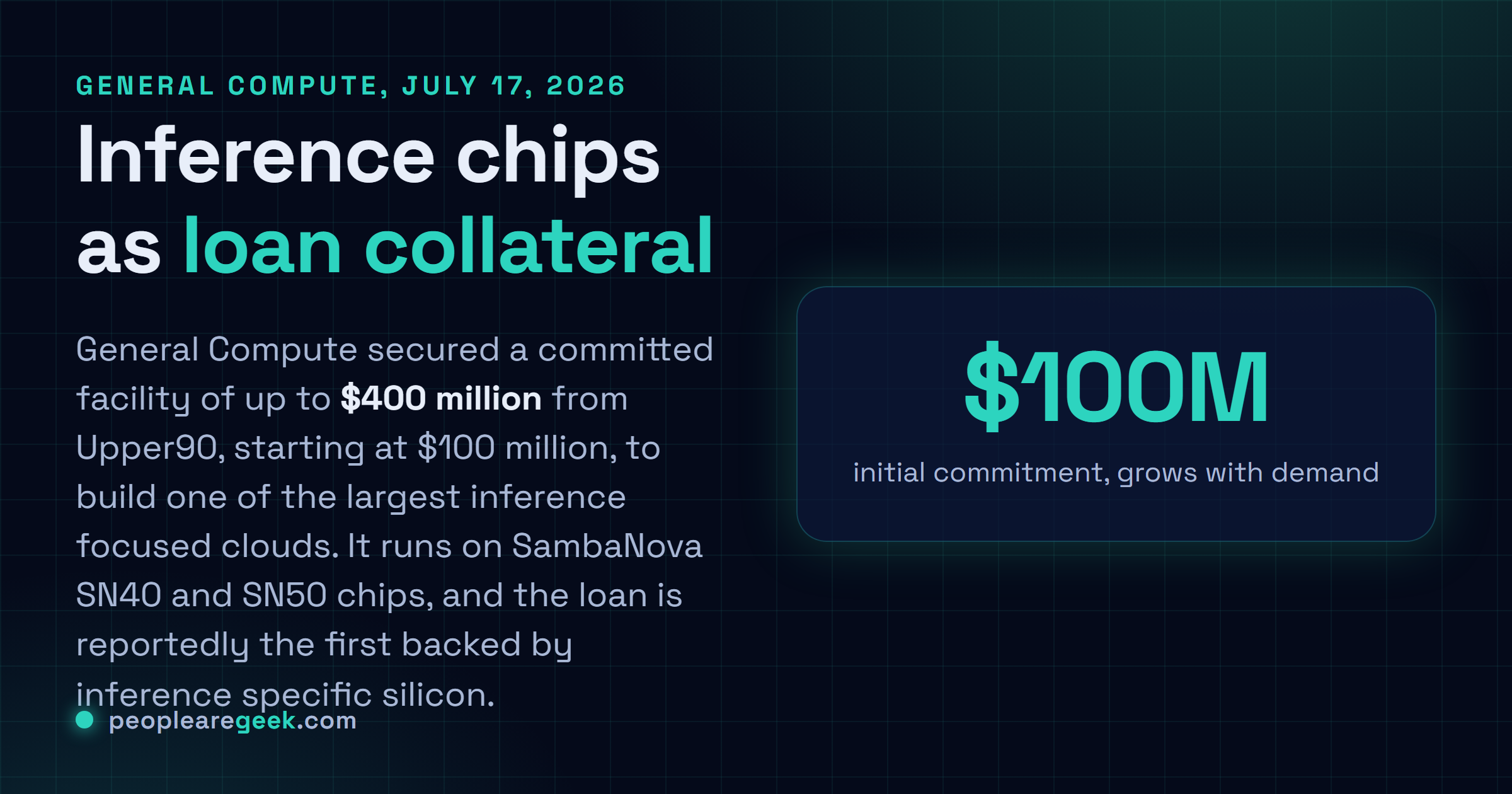
General Compute announced on July 17, 2026 that it secured a committed debt facility of up to $400 million from Upper90 Capital Management to build one of the largest clouds dedicated specifically to AI inference. The financing starts at $100 million and can grow with customer demand. The technical detail that makes this worth a read is the hardware and the structure. The platform runs on SambaNova SN40 and SN50 processors rather than general purpose GPUs, and the loan is backed by those inference chips as collateral, reportedly the first deal of its kind. General Compute claims inference up to sixteen times faster than standard GPU clouds, a first token up to seven times faster, and output up to one thousand tokens per second.
The short answer
General Compute announced on July 17, 2026 a committed debt facility of up to $400 million from Upper90 Capital Management, starting at $100 million and growing with demand, to build one of the largest clouds dedicated to AI inference. The platform runs on SambaNova SN40 and SN50 processors instead of general purpose GPUs, and the loan is reportedly the first backed by inference specific chips as collateral. The company claims inference up to sixteen times faster than standard GPU clouds, a first token up to seven times faster, and up to one thousand tokens per second of output.
The number in the headline is the least interesting thing about this deal. What makes it worth attention is that a lender agreed to treat inference chips as collateral, which says something about how the industry now values the unglamorous half of the AI stack.
Inference as a bankable asset
For the last two years, most AI infrastructure financing has been anchored to training GPUs, the scarce, expensive parts used to build models. General Compute's facility flips that. The loan is reportedly the first to use inference specific chips as the collateral, and the reasoning tracks. Training is the spiky, capital heavy phase that happens in bursts. Inference is the steady state, the part that runs every time a user sends a request, and it is tied directly to product usage and revenue.
A lender that will lend against inference silicon is implicitly saying that running models is now a durable, cash generating business in its own right, not just a cost centre bolted onto training. That is the quiet structural story here, and it is more consequential than any single company's growth.
Why not just use GPUs
General Compute's platform is built on SambaNova SN40 and SN50 processors rather than general purpose graphics processing units. The distinction is not branding. Training chips and inference chips optimise for different things. Training rewards raw throughput across enormous batch jobs. Inference rewards low latency, high tokens per second, and efficiency per query, because the workload is many small, latency sensitive requests rather than a few giant ones.
By committing to inference specific hardware, General Compute is making a focused bet that the serving side of AI deserves purpose built silicon. That bet is also what its performance claims depend on, so the two cannot be separated.

The performance claims, and how to read them
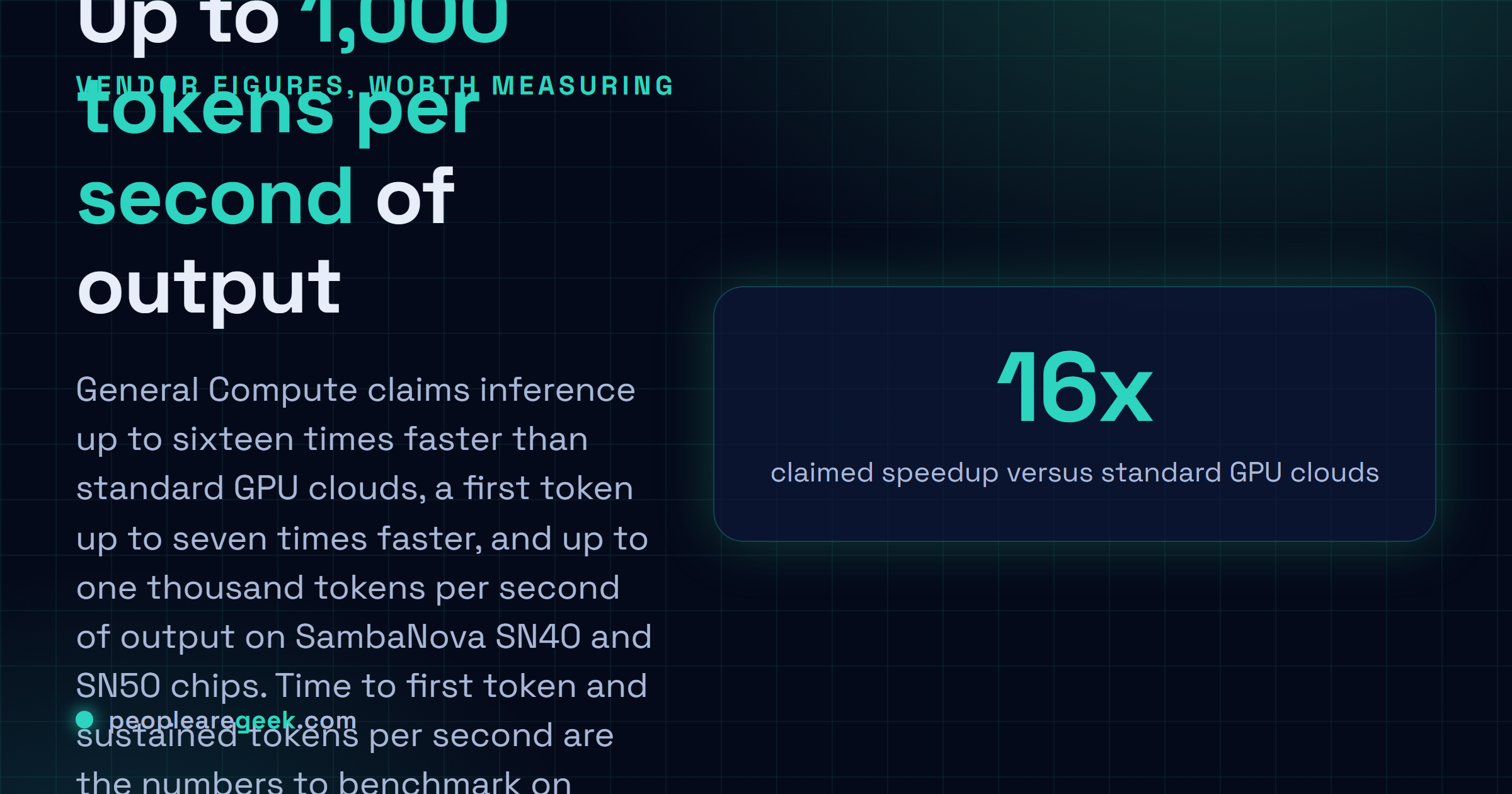
The company states that its infrastructure can deliver inference up to sixteen times faster than standard GPU cloud platforms, produce a first token up to seven times faster, and reach up to one thousand tokens per second of output. These are the right metrics to care about. Time to first token governs how responsive an application feels, and sustained tokens per second governs how quickly long responses complete and how much you can serve per dollar.
They are also vendor numbers, which means they are claims, not verdicts. Anyone evaluating an inference provider should run their own models against the platform and measure those exact figures under realistic concurrency, because headline speedups tend to shrink once you account for your specific model, context length and request mix. The useful takeaway is not the multiplier, it is that inference performance is now a competitive axis worth benchmarking deliberately.
What this means if you run models in production
Two things are worth carrying away. First, the financing signals that inference is maturing into its own market with its own economics, which over time should mean more providers, more purpose built hardware, and more pricing pressure on the cost of serving models. That is good news if inference is a line item you watch. Second, a growing set of non GPU inference platforms means the sensible next step is to treat inference as something you benchmark and shop for, not a default you inherit from wherever you trained. Measure time to first token and tokens per second on your own workload, and let the numbers, rather than the marketing multiplier, decide.
Sources and further reading
- General Compute secures up to $400 million debt facility (Pulse 2.0)
- Inference cloud operator General Compute raises $400M in debt financing (SiliconANGLE)
- Why the first GPU financiers are turning to inference chips (TechCrunch)
Frequently asked questions
What did General Compute announce?
On July 17, 2026, General Compute said it secured a committed debt facility of up to $400 million from Upper90 Capital Management. The facility begins with an initial commitment of $100 million and can increase in line with customer demand. The capital is earmarked to buy and deploy specialised AI inference chips, expand computing capacity, and build one of the largest cloud platforms focused specifically on inference rather than training.
Why does it matter that this is debt backed by inference chips?
Most AI infrastructure financing to date has leaned on training GPUs as the underlying asset. General Compute's facility is reportedly the first to use inference specific chips as the collateral for a major loan. That is a signal about where lenders now see durable value. Inference is the recurring, revenue generating half of the AI workload, and financing that treats inference silicon as a bankable asset suggests the market for running models is maturing into its own category, separate from the market for building them.
What hardware does the platform run on?
General Compute's platform is built on specialised inference processors from SambaNova Systems, specifically its SN40 and SN50 chips, rather than general purpose graphics processing units. These are designed to run already trained models efficiently, which is a different optimisation target from the chips used to train models in the first place. Choosing inference specific silicon is the whole thesis of the company, and it is what the performance claims rest on.
How fast does General Compute claim to be?
The company says its infrastructure can deliver AI inference up to sixteen times faster than standard GPU cloud platforms, can produce the first token of a response up to seven times faster, and can reach an output throughput of up to one thousand tokens per second. These are vendor figures, so treat them as claims to validate against your own models rather than settled benchmarks. Time to first token and sustained tokens per second are the two numbers to measure if you are evaluating inference providers.
What is a neocloud and why does inference get its own one?
Neocloud is the shorthand for a new wave of cloud providers built specifically around AI accelerators rather than general compute, storage and networking. An inference focused neocloud narrows that further, optimising the entire stack for serving models at low latency and high throughput instead of the long, batch heavy jobs that training requires. The economics differ too. Training is spiky and capital intensive, while inference is steady and tied to product usage, which is exactly the profile a lender likes when the hardware itself is the collateral.