Google has delayed Gemini 3.5 Pro, its flagship frontier model, after internal testing showed it falling short on coding and complex long horizon reasoning. The company first pointed to a June arrival, following the Gemini 3.5 Flash reveal at Google I/O 2026 in May, and that launch has now slipped by months. Reporting from mid July says Google retrained the model on new data to lift its coding skill, saw disappointing results, and in at least one account ordered a deeper rebuild before shipping. Alphabet shares fell after the reports. For developers who were planning agents and coding workflows around the Pro model, the slip is worth reading carefully, so here is what is known and what to do about it.
The short answer
Google has delayed Gemini 3.5 Pro, its flagship frontier model, after internal testing found it short on coding and complex long horizon reasoning. Promised for June following the Gemini 3.5 Flash reveal in May, the Pro model has slipped by months. Reporting says Google retrained it on new data, saw weak results, and weighed a deeper rebuild. Alphabet shares fell after the reports. For teams planning coding and agent workflows around the model, the safe move is a tested fallback.
When a model slips, the interesting question is not the missed date but the reason behind it. Gemini 3.5 Pro was meant to be Google's answer at the top of the frontier this summer, and instead it has become a case study in how hard the last stretch of capability has become. If you were planning to build coding tools or agents on the Pro model, the delay is not just Google's problem, it is a scheduling risk you now have to manage.
What Google actually said
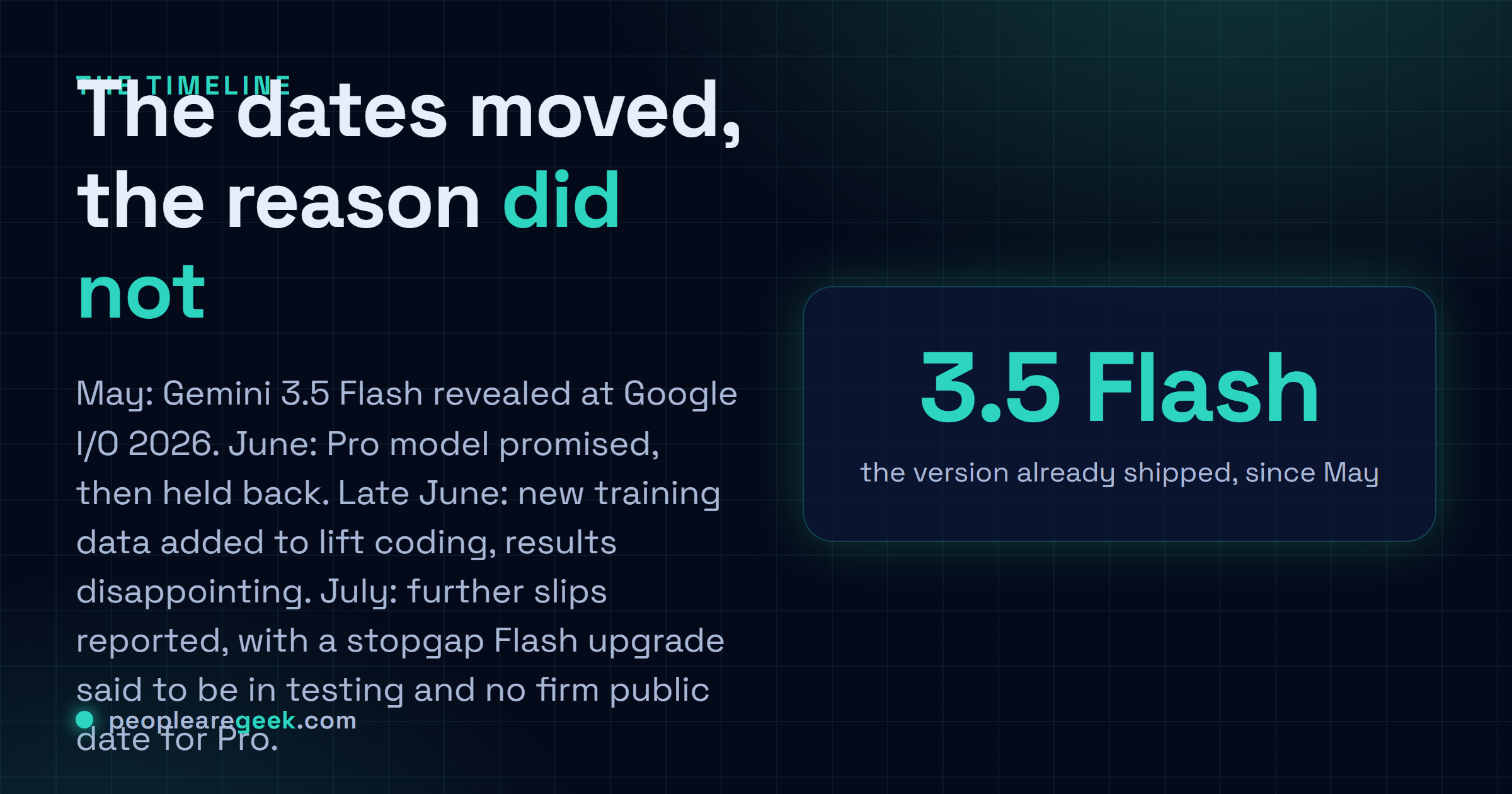
Google unveiled Gemini 3.5 Flash at Google I/O 2026 in May and indicated that the more capable Pro model would follow in June. That did not happen. In its own words, the company said it was "taking time to try to improve its capabilities, particularly in coding." Reporting through July then described a series of slips, with target dates circulating from leaks and unnamed internal sources rather than an official calendar, and each one passing without a release.
The honest reading is that most specific dates you saw for Gemini 3.5 Pro were never Google commitments. They were reported targets, and treating them as promises is exactly the trap that leaves a roadmap exposed. What Google has confirmed is the direction of the problem, which is capability rather than, say, a policy or safety hold.
Why the model slipped
The reported cause is quality, concentrated in two areas that matter most to this audience. The first is coding. The second is complex long horizon reasoning, the multi step chains that agentic workflows depend on. According to reporting, Google updated the data used to train Gemini in late June to lift its coding skill, and the results came back disappointing. At least one account goes further and says the company concluded the issues could not be fixed by fine tuning alone and ordered a deeper rebuild.
That detail is the one worth sitting with. A rebuild rather than a tune implies the shortfall was structural, not cosmetic, and structural fixes take time. It also lines up with a broader pattern this year, where several labs have found that pushing a frontier model to reliably plan, call tools, and stay coherent across long tasks is where the difficulty now concentrates.

A stopgap, and a talent question
Two threads run alongside the delay. The first is a possible stopgap. Several reports mention Google testing an upgraded Flash model that could ship while the Pro version is finished, which would give the lineup a fresh option without waiting for the flagship. The second is people. Some reporting ties the period to senior researchers leaving Google's AI group, including for rival labs, which if accurate adds pressure at an awkward moment. Both threads are reported rather than confirmed by Google, so hold them loosely.
The market noticed. Alphabet shares fell after the reports surfaced, with some accounts putting the drop at more than four percent, a reminder that model timelines now move a company's valuation. For a working developer that stock reaction is background noise, but it does tell you how much weight investors place on Google keeping pace at the frontier.
What this means if you were betting on Gemini
If your plans assumed Gemini 3.5 Pro would be available this quarter, rework them around what actually ships. Keep a tested fallback, whether that is the current Gemini 3.5 Flash, a rival frontier API, or one of the strong open weights models that landed this month, so a slipping release does not stall your own roadmap. Benchmark your real coding and agent workloads against whatever you can use today rather than waiting on a model with no firm date.
The wider lesson is about how you consume model news. Reported launch dates are not commitments, and building a plan on an unreleased model is a bet on someone else's schedule. The teams that stayed calm through this cycle are the ones that treated Gemini 3.5 Pro as an upgrade to adopt when it arrives, not a dependency to design around before it does.
Sources and further reading
- 9to5Google: Gemini 3.5 Pro delays due to coding performance
- Search Engine Journal: Google delays Gemini 3.5 Pro over coding, Bloomberg reports
- Technology.org: Google's Gemini 3.5 Pro is months late after missing internal coding targets
- Times of AI: Why Google delayed Gemini 3.5 Pro
- Bind AI: Gemini 3.5 Pro delayed, what developers should know
Frequently asked questions
Is Gemini 3.5 Pro cancelled?
No. Reporting describes a delay, not a cancellation. Google is still working on Gemini 3.5 Pro but has held it back because it fell short of internal quality targets, particularly on coding and multi step reasoning. The company has not given a firm public launch date, and several of the dates that circulated in July came from leaks and unnamed sources rather than an official Google announcement.
Why did Google delay the model?
The core reason reported is quality. Internal testing found Gemini 3.5 Pro underperforming on coding and on complex long horizon reasoning, the kind of multi step tasks that agents rely on. Google reportedly updated the training data in late June to raise coding skill but saw disappointing results, and at least one account says the company decided a deeper rebuild was needed rather than more fine tuning. Google's own statement said it was taking time to improve the model, particularly in coding.
When will Gemini 3.5 Pro launch?
There is no confirmed public date. Several target dates were reported through June and July, each slipping in turn, and reporting suggests the model may arrive months later than first planned. Some accounts mention Google weighing a stopgap release of an upgraded Flash model while the Pro version is finished. Treat any specific date as unconfirmed until Google announces it.
Can I use Gemini 3.5 Flash in the meantime?
Yes. Gemini 3.5 Flash was unveiled at Google I/O 2026 in May and is the model that is already available, and reporting mentions an upgraded Flash in testing. Flash is tuned for speed and cost rather than maximum capability, so for heavy coding or long agentic chains you may want to benchmark it against alternatives before committing a workflow to it.
What does this mean for the frontier model race?
It signals that scaling a frontier model to hit coding and reasoning targets is getting harder, even for a lab with Google's resources. In the same window, rivals shipped quickly, with new frontier and open weights models from several labs landing within days of each other. The practical takeaway for teams is to avoid betting a roadmap on a single unreleased model and to keep a tested fallback in place.