DevNews

Mesa 26.2 Brings Mesh Shaders to the NVK Driver

On this page
  1. Why this one extension carries weight
  2. OpenCL quietly became normal
  3. The rest of the tree
  4. What we would do
  5. Sources and further reading

Mesa 26.2 was released on August 5 as the quarterly feature update to the open source graphics stack, and the headline belongs to NVK: the community Vulkan driver for NVIDIA hardware now supports VK_EXT_mesh_shader, which was one of the last big feature gaps between it and the proprietary driver. Around that sit more than sixty new Vulkan and OpenGL extensions across the tree, OpenCL 3.1 support spreading through five Rusticl drivers, a Vulkan 1.4 badge for the Metal translation layer, and a new shader compiler for Arm Mali. Distributions will pick it up through testing repositories first.

The short answer

Mesa 26.2 is out, continuing OpenGL 4.6 and Vulkan 1.4 support and carrying more than sixty new extensions. NVK, the community Vulkan driver for NVIDIA hardware, gains VK_EXT_mesh_shader along with shader_fma, atomic float and binary import extensions. Rusticl spreads OpenCL 3.1 across asahi, iris, radeonsi, llvmpipe and zink. KosmicKrisp, the Vulkan to Metal translation layer, now exposes Vulkan 1.4. Arm Mali gains a new compiler called KRAID, AMD gets early GFX12.1 enablement, and the ancient R600g and R300g drivers still received fixes.

26.2released August 5, 2026, the quarterly Mesa feature update
VK_EXT_mesh_shadernow supported by NVK, closing a major gap
60+new Vulkan and OpenGL extensions across the tree
Answer card: Mesa 26.2 was released on August 5 2026 with VK_EXT_mesh_shader support in the NVK driver for NVIDIA hardware, more than sixty new Vulkan and OpenGL extensions across the tree, OpenCL 3.1 in five Rusticl drivers, Vulkan 1.4 exposed by the KosmicKrisp Metal translation layer and a new KRAID compiler for Arm Mali.
Mesa 26.2 at a glance. Sources: the Mesa 26.2 release announcement, Phoronix and Linuxiac reporting, August 5, 2026. PNG

Mesa releases arrive on a schedule and mostly read like a long list of things that got slightly better, which is why the interesting entry is easy to miss. In 26.2, released on August 5, it is a single extension name in the NVK section: VK_EXT_mesh_shader.

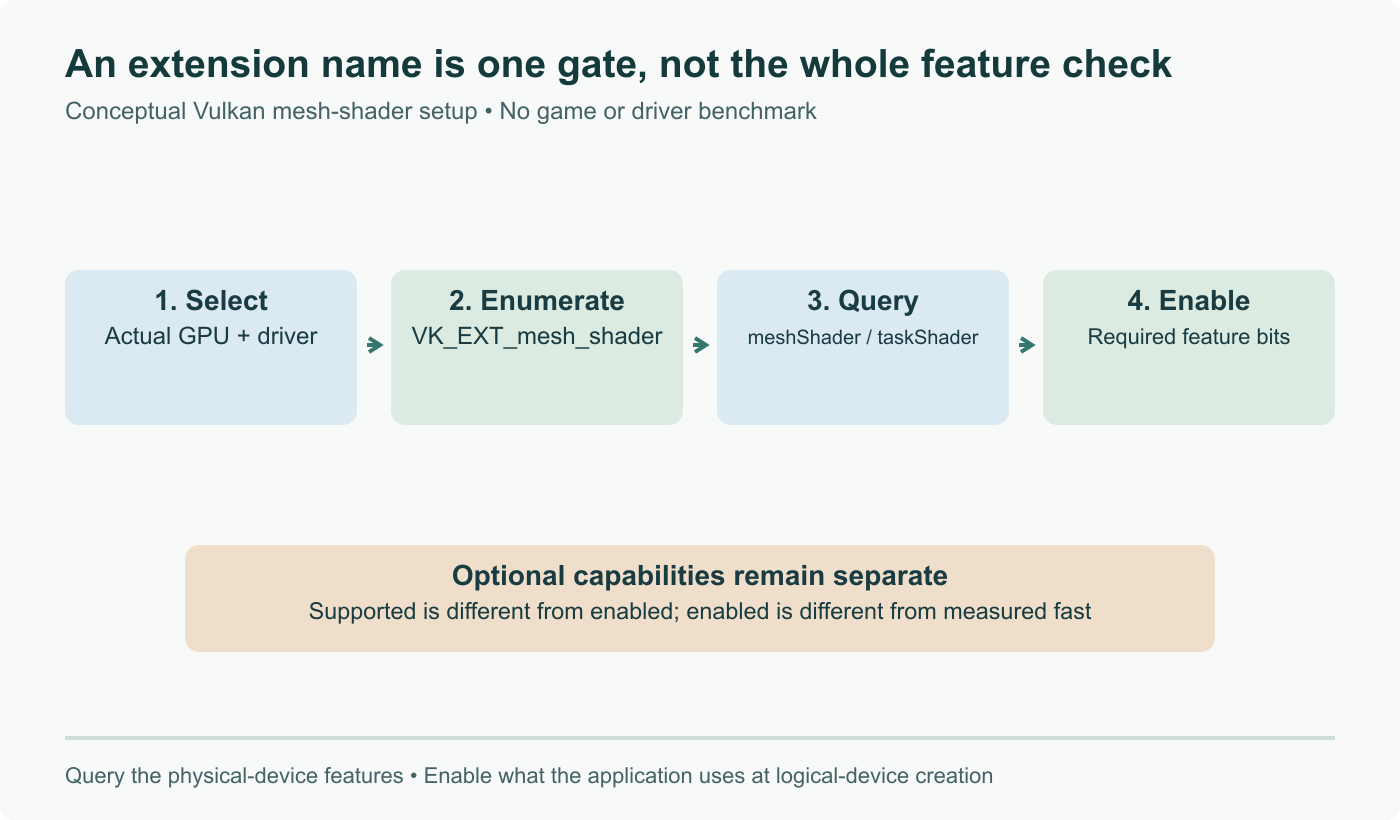
NVK is the Vulkan driver for NVIDIA hardware that lives in Mesa rather than in NVIDIA's proprietary stack. It has spent years catching up on a moving target, and mesh shaders were one of the remaining walls. Support is not a performance improvement. It is the difference between an application starting and an application refusing to start, because a program that declares the extension as required gets nothing from a driver that does not advertise it.

Why this one extension carries weight

The traditional graphics pipeline hands the GPU a buffer of vertices and lets fixed function hardware assemble them into primitives. Mesh shaders throw that out. You write something much closer to a compute shader that decides directly which primitives should exist, which means culling geometry the camera cannot see before it costs anything and generating detail procedurally rather than storing it.

Engines have been shipping against this for a while now. For a driver, the choice is binary: support it, or watch a growing share of new software walk past. NVK also picked up VK_KHR_shader_fma, VK_EXT_shader_atomic_float, VK_NV_shader_atomic_float16_vector and VK_NVX_binary_import in the same cycle, which together read like a driver finishing its homework rather than exploring.

The DLSS work that landed in the 26.2 development cycle got more attention in the gaming press, and it is genuinely interesting, but it is early and experimental. Mesh shader support is the entry that changes what runs.

Terminal card showing how to check which Mesa version and Vulkan driver a system is using, how to confirm whether the mesh shader extension is present, and how to list the OpenCL platforms Rusticl exposes.
Finding out what your machine actually reports, before and after a Mesa upgrade. PNG

OpenCL quietly became normal

Rusticl is Mesa's OpenCL implementation, written in Rust, and 26.2 widens OpenCL 3.1 support across asahi, iris, radeonsi, llvmpipe and zink.

That list is worth reading slowly, because it covers Apple Silicon, Intel graphics, AMD graphics, a pure CPU path and anything reachable through the Vulkan translation layer. OpenCL on Linux spent a long time as a problem you solved by installing a vendor runtime, discovering it conflicted with something, and giving up. A single implementation in the Mesa tree covering that much hardware changes the default answer.

The llvmpipe entry is the one we would flag for anyone doing infrastructure work. A functioning CPU backend means OpenCL code can be developed, tested and run in continuous integration on machines with no GPU compute at all, including virtual machines. Slow, obviously. Available, which was the harder part.

The rest of the tree

KosmicKrisp, the driver that translates Vulkan into Apple's Metal, now exposes Vulkan 1.4. Translation layers are judged almost entirely by the version number they advertise, because applications check it before deciding whether to run, so moving to the current core version is the whole job.

On Arm, a new compiler called KRAID was merged for the Panfrost and PanVK drivers that serve Mali hardware. Replacing a shader compiler is a large, unglamorous undertaking and it usually signals that the previous one had reached the end of what it could be improved to do.

AMD received early GFX12.1 enablement, which is the usual signal that hardware is coming, plus continued RADV work on ray tracing, descriptors and shader compilation. Intel's ANV took its regular round of fixes. A new tool called Gamma landed for inspecting ray tracing acceleration structures, RADV only for now. And R600g and R300g, drivers for GPUs old enough to vote, still got fixes.

What we would do

Nothing urgent, and that is the correct answer for a graphics stack.

Mesa goes to rolling and testing repositories first, so if you run Arch or Rawhide it will find you. If you run a stable distribution, waiting for your next cycle is not a compromise, it is the sensible path: a graphics driver regression on a working machine costs more than a feature you were not using yesterday.

The people who should move sooner are narrower. If you run NVK and an application refused to launch on a mesh shader requirement, this release is the reason to upgrade. If you have OpenCL work sitting in a corner because the vendor runtime was too much trouble, it is worth trying again on Rusticl, and worth knowing that llvmpipe gives you a path on a machine with no GPU at all.

Sources and further reading

Frequently asked questions

What is a mesh shader and why does NVK getting it matter?

A mesh shader replaces the fixed vertex processing pipeline with something closer to a compute shader that emits geometry directly. Instead of feeding the GPU a vertex buffer and letting fixed function hardware assemble triangles, you write a program that decides which primitives exist at all, which lets you cull invisible geometry before it costs anything and generate detail procedurally. Modern engines use it heavily. For NVK, the community Vulkan driver for NVIDIA hardware, this was one of the last structural gaps against the proprietary driver: an application that requires VK_EXT_mesh_shader simply would not run before, no matter how well the rest of the driver performed. Closing a gap like that changes the question from whether NVK is complete enough to whether it is fast enough, which is a much better problem to have.

Should I upgrade to Mesa 26.2 right away?

It depends entirely on which distribution you run, and mostly the decision is not yours to make. Mesa lands in rolling release and testing repositories first, so Arch and its derivatives, Fedora Rawhide and the various testing channels will see it within days. Stable distributions will pick it up at their next cycle, and that is usually the right outcome: a graphics stack is not a package you want to be adventurous with on a machine you need for work. If you do run it early, the two things worth watching are the drivers that changed most in this cycle, which are NVK and the Arm Mali stack, and anything relying on OpenCL through Rusticl. If you use the proprietary NVIDIA driver rather than NVK, Mesa 26.2 still matters to you for OpenGL and Vulkan on your other GPUs, but the NVK work does not apply.

What is Rusticl and does OpenCL 3.1 change anything practical?

Rusticl is Mesa's OpenCL implementation written in Rust, and it exists because OpenCL on Linux had been served for years by stacks that were either vendor specific or unmaintained. Mesa 26.2 expands OpenCL 3.1 support across asahi, iris, radeonsi, llvmpipe and zink, which is a broader set of hardware than it sounds: Apple Silicon, Intel graphics, AMD graphics, pure CPU fallback and anything reachable through the Vulkan translation layer. The practical effect is that OpenCL workloads become something you can reasonably expect to run on a Linux box without hunting for a vendor runtime first. llvmpipe deserves a specific mention, because a working CPU backend means you can develop and test OpenCL code on hardware that has no usable GPU compute at all, including inside a virtual machine or a CI runner.

What does KosmicKrisp exposing Vulkan 1.4 mean?

KosmicKrisp is the Mesa driver that translates Vulkan calls into Apple's Metal API, so Vulkan applications can run on macOS hardware without a native Vulkan implementation. Exposing Vulkan 1.4 means it now advertises conformance with the current core version rather than an older one, which matters because applications check the reported version before they run and will refuse or fall back if it is too low. Translation layers live or die on that number. This is the same category of work as the Vulkan to DirectX and Vulkan to Metal layers that came before it, with the difference that this one lives in the Mesa tree and follows the same release cadence as everything else, so it inherits the extension work happening across the stack rather than being maintained separately.

Is there anything in this release for AMD or Intel users?

Yes, though it is quieter than the NVK headline. RADV, the Mesa Vulkan driver for AMD hardware, took another round of work on ray tracing, descriptor handling and shader compilation, plus early enablement for the GFX12.1 generation, which is the pattern you see before new hardware appears. ANV, the Intel Vulkan driver, received its usual set of fixes and optimisations. Both drivers also inherit the general extension work, including maintenance extensions like VK_KHR_maintenance11 that quietly remove long standing rough edges in the API. There is also a new debugging tool called Gamma for inspecting acceleration structures in ray tracing workloads, which currently supports RADV only, and the older R600g and R300g drivers received fixes, which is a reminder that Mesa still carries hardware from two decades ago.