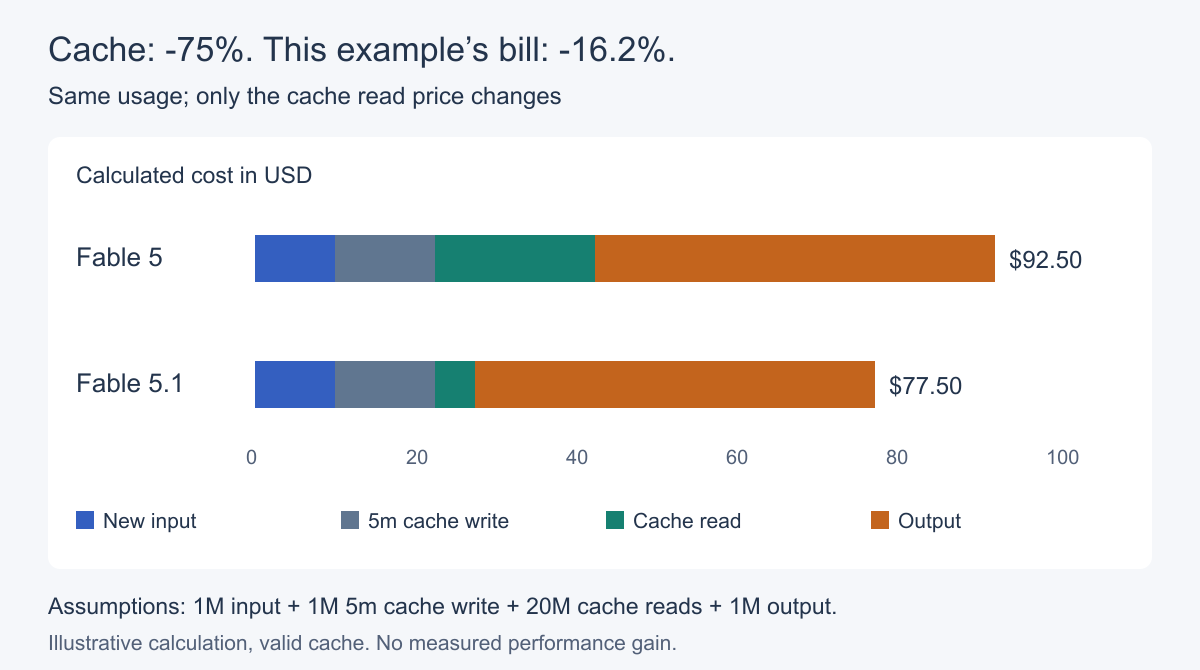
Anthropic released Claude Fable 5.1 on September 1, 2026, and the price that moved is the one most teams never look at. Input stays at ten dollars per million tokens and output stays at fifty. The cache read rate fell from one dollar to twenty five cents, a seventy five percent cut, which means the bill you actually pay now depends on how much of your context you manage to keep cached between calls. Anthropic puts the effect at roughly twenty five percent less for typical work and around forty five percent for agent loops. We looked at where that saving comes from, what the benchmarks say, and how to restructure a prompt to collect it.
The short answer
Anthropic released Claude Fable 5.1 and Claude Mythos 5.1 on September 1, 2026. They are the same model behind different safeguard settings, with Fable 5.1 generally available and Mythos 5.1 limited to vetted access programmes. Input and output pricing is unchanged at ten and fifty dollars per million tokens, but cache reads fall from one dollar to twenty five cents, which Anthropic estimates at roughly twenty five percent lower cost for typical work and around forty five percent for agent loops. Benchmarks improve across the published set, notably Terminal-Bench 4.0 at 55.8 percent and Terminal-Bench-Science 0.1 at 52.6 percent. The API identifier is claude-fable-5-1, available on the Claude API, AWS, Google Cloud and Microsoft Azure.
Most model launches ask you to compare two headline numbers and pick. This one does not, because the headline numbers are identical to the previous release. Claude Fable 5.1 costs ten dollars per million input tokens and fifty dollars per million output tokens, exactly what Fable 5 cost. If you stopped reading the pricing page there, you would conclude nothing had changed.
The only number that moved is the one you control
Anthropic cut the cache read rate from one dollar to twenty five cents per million tokens. A cache read is an input token the model has already processed and stored from an earlier call in the same conversation or agent run, and in a long running session it is most of what you send. The system prompt, the tool definitions, the retrieved documents, every prior turn: all of it goes back over the wire on each request, and all of it is eligible to be served from cache.
That is why one price cut produces two very different savings. Anthropic puts the effect at about twenty five percent for typical workloads and around forty five percent for highly agentic work. The gap between those figures is not a rounding difference, it is the cache hit rate. A single shot classification call with a short prompt reuses almost nothing and barely benefits. An agent that grinds through forty tool calls against the same repository context reuses nearly everything and collects the full discount.
Cache writes still cost more than plain input, at twelve dollars fifty per million for the five minute time to live and twenty dollars for the one hour variant. That is the part worth modelling before you celebrate. Caching is a bet that you will read a prefix back often enough to amortise the write, and the new read price moves the break even point sharply in your favour: at twenty five cents a read, a five minute cache write pays for itself faster than it used to, and a long agent session amortises it many times over.
The benchmark gains are wide rather than one tall spike
Anthropic reported improvements across its whole published set. Terminal-Bench 4.0 goes from 42.0 percent on Fable 5 to 55.8 percent, with Mythos 5.1 at 60.9 percent. Terminal-Bench-Science 0.1 more than doubles, 24.7 to 52.6 percent. AutomationBench nearly doubles, 17.1 to 31.4 percent. CursorBench 3.2.0 moves from 70.5 to 73.4 percent and GDPval-AA v2 from 1723 to 1853. On OSWorld 2.0 the strict score goes from 36.1 to 41.7 percent.
These are vendor figures, and the honest reading of any vendor benchmark table is that it tells you what the lab optimised for. The more interesting signal sits in the customer reporting published alongside it, because those describe shapes of work rather than scores. Browserbase says the model completed 82 percent of its hardest task set against 74 percent for Opus 5 and 57 percent for Fable 5. MongoDB describes unattended multi hour runs with verification loops. Datadog cites production incident diagnosis. Those all point at the same property, longer autonomous runs that hold together, which is exactly the workload the cache price change is aimed at.
Effort levels turn quality into a dial you can spend against
Fable 5.1 exposes five effort settings, low, medium, high, xhigh and max, with high as the default in Claude Code. Anthropic's claim is that the model matches or beats Fable 5 at low and medium effort, and separates further at the top tiers.
That is the underrated half of this release. Effort largely governs output tokens, and output is the expensive side of the meter at fifty dollars per million. If a task previously needed Fable 5 running flat out, there is a fair chance it now clears at medium, and medium costs less per attempt as well as returning faster. The right response to this release is not to move everything to max because the model got better. It is to re-run your evaluation set at each tier and find the lowest one that still passes, which is the same discipline that made Opus 5 worth routing to at half the price of Fable 5.
What to check before you change the model string
The identifier is claude-fable-5-1, and availability spans the Claude API, Claude.ai, Claude Code, Claude Enterprise and Claude Cowork, plus Amazon Bedrock and the Claude Platform on AWS, Google Agent Platform and Microsoft Foundry. Swapping the string is a small change. The two things worth doing first are less small.
Audit your prompt prefix. Caching keys on an exact prefix match, so the discount only arrives if the reused part of your prompt is byte identical between calls. A timestamp in the system prompt, a request id injected into the header, or a tool list serialised in a non deterministic order will silently invalidate the cache on every request. You still get an answer, you just pay full input price for it, and nothing in the response tells you that happened. Log your cache hit tokens and watch the ratio for a day before you assume the saving landed.
Re-baseline your effort tier. A cheaper cache read plus a stronger model at low effort means your current configuration is probably no longer the cost optimum. Anthropic also says its safeguards now produce far fewer false positives on benign technical requests than the previous generation, which mostly matters if you had built retry logic around refusals on legitimate work.
On the data side, Anthropic announced Enterprise Frontier Safeguards, a system that stores monitoring data inside the customer's own AWS, Azure or Google Cloud environment under customer managed encryption keys rather than in Anthropic's infrastructure. There is no separate charge, though you pay your own cloud provider for storage, operations and egress. It arrives in phases from the autumn of 2026, and until then eligible Fable 5.1 and Fable 5 customers can run under zero data retention. For teams whose procurement review stalled on retention wording, that is the paragraph to forward, and it pairs with the watermarking Anthropic now applies to Claude output for anyone tracking the compliance surface.
Sources and further reading
- Introducing Claude Fable 5.1 and Claude Mythos 5.1, Anthropic, September 1, 2026
- Anthropic's new Fable release is cheaper, less restrictive, TechCrunch, September 1, 2026
- Anthropic's Claude Fable 5.1 and Mythos 5.1 arrive with a 75% cost reduction for Fable cache reads, VentureBeat, September 1, 2026
- Anthropic Launches Claude Fable 5.1 With Lower Costs and Fewer False Positives, MacRumors, September 1, 2026
Frequently asked questions
What exactly changed in the price of Claude Fable 5.1?
Only the cache read rate. Input is still ten dollars per million tokens and output is still fifty, the same as Fable 5. A cache read, meaning a token that was already processed and stored from an earlier call, drops from one dollar to twenty five cents per million. Cache writes are twelve dollars fifty for the five minute time to live and twenty dollars for the one hour variant. Batch processing halves the input and output rates to five and twenty five. Anthropic estimates the net effect at about twenty five percent less for typical workloads and around forty five percent for highly agentic work, where the same long context is replayed on every turn.
How do I actually get that discount?
By making the reused part of your prompt stable and putting it first. Prompt caching keys on an exact prefix, so anything that changes between calls has to sit after everything that does not. In practice that means system instructions, tool definitions, retrieved documents and prior turns go at the top in a fixed order, and the new user message goes at the bottom. Teams that interleave a timestamp, a request id or a randomly ordered tool list into the header pay full input price on every call and never notice, because the invoice does not tell you which tokens missed the cache. The saving is real but it is conditional on prompt hygiene.
Is Fable 5.1 actually better, or just cheaper?
Anthropic published gains on every benchmark it reported. Terminal-Bench 4.0 goes from 42.0 percent for Fable 5 to 55.8 percent for Fable 5.1, with Opus 5 at 52.3 percent and GPT-5.6 Sol at 37.3 percent. Terminal-Bench-Science 0.1 more than doubles, from 24.7 to 52.6 percent. CursorBench 3.2.0 moves from 70.5 to 73.4 percent, AutomationBench from 17.1 to 31.4 percent, and GDPval-AA v2 from 1723 to 1853. These are vendor reported figures, so treat them as a direction of travel rather than an independent measurement, and run your own evaluation before you route production traffic.
What are the effort levels and why do they matter now?
Fable 5.1 exposes five effort settings: low, medium, high, xhigh and max, with high as the default in Claude Code. Anthropic says the model matches or beats Fable 5 at low and medium effort and pulls further ahead at the higher tiers. That turns effort into a genuine cost knob rather than a quality slider you always pin to the top. If a task used to need Fable 5 at full tilt, there is a reasonable chance it now clears at medium, and medium spends fewer output tokens, which is the expensive side of the meter at fifty dollars per million.
Where can I run it and what happens to my data?
The API identifier is claude-fable-5-1, and it is available through the Claude API, Claude.ai, Claude Code, Claude Enterprise and Claude Cowork, plus Amazon Bedrock, Google Agent Platform and Microsoft Foundry. On retention, Anthropic announced Enterprise Frontier Safeguards, which keeps monitoring data inside the customer's own AWS, Azure or Google Cloud account under customer managed keys, with no separate charge beyond the cloud storage and egress you already pay for. It rolls out in phases starting in the autumn of 2026, and eligible Fable 5.1 and Fable 5 customers can use zero data retention until it lands.