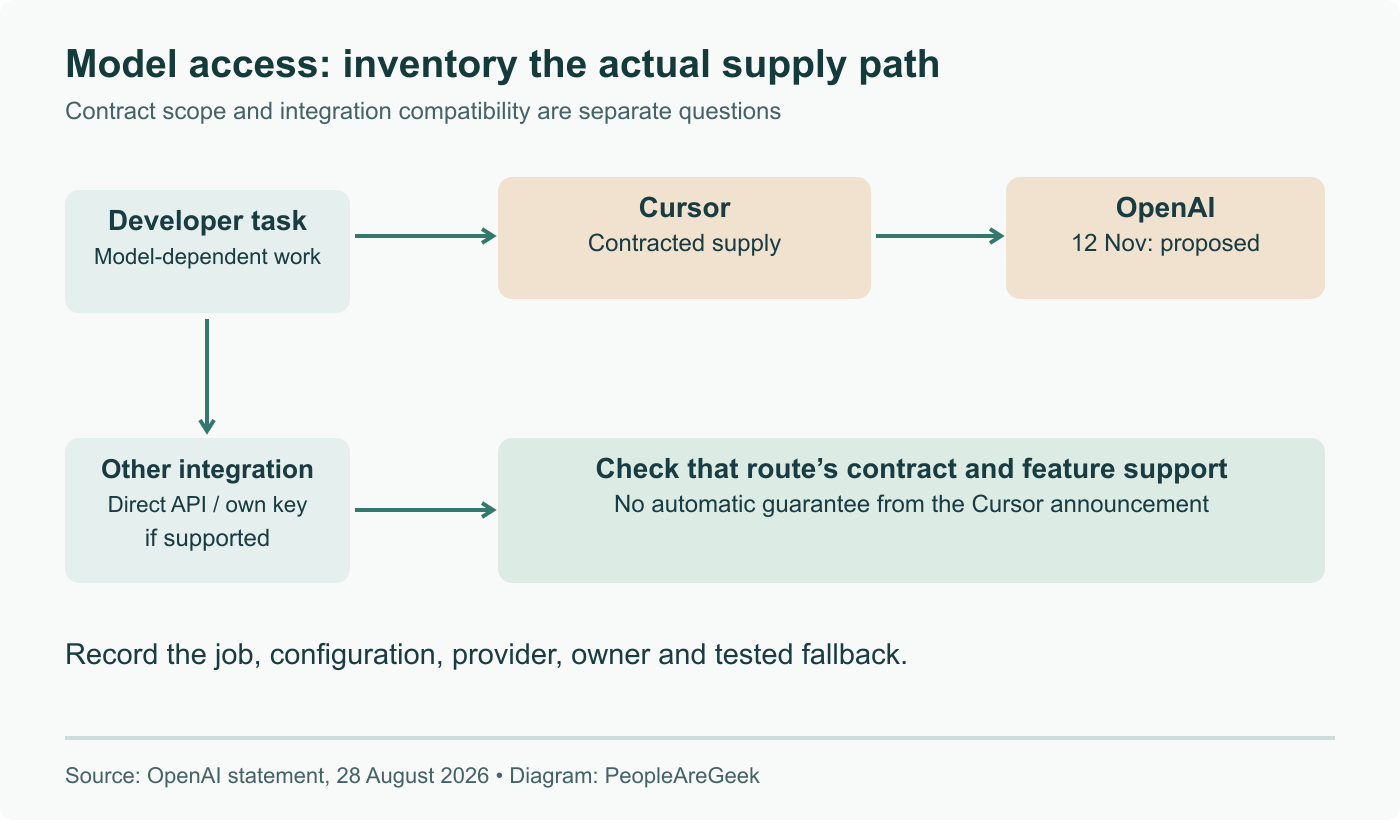
OpenAI will stop serving its models inside Cursor on November 12, 2026. The company announced the decision on August 29, two weeks after SpaceX closed its sixty billion dollar purchase of Anysphere, and it gave a blunt reason: it cannot be confident that SpaceX will use the technology within its terms of service. For most Cursor users the immediate blast radius is small, because OpenAI models carry roughly five percent of the editor's traffic. The interesting part is what the decision establishes. Model access is a commercial lever a provider can pull for reasons that have nothing to do with your code, and that changes how a team should write its editor configuration.
The short answer
On August 29, 2026 OpenAI said it is ending its partnership with Cursor, with the editor's direct access to OpenAI models proposed to end on November 12. The trigger is ownership: SpaceX closed its all stock acquisition of Anysphere on August 14 in a deal valued at sixty billion dollars, and OpenAI said it cannot be confident SpaceX will use its technology within its terms of service. Cursor chief executive Michael Truell put the affected traffic at about five percent and said talks continue. Anthropic said it will add compute to support Claude models in Cursor. The models keep working until the cutoff date.
Most supplier changes in developer tooling arrive as a deprecation note at the bottom of a changelog. This one arrived as a public statement about whether a customer can be trusted, which is unusual enough to be worth reading carefully even if you have never opened Cursor.
What was actually announced
OpenAI published its decision on August 29, 2026. Under its proposal, Cursor's direct access to OpenAI models ends on November 12. The company framed the reason in terms of contract confidence rather than product strategy: it cannot be confident that SpaceX will use its technology within the terms of service, based on what it describes as experience with Elon Musk's companies violating contracts. It pointed at xAI using OpenAI output to train competing models through distillation as the specific pattern it is worried about.
The timing is the striking part. SpaceX closed its all stock purchase of Anysphere, the company that builds Cursor, on August 14, 2026, in a deal valued at sixty billion dollars. Two weeks later the model supply started to unwind. We covered the close of that acquisition at the time, and the risk that model vendors would reprice or withdraw was the obvious open question then. It did not take a quarter to be answered.
OpenAI also said it is giving the maximum notice its contract allows, which works out to more than two months. That is worth noting because it sets the shape of the transition: nothing breaks today, nothing breaks next week, and everything that is going to break has a date attached to it.
Five percent is the number that defuses the panic
Michael Truell, Cursor's chief executive, said OpenAI models account for roughly five percent of Cursor user traffic, and that the two companies are still in discussion. Before the acquisition Cursor leaned on OpenAI models alongside Anthropic's Claude and Google's Gemini, and the editor now also promotes its own pool, currently built around Grok 4.6, Grok 4.5 and Composer 2.5.
So the honest read is that this is a small operational event wrapped in a large strategic one. Five percent of traffic moving to a different provider is a settings change for most teams. If your daily loop already runs on Claude or Gemini inside Cursor, November 12 will pass without you noticing. The exception is the team that standardised on one specific OpenAI model for one specific job, usually because it behaved predictably on a narrow task: a commit message format, a test scaffold, a refactor pattern that somebody tuned prompts around. Those setups are exactly the ones that do not survive a provider swap cleanly, because the value lived in the calibration and the calibration does not transfer.
Model supply is a dependency, and it now behaves like one
The reason to care about this story even from outside the Cursor user base is the precedent. A model provider withdrew access from a downstream product because of who bought that product. The product did nothing wrong, the users did nothing wrong, and the models still exist. The supply simply stopped being offered through that channel.
Software teams already know how to reason about this shape of risk in other layers. A package registry can remove a package. A cloud region can be withdrawn. A licence can change under a project you build on, and the sensible response has never been to panic but to know where the dependency sits and what the substitution costs. Model access has now joined that list, which means it belongs in the same place: written down, with an owner, and with a known alternative that somebody has actually tested.
What makes model dependencies awkward is that the substitution cost is not visible in a manifest. Swapping a JSON parser is a diff. Swapping the model behind an agent that edits your code changes output quality in ways that only show up in review, which is why the useful window is the one where both options still work. That window closes on November 12.
Practical steps while both options still run
Find the pins. Search the repository for model identifiers in rules files, editor settings, task definitions and any script that calls the editor's agent. A hardcoded model name is the failure that arrives without a message.
Compare on real work, not on a demo. Take a pull request your team actually reviewed last week, run it through a candidate model in the same editor with the same rules file, and read the difference. That is a one hour exercise and it is the only one that produces an informed choice.
Write down who supplies what. One short document listing which provider serves which part of your workflow, and what the fallback is, converts the next announcement of this kind from an interruption into a decision you already made. If you are tracking how the rest of the editor is changing under new ownership, our note on Cursor's code hosting beta covers the direction the product was already heading before any of this landed.
The models keep working until the cutoff. The thing worth doing before then is not switching in a hurry, it is knowing exactly what a switch would touch.
Sources and further reading
- Our decision on Cursor following its acquisition by SpaceX, OpenAI, August 29, 2026
- OpenAI to end model access to Cursor after acquisition by Elon Musk's SpaceX, CNBC, August 29, 2026
- OpenAI will pull its models from Cursor due to SpaceXAI acquisition, Engadget, August 29, 2026
- Anthropic offers higher Claude limits to affected Cursor users, Digital Trends
- SpaceX closes its $60 billion Cursor acquisition, PeopleAreGeek, August 16, 2026
Frequently asked questions
What exactly stops working, and when?
Cursor's direct access to OpenAI models ends on November 12, 2026 under OpenAI's proposal. That covers the models Cursor serves to you through its own plans and billing, which is how most people reach them inside the editor. It does not describe anything about your own OpenAI account. If you hold an OpenAI API key yourself and Cursor still offers a bring your own key path for it, that is a separate commercial relationship between you and OpenAI, and it is not what this announcement terminates. Until November 12 the models remain available under Cursor's existing plans and availability.
Why did OpenAI do this?
The stated reason is trust in contract terms. SpaceX completed its all stock acquisition of Anysphere, the company behind Cursor, on August 14, 2026 in a deal valued at sixty billion dollars. OpenAI said it cannot be confident that SpaceX will use its technology within its terms of service, based on its experience with Elon Musk's companies violating contracts, and it pointed specifically at xAI using OpenAI output to train competing models through distillation. Whether you find that persuasive, the operative fact is that a supplier decided an ownership change made a customer unacceptable and acted on it.
How much of Cursor actually depends on OpenAI models?
Cursor chief executive Michael Truell put OpenAI models at about five percent of Cursor user traffic and said the two companies are still talking. That number is the reason this is a governance story more than an outage story. The editor already routes across Anthropic's Claude models, Google's Gemini models and its own pool, which currently includes Grok 4.6, Grok 4.5 and Composer 2.5. A five percent slice moving to another provider is a configuration change for most teams, not a migration.
What are the alternatives inside Cursor?
The same menu you already have, minus one supplier. Anthropic responded quickly: co-founder and chief operating officer Tom Brown said Cursor has been a trusted partner since Claude 3.5 and that Anthropic will continue to increase compute to support Claude models in the editor, which is the kind of statement that usually arrives with capacity behind it. Google's Gemini models remain available, and Cursor's own model pool is being promoted harder than before. The practical question is not whether a replacement exists but whether the one you pick behaves the same way against your prompts and your rules files.
What should a team using Cursor do before November 12?
Find out what you have pinned. Search your repository for rules files, editor settings and any automation that names a specific model, because a hardcoded model identifier is the thing that breaks silently rather than loudly. Then run your normal review workload against a candidate replacement while both are still available, so you are comparing behaviour rather than guessing at it. Finally, write down which provider each part of your workflow depends on. This announcement is a reminder that the answer can change for reasons outside your control, and two months of notice is only useful if somebody uses it.