Tripo AI raised about 3 billion yuan, roughly 446 million dollars, across Series B and Series B plus rounds announced on September 1, 2026, and paired the news with a preview of Tripo P2.0. The funding is notable, but the model claim is the one that matters to anyone who has tried to use generated 3D assets in real work: P2.0 outputs quad topology. Generated meshes have historically arrived as triangle soup, correct in silhouette and useless downstream, because rigging, subdivision and clean UV unwrapping all assume quads. We looked at what changes if that assumption finally holds.
The short answer
Tripo AI announced on September 1, 2026 that it raised approximately 3 billion yuan, around 446 million dollars, across Series B and Series B plus rounds led by MPCi, with game studios Perfect World, Yanqu Games and 37 Interactive Entertainment among the strategic investors. Alongside the round the company previewed Tripo P2.0, a 3D native foundation model that the company says produces quad topology, which it describes as a first for the industry, generating production ready 3D objects in seconds. Funds go to 3D foundation models and data infrastructure, training and inference capacity, and commercialisation across manufacturing, virtual reality, interactive entertainment and embodied AI.
Anyone who has taken a generated 3D asset into a real project knows the shape of the disappointment. The preview looks right. You open the file, and it is a dense triangle mesh with no discernible edge flow, which means the subdivision modifier produces creases in the wrong places, the UV unwrap distorts, and rigging a joint through it is guesswork. So you retopologise by hand, which is most of the work the generator was supposed to save.
Tripo AI says its new model, previewed on September 1, 2026 alongside a round of about 446 million dollars, produces quad topology instead.
Why four sided polygons carry so much weight
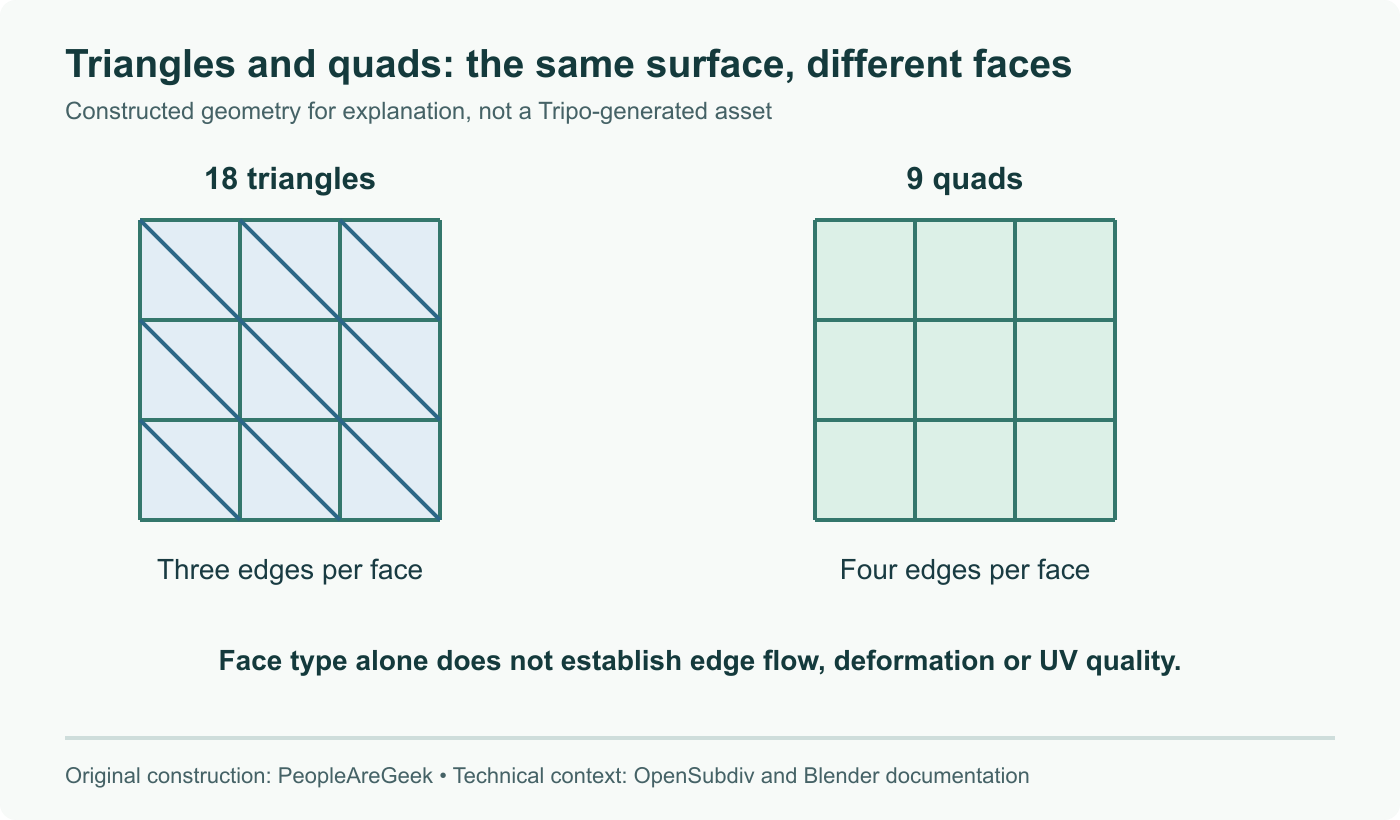
A quad is a polygon with four sides. That sounds like a trivia detail and it is actually the interface between a mesh and every tool downstream of it.
Catmull Clark subdivision, the standard method for smoothing a low polygon cage into a high resolution surface, is defined over quads. Feed it triangles and it still produces output, but the result pinches and the artist ends up fighting it. Edge loops, the continuous rings of edges that let you place deformation exactly where a knee or an eyelid bends, are a quad concept. UV unwrapping distorts far less across quads than across arbitrary triangle fans. Even simple modelling operations like inset, bevel and loop cut behave predictably on quads and unpredictably on dense triangle output.
The result is that "generated mesh" and "usable mesh" have been two different things, separated by a retopology pass that a person does by hand. If quad output holds up in practice, that pass is what disappears.
What the claim does not cover
Worth being precise about the boundary, because "production ready" is doing a lot of work in the announcement copy.
Quad topology is a necessary condition for a lot of downstream work. It is not a sufficient one. A mesh can be entirely quads and still have edge flow that runs the wrong way across a shoulder, in which case rigging it is no easier than rigging triangles. It can be quads at a polygon count nobody wants in a real time engine. It can arrive at the wrong scale, with materials assigned in a way that does not survive export, and with no level of detail chain.
None of that makes the announcement less interesting. It means the honest reading is that one expensive manual step may be leaving the pipeline, not that the pipeline is going away. That is still a substantial change for a small studio or a solo developer, which is exactly the audience three game companies on the cap table are betting on.
The cap table says who this is for
The investor list is unusually legible. Perfect World, Yanqu Games and 37 Interactive Entertainment are game developers. BlueFocus is a marketing group and ThunderSoft is a software company. MPCi led, with CDH Venture and Growth Capital, CICC, CMC Capital Partners, Hongtai Aplus, 3H Health, Zhongping Capital and GreatOrigin Asia on the financial side, and a set of existing investors increasing their positions.
When three game studios put strategic money into a 3D generation company on the same day it ships quad output, the intended first market is not ambiguous. Asset production is one of the larger line items in a game budget and one of the slower ones to scale, and it is the place where a generator that emits clean topology stops being a demo and starts being a tool. The company also names intelligent manufacturing, virtual reality and embodied AI, all of which need 3D geometry, though on longer commercial cycles than a studio filling an asset library.
The team is worth noting for the same reason. Chief executive Simon Song previously helped build MiniMax, chief scientist Yanpei Cao ran Tencent's generative 3D department, and chief technology officer Ding Liang came from SenseTime with a Tsinghua doctorate. That is a graphics research background rather than a general purpose model background, which fits a company whose differentiator is the structure of the output rather than the fidelity of the preview.
For developers, the practical next step is small: take the preview, generate one asset in the class you actually ship, and run it through your own subdivision, unwrap and rig. Topology claims are easy to make and easy to check, and a single asset through your real pipeline will tell you more than any benchmark. The same advice applied when open weight model releases started arriving faster than anyone could evaluate them.
Sources and further reading
- Tripo AI Raises 3 Billion Yuan in Series B and Series B+ Funding, PR Newswire, September 1, 2026
- HK-based Tripo AI developer VAST raises 446m, DealStreetAsia, September 2026
- Tripo AI Raises Approx. 446M in Series B Funding, FinSMEs, September 2026
- Tripo AI Raises 3 Billion Yuan to Scale Generative 3D Technology, citybiz, September 2026
Frequently asked questions
What did Tripo AI announce?
Two things on the same day, September 1, 2026. The first is a funding round of about 3 billion yuan, roughly 446 million dollars, spanning Series B and Series B plus, led by MPCi. The second is a preview release of Tripo P2.0, the company's latest 3D native foundation model. The company is developed by VAST and was founded in 2023. Existing investors including Fortune Capital, Primavera Capital, 4399 Network, Muhua Tech Ventures, Vitalbridge Capital, INCE Capital and T-Capital increased their stakes alongside a long list of new financial and strategic investors.
What is quad topology and why does it matter?
A quad is a four sided polygon. A quad mesh is one built predominantly from them rather than from triangles. It matters because almost everything a 3D artist does after modelling assumes quads. Catmull Clark subdivision, the standard way to smooth a low polygon cage into a high resolution surface, is defined on quads. Edge loops, which is how you place deformation for a joint or a mouth, only read cleanly on quad topology. UV unwrapping produces far less distortion on quads. Generated meshes have typically been dense triangle output, which renders fine and then resists every one of those operations.
Does this mean generated assets are production ready now?
It removes one of the biggest structural blockers, not all of them. Quad output means a mesh can be subdivided, rigged and unwrapped using ordinary tools instead of being retopologised by hand first, and hand retopology has been a large share of the labour between a generated asset and a shippable one. What quad output does not automatically give you is sensible edge flow around deformation areas, sane polygon budgets, correct scale, clean material assignment or usable LODs. Treat it as removing a step from the pipeline rather than removing the pipeline.
Who is behind the company and who invested?
Tripo AI was founded in 2023 by a team from AI and computer graphics. Chief executive Simon Song is a Johns Hopkins graduate who previously helped build MiniMax, chief scientist Yanpei Cao headed Tencent's generative 3D department, and chief technology officer Ding Liang holds a Tsinghua doctorate and came from SenseTime. The round was led by MPCi. Strategic investors include game companies Perfect World, Yanqu Games and 37 Interactive Entertainment, plus BlueFocus and ThunderSoft. Financial investors include CDH Venture and Growth Capital, CICC, CMC Capital Partners, Hongtai Aplus, 3H Health, Zhongping Capital and GreatOrigin Asia.
What will the money be spent on?
The company states three destinations. Development of 3D native foundation models and 3D data infrastructure, which is the research line that produced P2.0. Expansion of computing infrastructure for training and inference, which is where most of a round this size goes at present. And product development and commercialisation, meaning the paid surface around the model. The named target industries are intelligent manufacturing, virtual reality, interactive entertainment and embodied AI, and the presence of three game studios on the cap table tells you which of those is expected to convert first.