Intel is putting five billion euros, about five point seven billion dollars, into its Leixlip campus in Ireland to build more of the server processors that run data centers. Announced on July 13, 2026, the investment scales capacity for Intel Xeon 6 and the next generation of Xeon on the company's Intel 3 process, and it lands just months after Intel bought back full control of the Fab 34 facility. Server chips rarely make headlines the way AI accelerators do, but the Xeon in the rack is still doing most of the quiet work in every data center, and where it gets built has become a strategic question in its own right.
The short answer
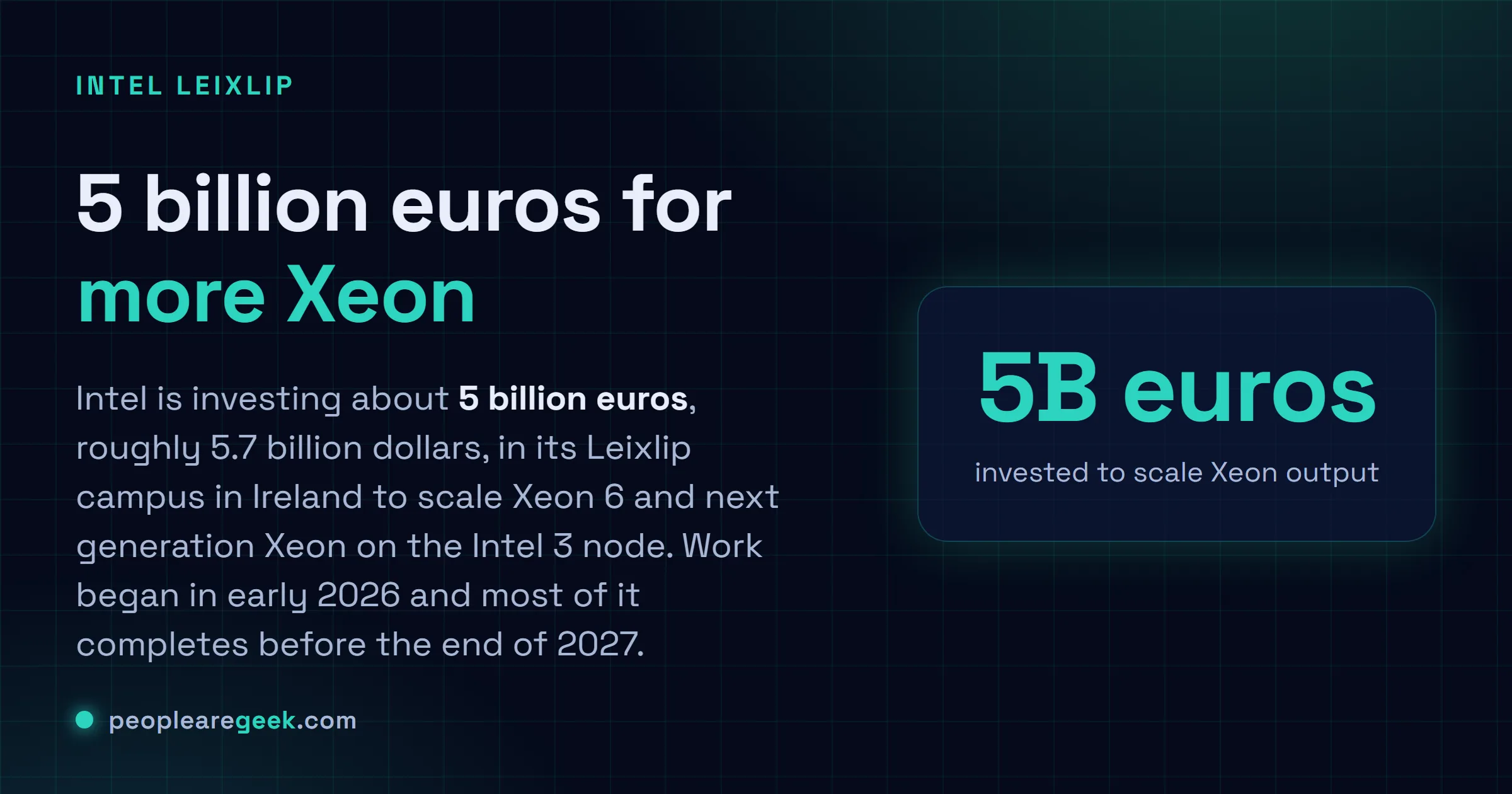
Intel is investing about 5 billion euros, roughly 5.7 billion dollars, in its Leixlip campus in Ireland to scale production of Xeon 6 and next generation Xeon server processors on the Intel 3 node. Announced July 13, 2026, the program follows Intel's April buyback of the 49 percent stake in Fab 34 it did not own, for about 14.2 billion dollars, restoring full control. Roughly 70 percent of the funding lands before the end of 2027, and it makes up about 30 percent of Intel's projected 17 billion dollar capital budget for 2026.
The chip stories that get the loudest coverage are about accelerators, the parts that train and serve the big models. But walk into any data center and most of the machines are doing ordinary work on ordinary server processors, and for a large share of the industry that processor is a Xeon. Intel's July announcement is a reminder that the boring part of the stack still needs capital, and a lot of it.
What Intel announced
On July 13, 2026, Intel said it would invest about five billion euros, roughly five point seven billion dollars, at its Leixlip campus in Ireland. The money expands capacity for Intel Xeon 6 and the next generation of Xeon, both built on the company's Intel 3 process node. Intel framed the driver plainly. Demand for AI and high performance computing is pushing the need for more server silicon, and the company is scaling to meet it.
The timeline is concrete. Work began in early 2026, and most of the investment is expected to be complete before the end of 2027, with roughly seventy percent of the funding committed by then. Intel put the program at about thirty percent of its projected seventeen billion dollars of capital expenditure in 2026, which makes this one European site a serious fraction of the company's whole capital plan for the year.
Why the node and the location both matter
Intel 3 is the process node under Xeon 6 and its successor, the specific manufacturing recipe that sets how fast and how efficient the chips are. For the people who run servers, the node is not a spec sheet curiosity. It drives performance per watt, and in a room full of machines running twenty four hours a day, watts are the currency. A more efficient node means more useful compute inside the same power and cooling budget, which is the constraint most data centers actually hit before they run out of floor space.
The location matters for a different reason. Advanced node manufacturing has become geographically concentrated, and both Intel and many of its customers now treat where chips are made as a resilience question rather than an afterthought. A large, established Irish site gives Intel a European base for leading edge production, which is worth something to buyers who care about supply diversity.

The Fab 34 backstory
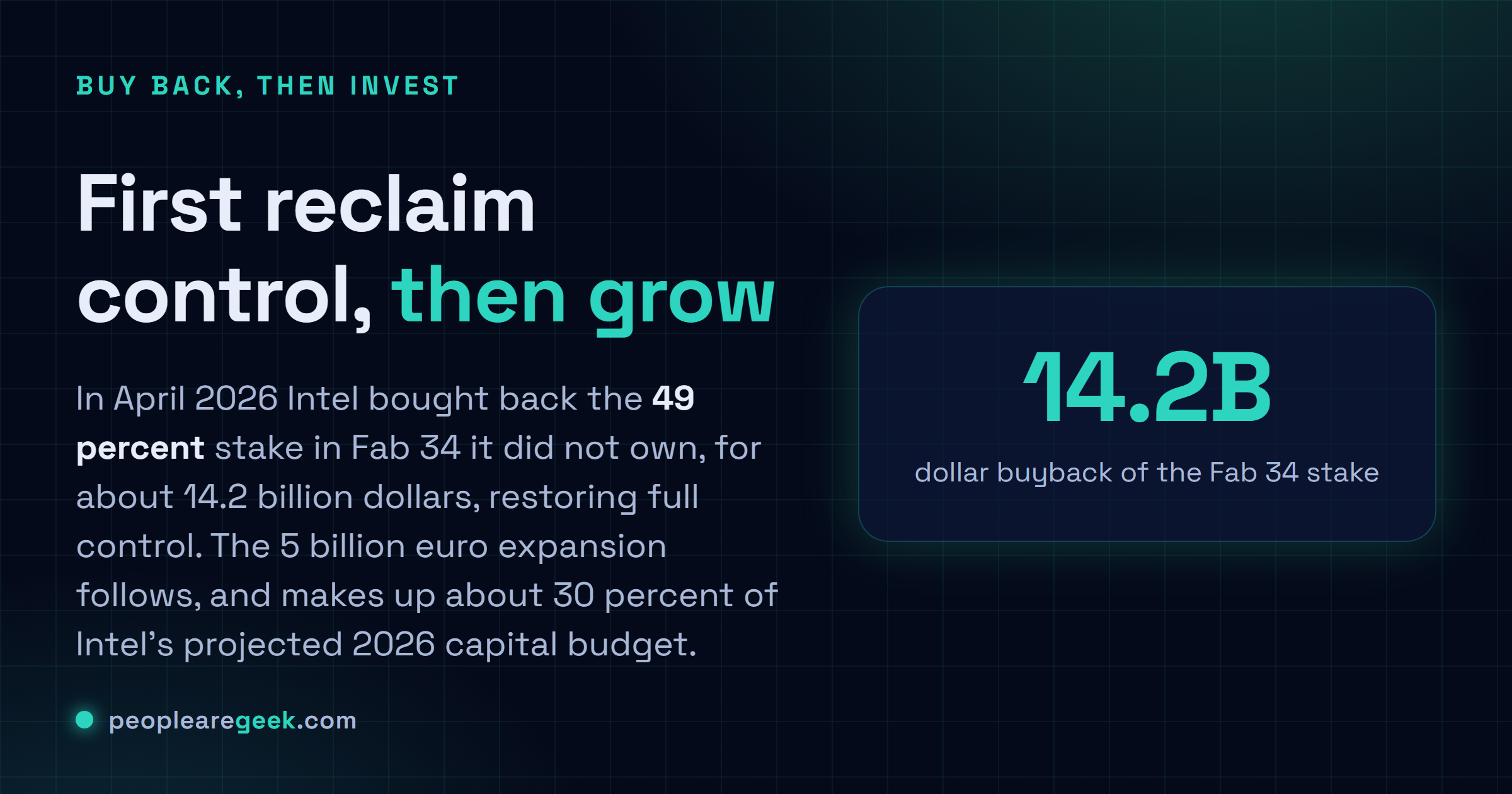
The expansion reads differently once you know the recent history of the plant. Fab 34 is the Leixlip fabrication facility, and in 2024 Apollo managed funds took a forty nine percent stake in a joint venture built around it, a financing move at a time when Intel needed cash. In April 2026 Intel bought that stake back for about fourteen point two billion dollars, restoring full financial control of the site.
Seen in sequence, the two moves make sense together. First Intel reclaimed complete ownership of the facility, then it committed five billion euros to grow it. Companies invest most confidently in assets they fully own, and the July announcement is what that confidence looks like once the ownership question is settled.
What to take from it
For anyone who plans or buys data center compute, the signal is simple. The server processor is not a solved, static part of the stack. Capacity for it is being expanded, the process nodes underneath it keep improving performance per watt, and the geography of where it is made is now a factor worth tracking alongside price and availability. Accelerators get the headlines, but the Xeon in the rack is still doing most of the work, and Intel just put five billion euros behind making more of it in Ireland.
Sources and further reading
- Intel Newsroom: Intel invests 5 billion euros to expand manufacturing in Europe
- The Irish Times: Intel to invest 5bn euros in Leixlip campus
- Wccftech: Intel pours 5 billion euros into Ireland, scaling Intel 3 for Xeon 6 and Diamond Rapids
- Electronics Weekly: Intel puts 5.7bn dollars into Leixlip
Frequently asked questions
What exactly did Intel announce for Ireland?
On July 13, 2026, Intel announced a capital investment of about 5 billion euros, roughly 5.7 billion dollars, at its Leixlip campus in Ireland. The money scales manufacturing capacity for Intel Xeon 6 server processors and the next generation of Xeon, both built on Intel's Intel 3 process node. Work began in early 2026, and most of it is expected to be complete before the end of 2027.
What is the Intel 3 node and why does it matter for servers?
Intel 3 is one of Intel's manufacturing process nodes, the recipe of transistor design and lithography used to make a chip. Xeon 6 and its successor are built on it. For data center operators the node matters because it drives performance per watt, and in a rack full of servers running around the clock, efficiency per watt is what shapes both electricity bills and how much compute fits in a given power and cooling envelope.
What happened with Fab 34 and Apollo?
Fab 34 is the Leixlip fabrication plant. In 2024 Apollo managed funds took a 49 percent stake in a joint venture around it. In April 2026 Intel repurchased that 49 percent interest for about 14.2 billion dollars, restoring full financial control of the facility. The 5 billion euro expansion follows that buyback, so Intel is now investing in a plant it once again fully owns.
How big is this relative to Intel overall spending?
Intel said roughly 70 percent of the 5 billion euro program will be committed before the close of 2027, and that the effort represents about 30 percent of Intel's projected 17 billion dollars of capital expenditure in 2026. In other words this single European expansion is a meaningful slice of the company's total capital plan for the year.
Why build server chips in Europe specifically?
Demand for AI and high performance computing is driving the need for more Xeon capacity, and geographic diversity in manufacturing has become a priority for both Intel and its customers. A large, established site in Ireland gives Intel a European base for advanced node production, which matters to buyers who care about supply resilience and about where their chips are made.