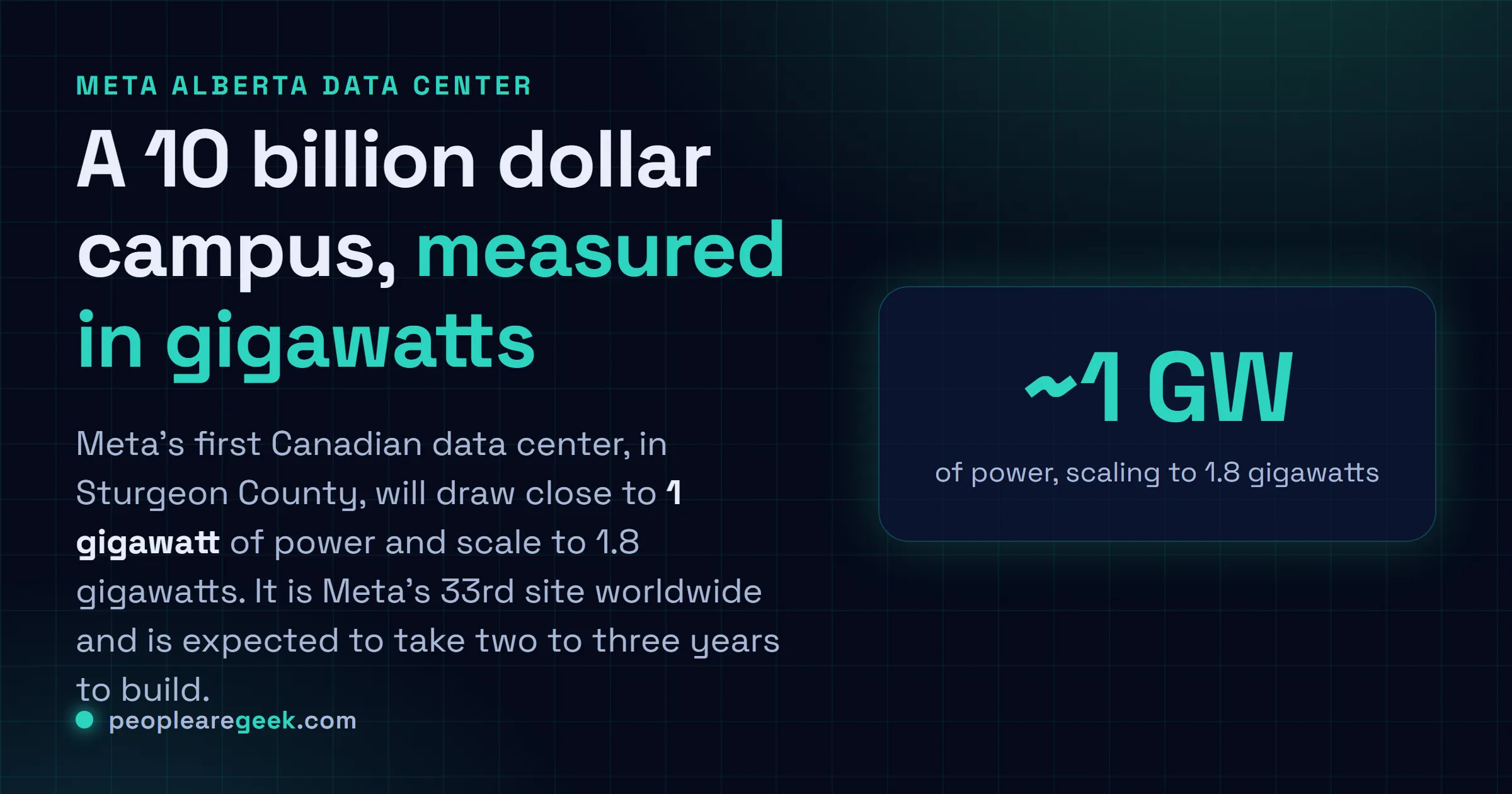
Meta will spend roughly 10 billion dollars (about 13 billion Canadian) to build its first ever Canadian data center in Sturgeon County, Alberta, a campus designed to draw close to 1 gigawatt of power and scale to 1.8 gigawatts later. Announced on July 8, 2026, it becomes Meta's 33rd data center worldwide and a clear marker of where the AI buildout is running into physics. The compute is the easy part now. The hard part is electricity, and this project ships with a dedicated 4.6 billion dollar natural gas plant to feed it. For anyone who plans capacity, the story here is power.
The short answer
Meta will spend about 10 billion dollars (roughly 13 billion Canadian) on its first Canadian data center in Sturgeon County, Alberta. The campus is built to draw close to 1 gigawatt of power, with room to reach 1.8 gigawatts, and it arrives with a dedicated 4.6 billion dollar natural gas plant to feed it. Announced July 8, 2026, it is Meta's 33rd data center. The headline is not the chips inside. It is the electricity, which is now the thing that decides how fast AI infrastructure can grow.
For years the mental model for a data center was racks, cooling, and a fat network link. That model is out of date. The new constraint on a hyperscale AI campus is raw electricity, and Meta's Alberta announcement reads less like a real estate deal than an energy deal wearing a data center label.
What Meta is building
On July 8, 2026, Meta named Sturgeon County, Alberta as the home of its first data center in Canada, at a projected cost of about 10 billion US dollars, or roughly 13 billion Canadian. The campus is designed to draw close to 1 gigawatt of power, with headroom to scale to about 1.8 gigawatts as it fills out. It will be Meta's 33rd data center globally and its first north of the US border, part of a broader plan the company has described to roughly double its total compute capacity by 2027.
The build is expected to take two to three years. Meta says the site will employ more than 3,000 workers at the peak of construction and more than 300 people once it is running. Those are the usual figures for a project this size. The number that actually reframes the story is the gigawatt.
Why power is the real headline
One gigawatt is enough electricity to supply roughly 750,000 homes. Point that much power at a single campus and the questions change. It stops being about how many accelerators you can buy and becomes about whether a regional grid can deliver steady, uninterrupted power at that scale, and what happens to local rates and reliability when it does.
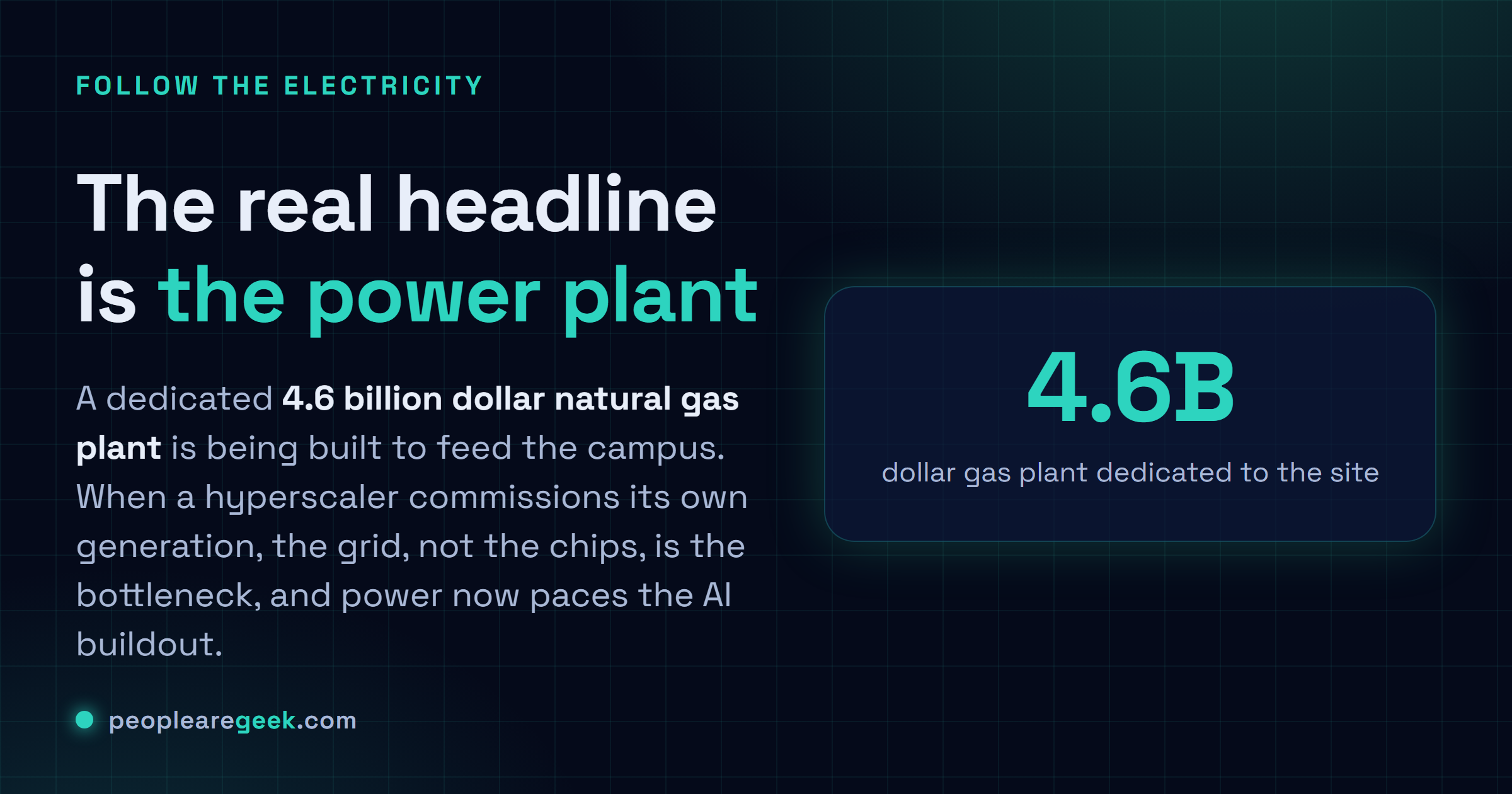
That is why the most telling part of the announcement is not the data center at all. It is the power plant. A separate 4.6 billion dollar natural gas facility is being built in Sturgeon County by Pembina Pipeline, Morgan Stanley Infrastructure Partners, and Kineticor Asset Management, specifically to serve the campus. When a hyperscaler has to commission its own generation to guarantee supply, that tells you the grid is now the bottleneck, not the chips.

The pattern to watch
Alberta is one instance of a pattern showing up across the industry. Gigawatt scale AI sites increasingly ship with dedicated generation attached, whether gas, nuclear, or long term renewable contracts, because relying on spare grid capacity no longer works when a single tenant wants as much power as a mid sized city. The location choices follow the same logic. Alberta offers land, a cold climate that helps with cooling, and access to natural gas, which matters more to Meta here than proximity to any particular fiber route.
For people who plan and run infrastructure, three things are worth taking from this.
- Power availability is now a siting decision. Where you can get a gigawatt, reliably, increasingly determines where the compute goes. Network and land come second.
- Dedicated generation is becoming normal. Expect more hyperscale sites paired with their own plants. The grid interconnect queue is too slow and too crowded to bet a multiyear buildout on.
- The timeline is measured in years. Two to three years from announcement to running capacity is the reality for a project this size. Compute demand may be immediate, but the physical supply behind it moves at construction speed.
Meta framed this as an expansion of its AI ambitions, and it is. But the more durable lesson sits underneath the press release. The scarce input for the next phase of AI is not the accelerator. It is the electricity to run it, and the companies building at this scale are now in the power business whether they wanted to be or not.
Sources and further reading
- CNBC: Meta is building its first big Canadian data center as AI expansion crosses the border
- The Globe and Mail: Meta to spend 13 billion dollars to build AI data centre in Alberta
- E&E News by POLITICO: Meta to invest 10 billion dollars in Alberta data center
- Yahoo Finance: Meta to build C 13 billion Alberta data center, its first in Canada
Frequently asked questions
How big is the Alberta data center and what will it cost?
Meta plans to invest about 10 billion US dollars, roughly 13 billion Canadian, in Sturgeon County, Alberta. The campus is designed to draw close to 1 gigawatt of power at first and to scale up to about 1.8 gigawatts. It will be Meta's first data center in Canada and its 33rd globally.
Why does the power figure matter more than the chip count?
A gigawatt is enough electricity to supply roughly 750,000 homes. At that scale the limiting factor for an AI campus is no longer how many accelerators you can buy but whether the grid can deliver steady power. That is why the project comes with its own generation, a signal that energy, not silicon, now paces the AI buildout.
Where does the electricity come from?
A separate 4.6 billion dollar natural gas plant is being built in Sturgeon County by Pembina Pipeline, Morgan Stanley Infrastructure Partners, and Kineticor Asset Management to serve the campus. Pairing a hyperscale data center with dedicated generation is becoming a common pattern for gigawatt scale AI sites.
When will it be running and how many jobs does it create?
The facility is expected to take two to three years to build. Meta says it will employ more than 3,000 workers at the peak of construction and provide more than 300 permanent jobs once operational.