WIRED reports Meta testing robots for cabling and server interventions. A useful way to assess that prospect is to separate the physical movement from identifying the correct target and verifying that service really recovered.
Reporting is not a deployment guarantee
The 28 August WIRED investigation relies on current and former workers. Meta declined to comment on the specific tests. This is not proof of fleet-wide autonomous maintenance.
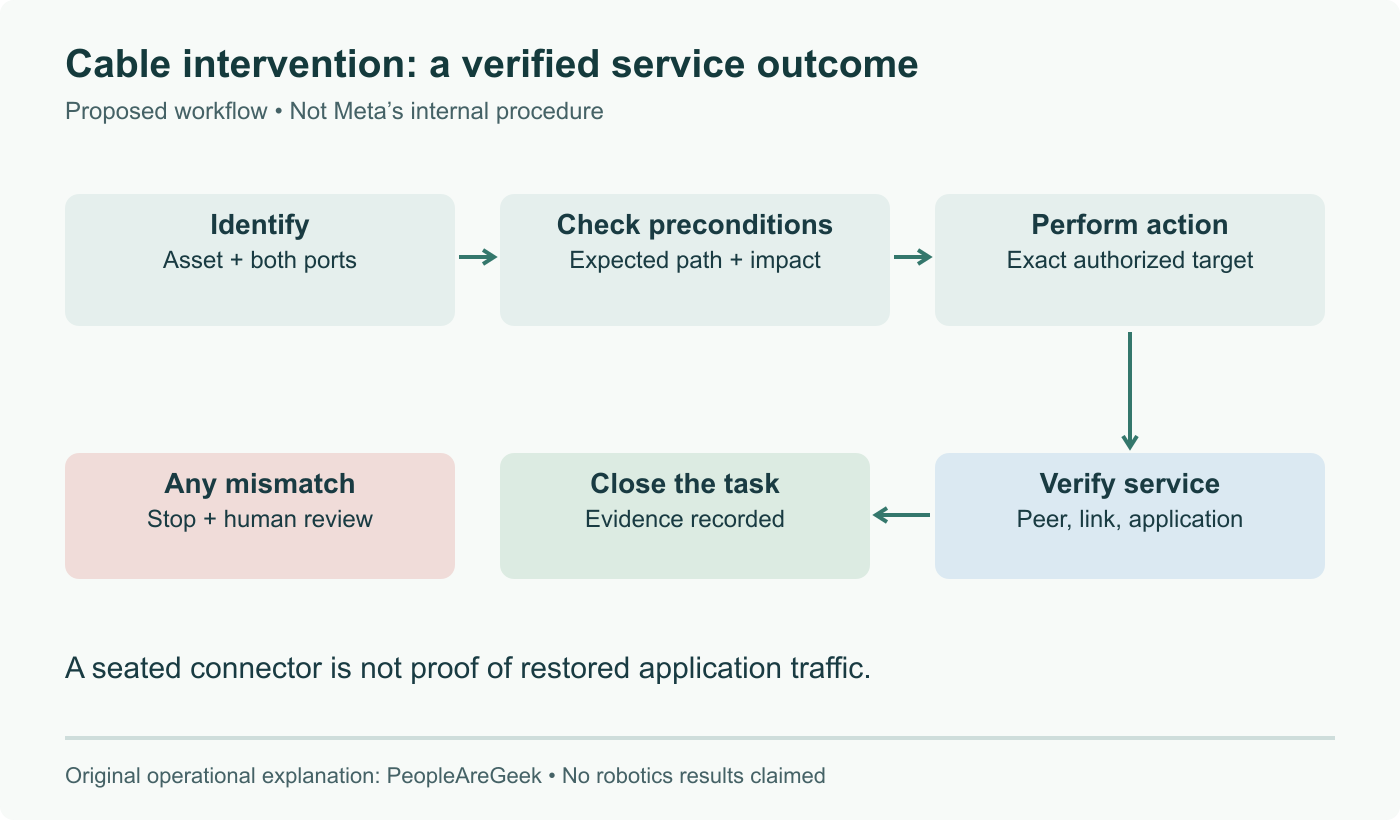
The diagram is our proposed verification workflow, not a depiction of Meta’s robots, equipment layout or internal procedure. It illustrates why successful motion alone is insufficient evidence of a successful repair.
Define the task before choosing the mechanism
A ticket saying replace the network cable is incomplete. An actionable task identifies the asset, rack, both ports, intended connection and allowed interruption. It also states what evidence justified touching that connection. Otherwise, an accurately executed movement can disconnect the wrong service.
For a hypothetical dual-linked server, first establish that the alternate path actually carries the required traffic. A second cable physically present is not proof of a healthy failover path. Then define the exact target and a stop condition if the observed labels or connection disagree with the inventory.
Measure more than insertion success
An evaluation should distinguish target identification, physical action and service outcome. Suggested measurements include wrong-target attempts, interventions completed, human recoveries required, time to verified restoration and collateral faults. These are proposed criteria; we have no measured Meta results for them.
A connector seating mechanically does not prove the expected peer, speed, error rate or application reachability. The outcome check should match the incident: a management response may return while the production path still fails. Conversely, a healthy link may be blamed for an unrelated application failure.
Keep the exception path visible
During a trial, define when work stops and how a technician takes over. An obstructed connector, an unexpected cable route or conflicting asset labels should become a recorded exception. Continuing with a guessed target can make a small fault much larger.
Compare the whole intervention cycle with the current process, including diagnosis, travel, preparation, supervision and verification. A fast arm may not improve restoration time if the queue waits for a person to approve every ambiguous step. A slower mechanism may still help a narrow repetitive task; that requires measurement, not a general claim about staffing.
The previous article extrapolated from reported trials to labour efficiency and future roles. Those outcomes are not established here. The practical contribution is a testable definition of successful maintenance that applies whether the action is performed by a person, a remotely controlled device or an autonomous system.
Source
Linked the original reporting and kept tests attributed; removed speculative labour conclusions and replaced generic imagery with a verification workflow for cable intervention.