Meta is about to stop being purely a buyer of AI silicon and start being a maker of it at scale. According to an internal memo reported in early July 2026, the company will move its custom AI chip, code named Iris, into production in September, targeting a doubling of its compute capacity and a smaller bill from Nvidia and AMD. Iris is the fourth generation of Meta's MTIA program, designed with Broadcom and manufactured by TSMC, and the memo notes that testing took only six weeks with no major issues. For people who run infrastructure, the interesting question is not whether Meta can build a chip. It is what happens to the economics of AI compute when a hyperscaler makes its own.
The short answer
An internal memo reported in early July 2026 says Meta will put its custom AI chip, code named Iris, into production in September. Iris is the fourth generation of Meta's MTIA program, designed with Broadcom and built by TSMC, and Meta says testing took only six weeks. The chip serves both training and inference and is meant to help double compute capacity toward 14 gigawatts in 2027 while cutting reliance on Nvidia and AMD. Meta expects to spend up to 145 billion dollars on AI infrastructure this year.
There is a moment in every large infrastructure operation when buying stops making sense and building starts to. For Meta, on AI accelerators, that moment now has a date. An internal memo reported in early July 2026 says the company will move its custom chip, code named Iris, into production in September, and the reasoning is the same one that pushes any operator toward owning its own gear. When you are the biggest tenant of a scarce, expensive resource, the supplier's margin becomes your problem to solve.
What Iris actually is
Iris is the fourth generation of Meta's MTIA line, short for Meta Training and Inference Accelerator. These are not general purpose GPUs. They are chips designed around the specific workloads Meta runs, its recommendation systems and its AI features across the apps, which lets the company shape the silicon to the exact shape of the job rather than paying for flexibility it does not need.
Meta designed the chip with Broadcom, a partner it has leaned on for its custom silicon effort, and TSMC handles fabrication. One detail in the memo stands out for anyone who has shipped hardware. Testing Iris reportedly took only about six weeks and surfaced no major issues. A clean bring up at this scale is not luck. It signals that the MTIA program has matured from an experiment into a repeatable pipeline, which is the harder thing to build than any single chip.
Why a hyperscaler builds its own
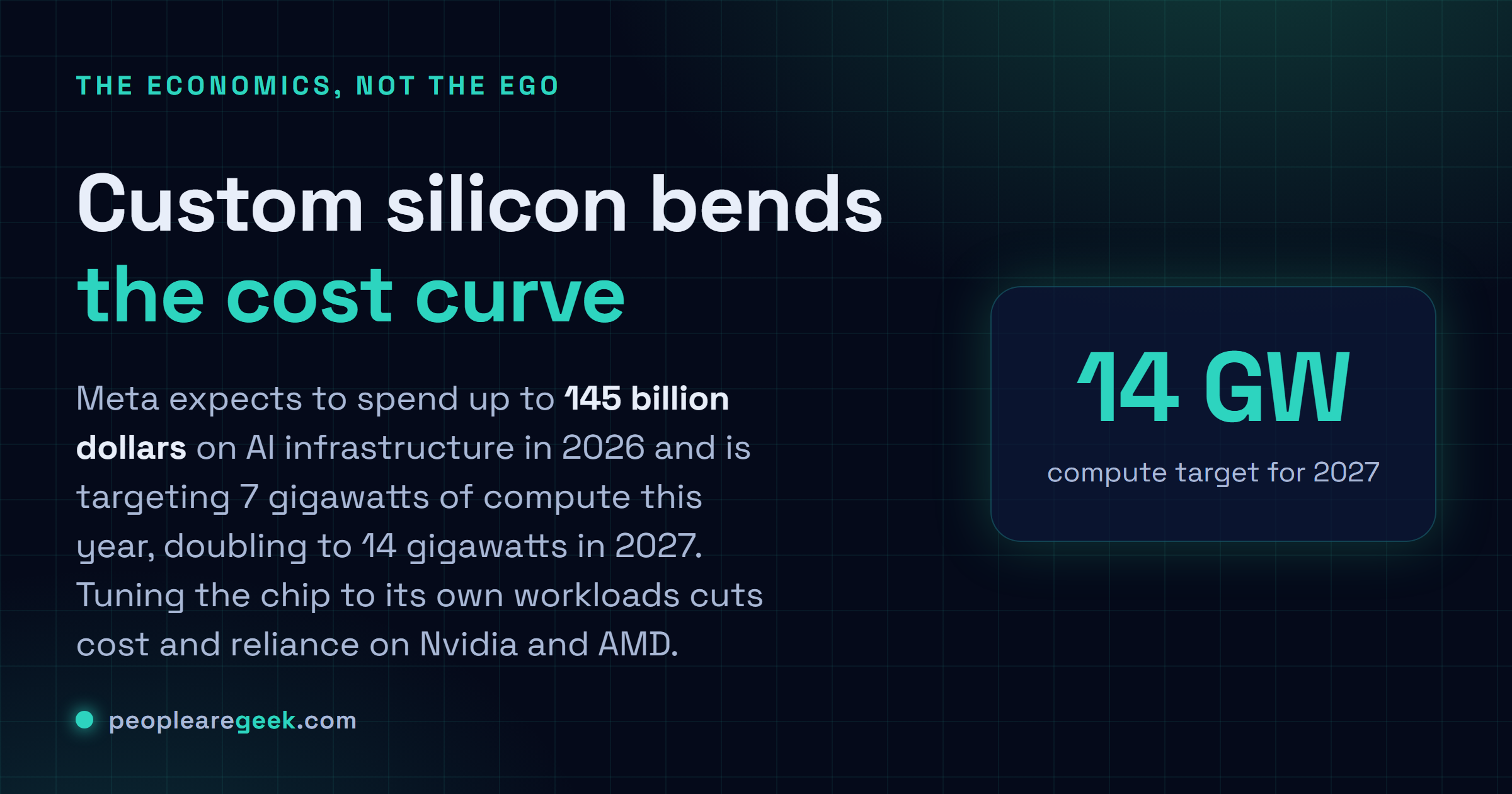
The motive is not pride, it is arithmetic. Meta has said it expects to spend up to 145 billion dollars on AI infrastructure in 2026 alone, and it is targeting roughly 7 gigawatts of compute by the end of this year, doubling to about 14 gigawatts in 2027. At those numbers, the cost per unit of useful compute is not a line item, it is a strategy. A chip tuned to your own workloads can beat a general purpose part on cost and power for the jobs you actually run, and every point of efficiency compounds across a fleet that large.
There is also the supply question. Nvidia and AMD accelerators are expensive and constrained, and betting a multiyear buildout on a short list of outside vendors is a risk. Owning a credible in house alternative changes the negotiation even if Meta keeps buying merchant silicon too. It is leverage as much as it is a chip.

What it signals for the rest of us
Most teams will never tape out a chip, and that is fine. The lesson here is not do it yourself. It is that the AI accelerator market is quietly splitting into two worlds. At the very top, the largest operators are building their own silicon to escape the cost and supply constraints of merchant parts. Everyone else keeps renting that capacity, increasingly through clouds and specialized providers.
For infrastructure planners, three things are worth holding onto. Custom silicon is now a routine hyperscaler play rather than a moonshot, so expect more of it and expect it to keep pressure on GPU pricing over time. The bottleneck story has shifted from can we get chips to what does each unit of compute cost, which is a healthier question to design around. And the workloads that justify custom hardware are the predictable, high volume ones, which is exactly the kind of work worth measuring carefully before you decide where it should run. Meta is answering that question by building. The value for the rest of us is watching which way the cost curve bends when it does.
Sources and further reading
- Reuters via U.S. News: Meta to put AI chip into production in September as it looks to double computing capacity, memo shows
- TechCrunch: Meta's new AI chips will begin production in September
- Meta Newsroom: Expanding Meta's custom silicon to power our AI workloads
- Meta Newsroom: Meta partners with Broadcom to co develop custom AI silicon
Frequently asked questions
What is Iris and how does it fit into Meta MTIA program?
Iris is the code name for the fourth generation of Meta's MTIA program, its line of custom Meta Training and Inference Accelerator chips. Unlike a general purpose GPU, MTIA parts are designed specifically for Meta's own recommendation and AI workloads, which lets the company tune the silicon to the exact jobs it runs across its apps.
When does Iris go into production and who builds it?
An internal memo reported in early July 2026 says Iris moves into production in September 2026. Meta designed the chip with Broadcom, and Taiwan Semiconductor Manufacturing Company, or TSMC, handles the actual fabrication. The memo also noted that testing the chip took only about six weeks and turned up no major issues.
Why is Meta building its own chip instead of just buying GPUs?
The goal is cost and control. Buying accelerators from Nvidia and AMD at the scale Meta needs is enormously expensive, and supply is tight. A custom chip tuned to Meta's own workloads can lower the cost per unit of useful work and reduce dependence on a small number of outside suppliers, which matters when you plan to double compute in a year.
How much compute is Meta trying to add?
Meta is targeting roughly 7 gigawatts of compute infrastructure by the end of 2026 and about 14 gigawatts in 2027. The company has said it expects to spend up to 145 billion dollars on AI infrastructure in 2026 alone, so shaving cost off each unit of compute has a very large absolute effect.
Will Iris be used for training or inference?
Both. Meta has said it plans to use its MTIA chips for training and for running, or inferring, AI models across its apps. Starting with inference and expanding into training is a common path for custom silicon, because inference workloads are more predictable and easier to target with fixed function hardware.