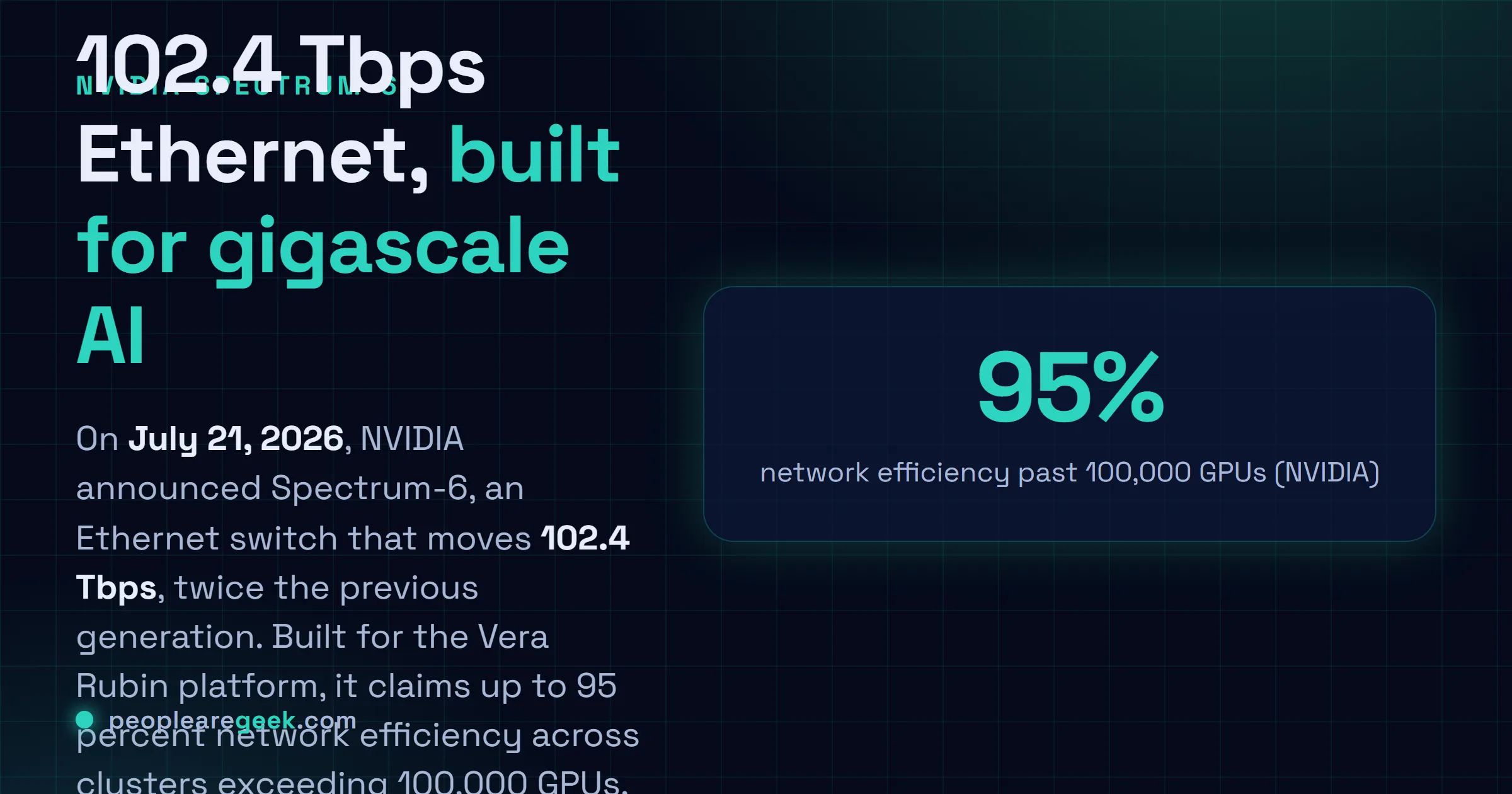
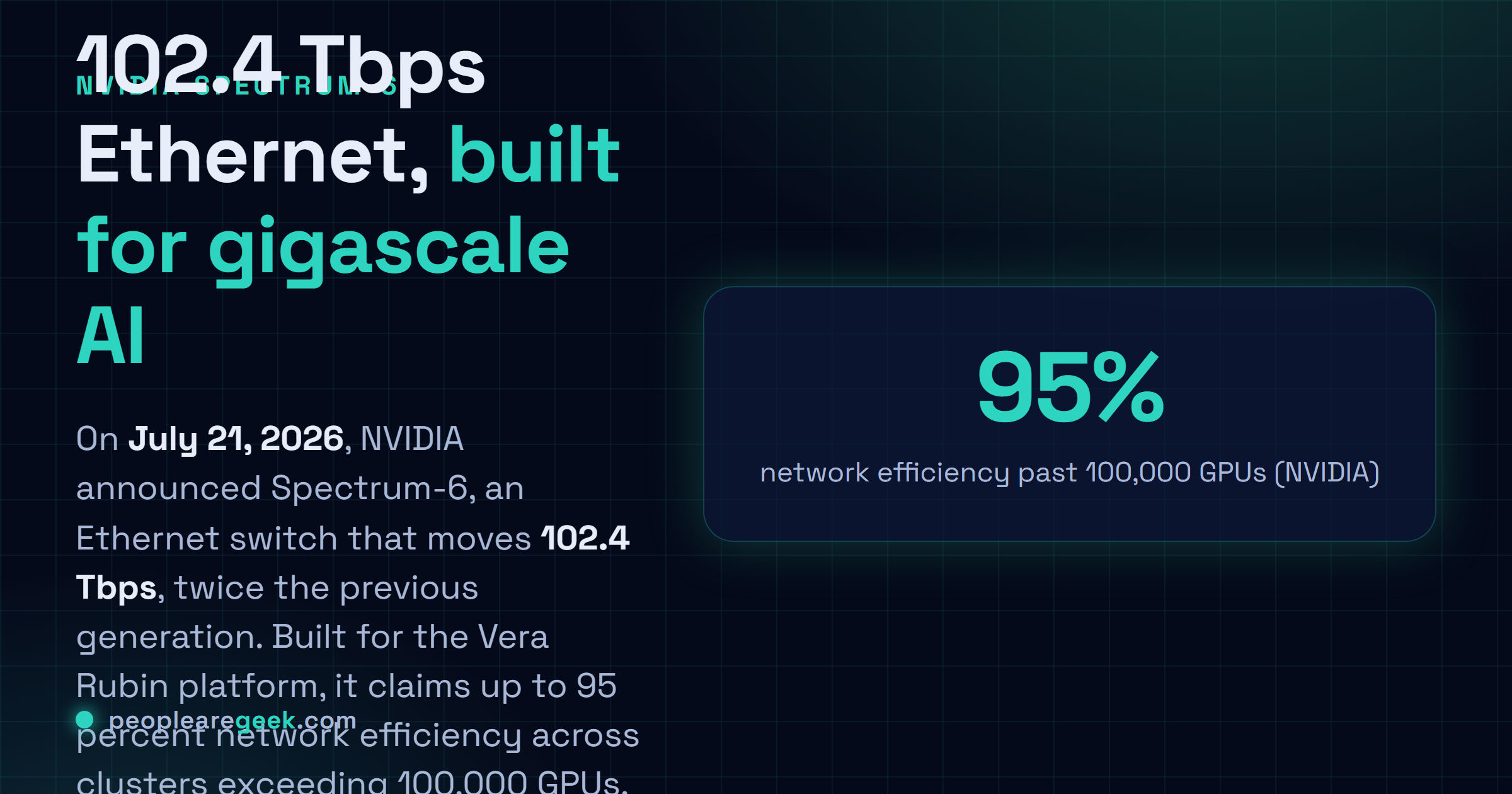
On July 21, 2026, NVIDIA announced Spectrum-6, a new Ethernet switching system that pushes 102.4 terabits per second through a single switch, twice the capacity of the previous generation. It is built for the Vera Rubin platform and aimed squarely at what NVIDIA calls gigascale AI factories, the very large clusters where the network, not the accelerator, is often the thing that decides whether all those GPUs actually stay busy. The pitch to network engineers is concrete: sustain up to 95 percent network efficiency across deployments that exceed 100,000 GPUs, cut the number of switches a data center needs by 1.7 times through better topology, and pair the switch with the ConnectX-9 SuperNIC on the host side. CoreWeave, Microsoft, Nebius, SpaceXAI, and Tesla are named as first adopters. For anyone who designs or runs large fabrics, the interesting part is not the headline number but what it takes to keep a fabric efficient at that scale.
The short answer
On July 21, 2026, NVIDIA announced Spectrum-6, an Ethernet switching system that moves 102.4 terabits per second per switch, twice the previous generation. Built for the Vera Rubin platform, it targets gigascale AI factories where the fabric decides whether GPUs stay busy. NVIDIA claims up to 95 percent network efficiency across clusters exceeding 100,000 GPUs, pairs the switch with the ConnectX-9 SuperNIC, and says better topology cuts the number of switches a data center needs by 1.7 times. CoreWeave, Microsoft, Nebius, SpaceXAI, and Tesla are first adopters.
Anyone who has scaled a network past a few racks knows the quiet truth of large clusters: the bottleneck moves. You add faster accelerators, and suddenly the thing holding back a training run is not the silicon doing the math but the fabric moving data between chips. NVIDIA's July 21 announcement of Spectrum-6 is aimed at exactly that shift, and it is worth reading past the headline number to see what problem it is really trying to solve.
What NVIDIA announced
Spectrum-6 is the newest switching system in NVIDIA's Spectrum-X Ethernet line. A single switch moves 102.4 terabits per second, which NVIDIA says doubles the capacity of the previous generation. It is built for the Vera Rubin platform, NVIDIA's next generation of AI infrastructure, and it is positioned for what the company calls gigascale AI factories: clusters with tens of thousands, and increasingly hundreds of thousands, of GPUs working on a single job.
On the host side, Spectrum-6 is meant to run alongside the ConnectX-9 SuperNIC. NVIDIA says the switch and SuperNIC together deliver up to 1.6 times higher AI networking performance than off the shelf Ethernet. That framing is the tell: the argument is not that Ethernet is new, it is that a tuned, end to end Ethernet fabric behaves very differently from a pile of generic switches once you push it to cluster scale.
Why efficiency beats raw bandwidth
The number that should catch a network engineer's eye is not 102.4 Tbps. It is the claim of up to 95 percent network efficiency across deployments exceeding 100,000 GPUs. Raw port speed is easy to advertise. Sustained efficiency at scale is the hard part, because large all to all traffic patterns create congestion, and congestion is where throughput quietly disappears.
In a big training run, thousands of GPUs exchange gradients in tight synchronization. If even a small fraction of that traffic backs up, the whole step waits, and the most expensive hardware in the building sits idle. A fabric that holds 95 percent efficiency at 100,000 GPUs is claiming it can keep that traffic flowing without the collapse that generic Ethernet tends to hit when many flows contend for the same links. Whether production fabrics match the vendor figure is the open question, but the metric NVIDIA chose to lead with is the right one to care about.

The specs that shape a build
Beyond bandwidth and efficiency, a few details matter for anyone planning a fabric:
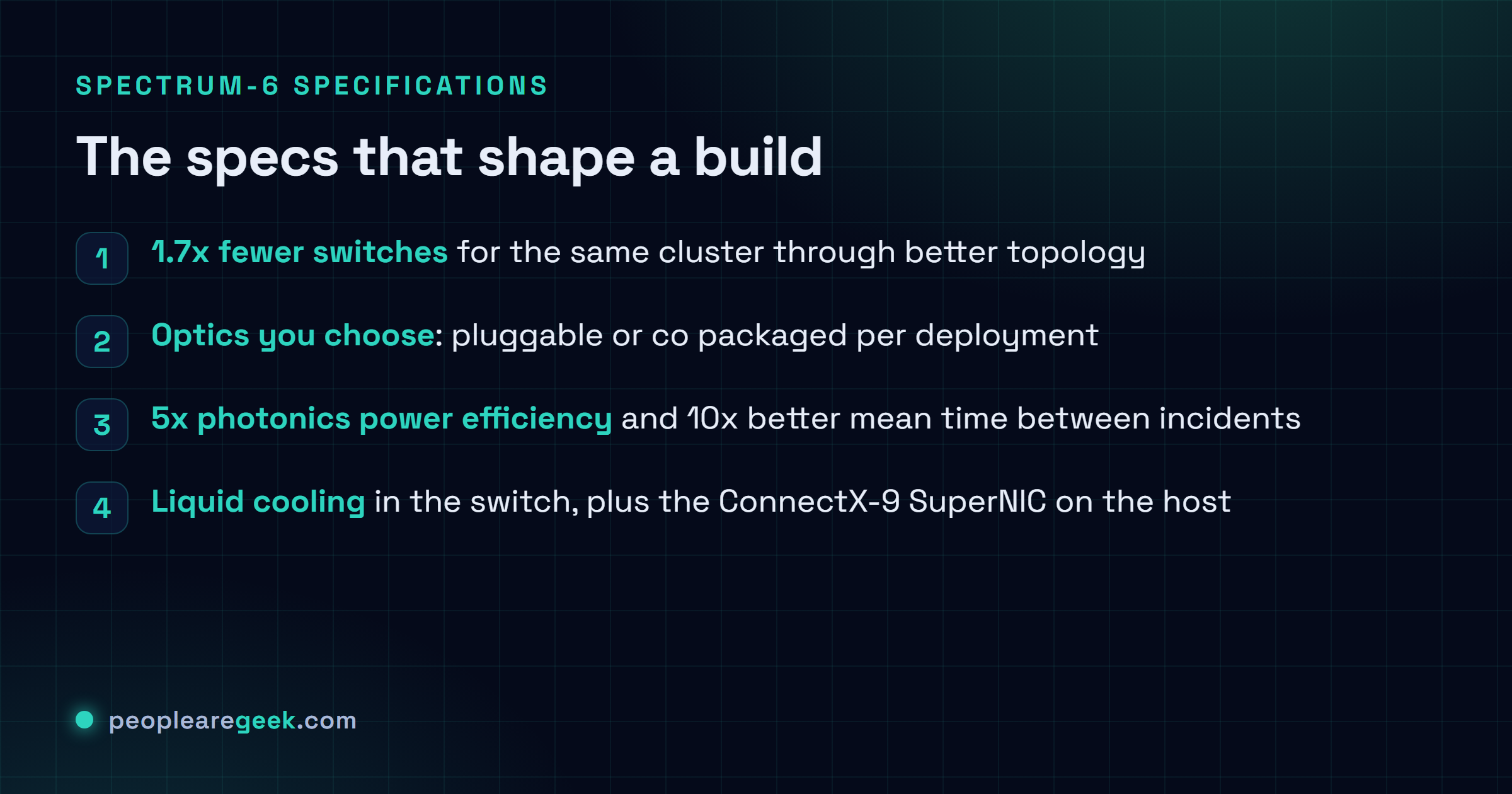
- Fewer switches for the same cluster. NVIDIA says better topology can reduce the number of switches a data center needs by 1.7 times. In a large build, switch count drives cost, cabling complexity, power, and the number of things that can fail, so a real reduction there is more than a rounding detail.
- Optics you can choose. The system supports both pluggable and co packaged optics. Pluggable optics are familiar and serviceable, co packaged optics trade some serviceability for efficiency. Having both means operators can pick per deployment rather than being forced into one model.
- Photonics efficiency and reliability. NVIDIA claims its photonics approach brings 5 times higher power efficiency and 10 times improved mean time between incidents. Power is the constraint that increasingly caps how big a cluster can get, and optical links are a common source of flaky, hard to trace failures, so both of those, if they hold, address real operational pain.
- Liquid cooling in the switch. The system includes liquid cooling. As switches move this much traffic, the switch itself becomes a meaningful thermal load, not just the GPUs around it.
Where this fits
NVIDIA names CoreWeave, Microsoft, Nebius, SpaceXAI, and Tesla as first adopters. CoreWeave's Min Jun framed it in operator terms, saying the combination of Spectrum-6 and liquid cooled Spectrum-X Ethernet will help deliver the bandwidth, resilience, and efficiency customers need. That is the honest scope of this release: it is infrastructure for organizations building clusters at a size where the network is a first class engineering problem, not an afterthought.
For most teams, a 102.4 Tbps switch is not something you will rack next quarter. But the direction it points is worth tracking even if you never touch one. The industry is treating the interconnect as the limiting factor in large scale AI, and the metrics that vendors now lead with, sustained efficiency and switch count rather than peak port speed, are a useful signal of where the real constraints have moved. When the network becomes the thing that decides how much of your compute is usable, the fabric stops being plumbing and becomes the design.
Sources and further reading
- NVIDIA Blog: Built for Vera Rubin, NVIDIA Spectrum-6 Arrives in Gigascale AI Factories
- Converge Digest: CoreWeave, Microsoft, Nebius, Tesla Will Be First to Deploy NVIDIA Spectrum-6
- GuruFocus: NVIDIA Launches Next-Gen Spectrum-6 Ethernet Switch System for AI Infrastructure
Frequently asked questions
What is NVIDIA Spectrum-6?
Spectrum-6 is an Ethernet switching system NVIDIA announced on July 21, 2026, as part of its Spectrum-X networking line. A single switch moves 102.4 terabits per second, which NVIDIA says is twice the capacity of the previous generation. It is built to connect the tens of thousands of GPUs and CPUs inside large AI clusters that NVIDIA calls AI factories, and it is designed for the upcoming Vera Rubin platform.
Why does a faster switch matter for AI training?
In a large training run, thousands of GPUs constantly exchange gradients and activations. If the network cannot keep up, the accelerators sit idle waiting on data, which wastes the most expensive hardware in the building. NVIDIA claims Spectrum-6 sustains up to 95 percent network efficiency across deployments exceeding 100,000 GPUs, meaning the fabric keeps the GPUs fed rather than stalling them. At that scale, network efficiency translates directly into training time and cost.
What are the key specifications?
The headline figure is 102.4 terabits per second per switch. NVIDIA pairs it with the ConnectX-9 SuperNIC on the server side and says the combination delivers up to 1.6 times higher AI networking performance than off the shelf Ethernet. The system supports both pluggable and co packaged optics and includes liquid cooling. NVIDIA says its photonics approach brings 5 times higher power efficiency and 10 times improved mean time between incidents, and that better topology can reduce the number of switches a data center needs by 1.7 times.
Who is deploying it first?
NVIDIA names CoreWeave, Microsoft, Nebius, SpaceXAI, and Tesla as first adopters of Spectrum-6. These are operators building very large GPU clusters, which is the workload the switch targets. As with any first generation rollout, real world numbers from production fabrics will be the ones worth watching, since a vendor benchmark and a live multi tenant cluster rarely behave identically.