OpenAI has shipped a new frontier lineup, GPT-5.6, and folded it into ChatGPT Work, a desktop agent that takes a goal and returns finished spreadsheets, slides, documents, and running code. Announced on July 9, 2026 and reaching broad availability by mid July after a staggered rollout, the release matters less for the benchmark bragging and more for the shape of the product. The chat box is no longer the center. The center is now a long running agent that plans, checks in, and does work across your connected apps for hours at a time. For anyone who writes code or ships documents for a living, that is the part worth reading closely.
The short answer
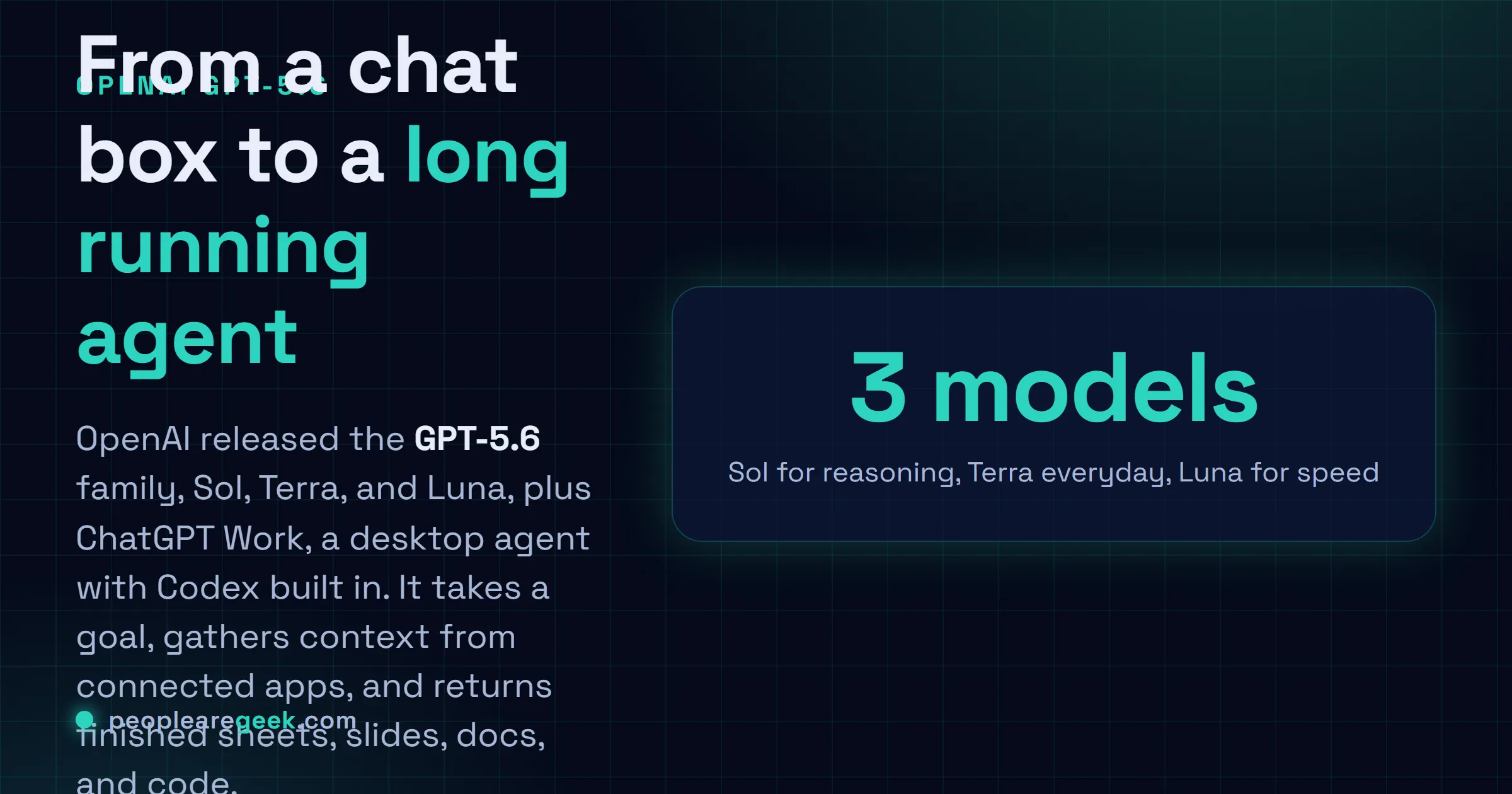
OpenAI released the GPT-5.6 family (Sol for hard reasoning, Terra for everyday work, Luna for speed) and ChatGPT Work, a desktop agent with Codex built in. It takes a goal, gathers context from your connected apps, plans the steps, and returns finished sheets, slides, documents, and code, staying on a task for hours. Plan mode, check ins, and action approvals let you set how autonomous it gets. Announced July 9, 2026, it landed on Mac and Windows first.
For a couple of years the model release ritual was predictable. A new number, a fresh set of benchmark bars, a day of arguments about whether the gains were real. GPT-5.6 has all of that, but the more interesting move sits next to it in the box. OpenAI shipped the model and, in the same breath, changed what the product is.
Three models instead of one
GPT-5.6 does not arrive as a single monolith. OpenAI split it into three variants so you can match the model to the job. Sol is the flagship, built for hard reasoning and agentic coding. Luna is the fast, low latency option for high volume and interactive work. Terra sits between them for everyday tasks where you want good answers without paying flagship prices.
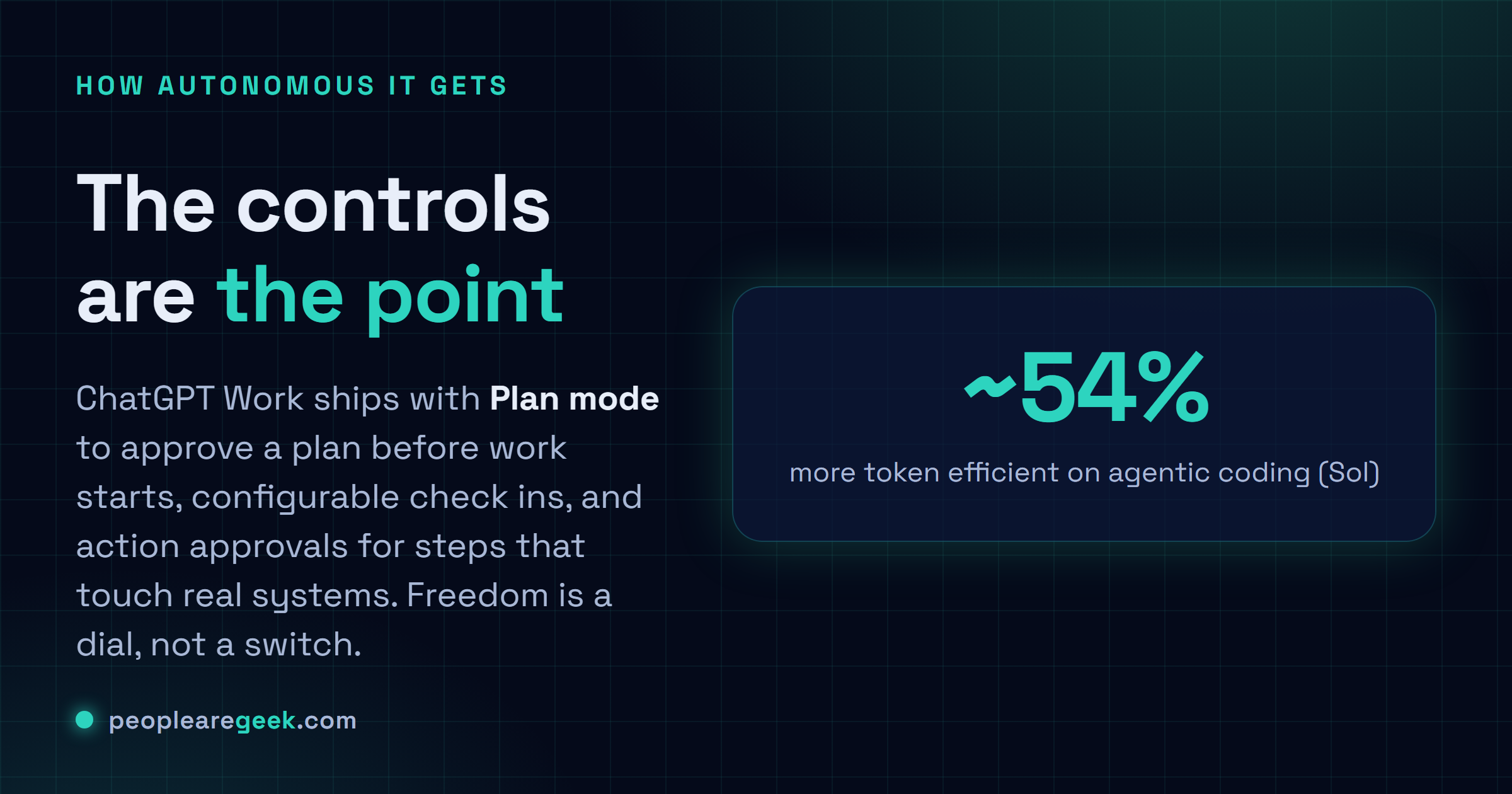
This is a quiet but useful admission. Not every call needs the most expensive brain on the shelf. Chief executive Sam Altman said Sol is about fifty four percent more token efficient than the prior generation on agentic coding tasks, which for anyone running long automated coding sessions is the number that actually touches the invoice. Fewer tokens per unit of work means more iterations on the same budget.
ChatGPT Work is the real story
The bigger change is ChatGPT Work, a desktop agent that runs on GPT-5.6 with OpenAI's Codex coding technology merged in. The pitch is simple and a little unsettling. You give it an outcome, not a prompt. It gathers context from your connected apps and files, breaks the goal into steps, and executes them on its own, staying with a complex project for hours and coming back with finished spreadsheets, slides, documents, and websites.
For developers, the Codex integration is the part to watch. This is not a chat window that suggests code. It is an agent that can plan a change, write it, run it, and iterate, all inside one desktop app across Mac and Windows first, with web and mobile to follow.

The controls matter more than the demo
An agent that works unattended for hours is only useful if you trust it, and OpenAI seems to know that. ChatGPT Work ships with three control surfaces that are worth more than any launch demo.
- Plan mode. Before the agent touches anything, it shows you a step by step plan to approve. You see the intended path and can stop it before it wanders.
- Configurable check ins. You decide where the agent pauses to report back, so a long job does not run to completion in the dark.
- Action approvals. Steps that touch real systems, files, or external services can be gated behind an explicit yes.
If you have ever watched an autonomous coding agent confidently do the wrong thing across forty files, you understand why these matter. The interesting design question for agents in 2026 is no longer whether they can do the work. It is how much freedom you hand them, and whether you can claw it back at the right moment. OpenAI's answer is to make that freedom a dial rather than a switch.
What to take from it
Two things stand out for people who build. First, the three tier model lineup is a nudge to stop reaching for the flagship by reflex and start routing by task, which is where a lot of real cost savings hide. Second, the product has moved from answering questions to finishing work, and the skill that matters shifts with it. Writing a good prompt gives way to scoping a good outcome, reviewing a plan, and setting the right checkpoints. The agent will do the typing. Your job becomes deciding what good looks like and where to intervene.
Sources and further reading
- Axios: OpenAI releases GPT-5.6 and ChatGPT Work tool
- Forbes: OpenAI's GPT-5.6 lands with work agents and a desktop pivot
- OpenAI: product release notes
- The Mac Observer: OpenAI launches GPT-5.6, ChatGPT Work, and a new desktop app with built in Codex
Frequently asked questions
What are the three GPT-5.6 models and how do they differ?
OpenAI split GPT-5.6 into three variants. Sol is the most capable and is aimed at hard reasoning and agentic coding. Luna is tuned for speed and low latency. Terra sits in the middle for everyday work. The idea is to let you match cost and latency to the task instead of paying frontier prices for simple calls.
What is ChatGPT Work and how is it different from regular ChatGPT?
ChatGPT Work is a desktop agent powered by GPT-5.6 with OpenAI's Codex coding technology built in. Instead of answering in a chat window, it takes an outcome, gathers context from your connected apps and files, breaks the job into steps, and completes them independently. It can stay on a complex project for hours and produce finished sheets, slides, documents, and websites.
Can I control how autonomous the agent is?
Yes. ChatGPT Work ships with control surfaces. Plan mode shows you a step by step plan to approve before any work starts. You can set configurable check ins so the agent pauses at points you choose, and action approvals gate steps that touch real systems. You decide how much freedom it gets rather than handing over the whole task blind.
How token efficient is the coding model?
OpenAI chief executive Sam Altman said Sol is about fifty four percent more token efficient than the previous generation on agentic coding tasks. For developers running long automated coding sessions, fewer tokens per unit of work translates directly into lower cost and faster iteration on the same budget.
Where can I get it and on which platforms?
ChatGPT Work first rolled out to the Mac and Windows desktop apps for all tiers, with web and mobile to follow. GPT-5.6 is also being made available through the API, and the model was designated as a preferred option inside Microsoft Copilot 365 for certain scenarios.