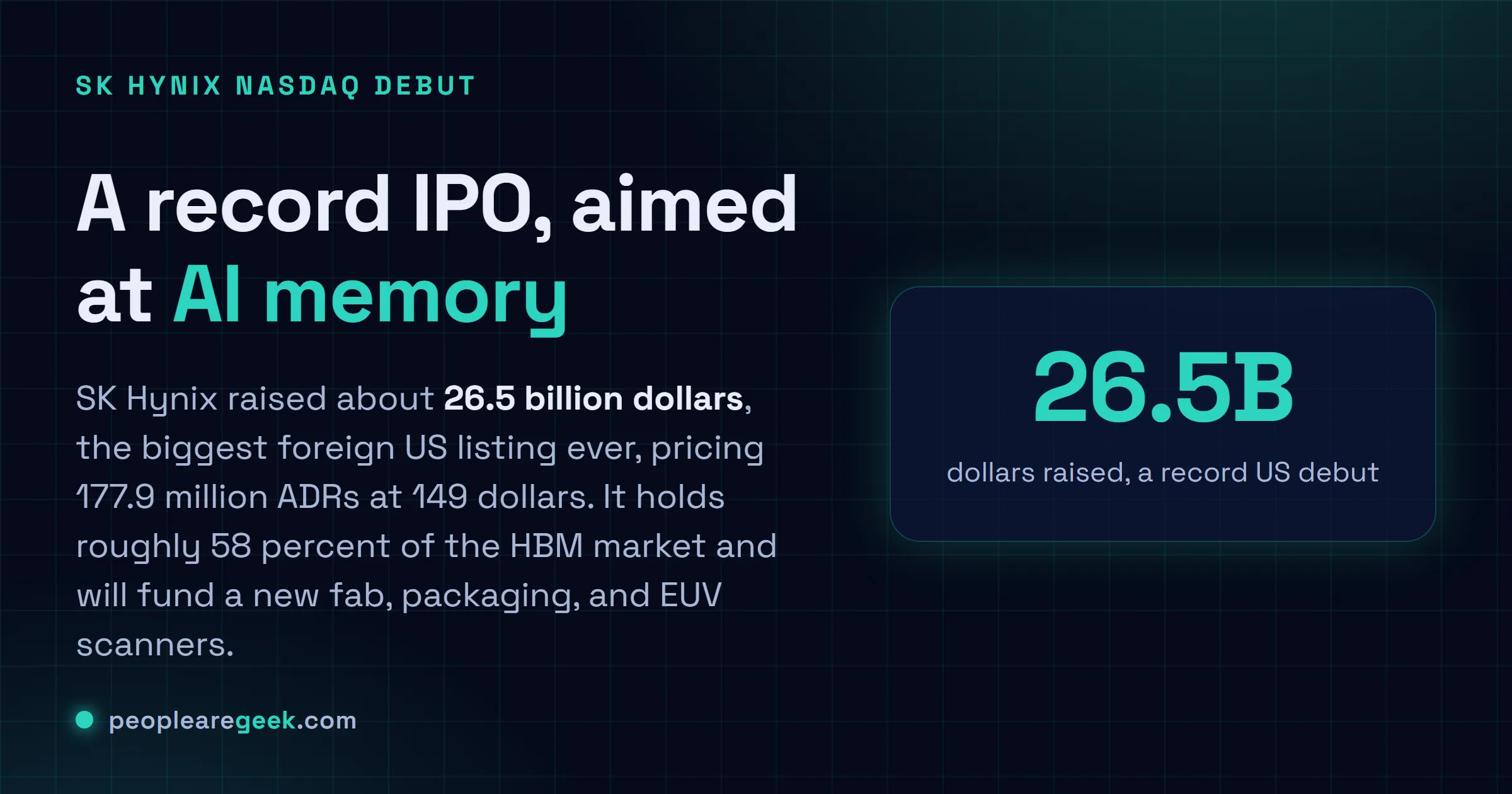
SK Hynix just raised 26.5 billion dollars in its Nasdaq debut, the largest US listing ever by a foreign company, and the cash is aimed squarely at the memory that feeds AI accelerators. The South Korean maker priced 177.9 million American depositary receipts at 149 dollars each, closed its first session up about thirteen percent, and began regular trading under the ticker SKHY on Monday, July 13. Behind the headline number sits a simple fact for anyone building AI infrastructure: high bandwidth memory is the bottleneck, SK Hynix holds most of that market, and it is about to pour billions into making more of it.
The short answer
SK Hynix raised about 26.5 billion dollars in its Nasdaq listing, the biggest ever US debut by a foreign company. It priced 177.9 million American depositary receipts at 149 dollars each and closed its first day near 168 dollars, up roughly thirteen percent. The money funds a new fab, a packaging plant, and more EUV scanners, all to make more high bandwidth memory. For AI infrastructure, HBM supply is the real constraint, and SK Hynix owns most of it.
If you have priced out a GPU server lately, you already know the quiet truth of this IPO. The compute die gets the headlines, but the thing you cannot get, and the thing that sets the price, is memory. On Friday SK Hynix turned that scarcity into the largest US market debut a foreign company has ever managed, and the numbers are worth reading closely because they tell you where AI infrastructure costs are heading.
What SK Hynix actually sold
SK Hynix sold 177.9 million American depositary receipts at 149 dollars apiece, with each ADR representing a tenth of a share listed in Seoul. That raised roughly 26.5 billion dollars. For scale, it beats the 25 billion dollars Alibaba raised in 2014, which had stood as the record for a US listing by a non American company for more than a decade.
Demand was not shy. The book was more than seven times oversubscribed and pulled in over 500 investment firms. Shares traded briefly under the temporary ticker SKHYV, closed the first session near 168 dollars (about thirteen percent above the 149 dollar offer price), and moved to regular trading as SKHY on Monday, July 13. In one afternoon SK Hynix went from a Seoul memory supplier most people never think about to one of the more closely watched names on the Nasdaq.
Why HBM is the real story
Strip away the finance and this is a memory story. High bandwidth memory, or HBM, is DRAM stacked vertically into a tower and set right beside a GPU or AI accelerator, connected through a very wide interface. That layout moves data into and out of the chip far faster than the memory in a normal server, and that speed is exactly what large models are starving for.
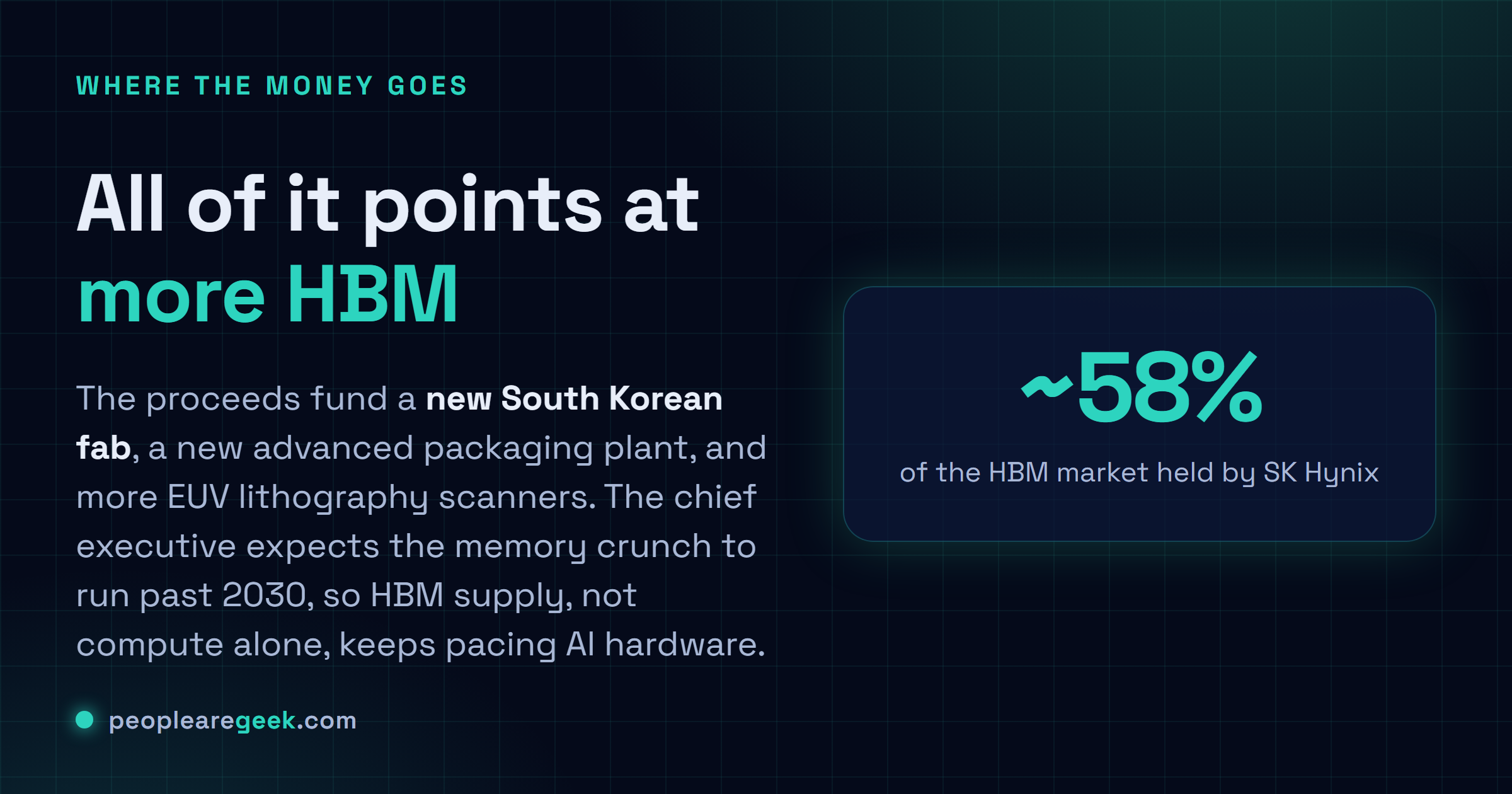
Here is the part that matters for planning capacity. A modern accelerator spends a lot of its life waiting for data, not doing math. Feed it faster and it does more useful work. So the number of AI servers the industry can actually build is gated less by how many logic chips a foundry can print and more by how much HBM exists to sit next to them. SK Hynix held about 58 percent of HBM revenue in the first quarter of 2026, which puts it at the center of that bottleneck. Its 35.55 billion dollars of quarterly revenue at a very fat operating margin is what a supply crunch looks like on an income statement.

What the money buys
SK Hynix has been clear about where the proceeds go, and none of it is a surprise once you accept that HBM is the product. The plan funds a new fabrication plant in South Korea, a new advanced packaging facility (packaging is where the DRAM stacks are assembled and bonded, a step that has become as hard as making the chips themselves), and more EUV lithography scanners, the extreme ultraviolet machines that print the finest features on leading edge silicon.
The chief executive framed the demand picture bluntly, saying the memory crunch should extend beyond 2030. Read that as a multiyear signal rather than a quarter to quarter blip. If the largest HBM maker is raising a record sum to build capacity it expects to stay sold out for years, the message to buyers is that memory pricing has structural support, not a temporary spike.
What it signals for anyone running AI infrastructure
You do not need to trade the stock to care about this. Three practical takeaways stand out.
- Budget for memory, not just GPUs. The cost and lead time on an AI node increasingly track HBM availability. Plan procurement around memory supply windows, because that is the part that slips.
- Lead times will stay long. New fabs and packaging lines take years to come online. A raise announced today does not add capacity this quarter, so the tight supply that pushed prices up is likely to persist through the buildout.
- Concentration is a risk to model. With a single supplier holding most of the HBM market, any disruption at one company ripples across every accelerator vendor downstream. If your roadmap depends on a steady flow of AI servers, single source risk deserves a line in the plan.
The IPO is a milestone for SK Hynix, but for the people who actually rack and run this hardware it is confirmation of something they have felt for a year. The scarce, expensive, decisive component in an AI server is the memory, and the company that makes most of it just raised a record pile of cash to make more.
Sources and further reading
- Tom's Hardware: SK Hynix raises a record 26.5 billion dollars in historic US IPO
- TechCrunch: SK Hynix raises 26.5B in the biggest foreign IPO in US history
- TechTimes: SK Hynix soars 13 percent on Nasdaq debut
- Seeking Alpha: SK Hynix hits Nasdaq at 171, CEO expects memory crunch to extend beyond 2030
Frequently asked questions
How much did SK Hynix raise and why is it a record?
SK Hynix raised about 26.5 billion dollars, making it the biggest US market debut ever by a non American company. It topped the previous record, Alibaba's 25 billion dollar listing from 2014. The offering was more than seven times oversubscribed and drew demand from over 500 investment firms.
What is HBM and why does it matter for AI servers?
High bandwidth memory is DRAM stacked vertically and placed right next to a GPU or accelerator, wired through a wide interface so data moves far faster than with ordinary memory. Modern AI training and inference are often limited by how quickly a chip can be fed data, so HBM capacity, not raw compute alone, decides how many accelerators can actually ship.
What will SK Hynix do with the money?
The company plans to fund a new fabrication plant in South Korea, a new advanced packaging facility, and more EUV lithography scanners, the machines that print the smallest features on leading edge chips. All of it points at expanding HBM output to meet AI demand the company expects to run past 2030.
How large is SK Hynix in the memory market?
SK Hynix held roughly 58 percent of HBM revenue in the first quarter of 2026, making it the clear leader in the memory that AI accelerators depend on. It reported 35.55 billion dollars of revenue in that quarter at a very high operating margin, a sign of how tight HBM supply has become.