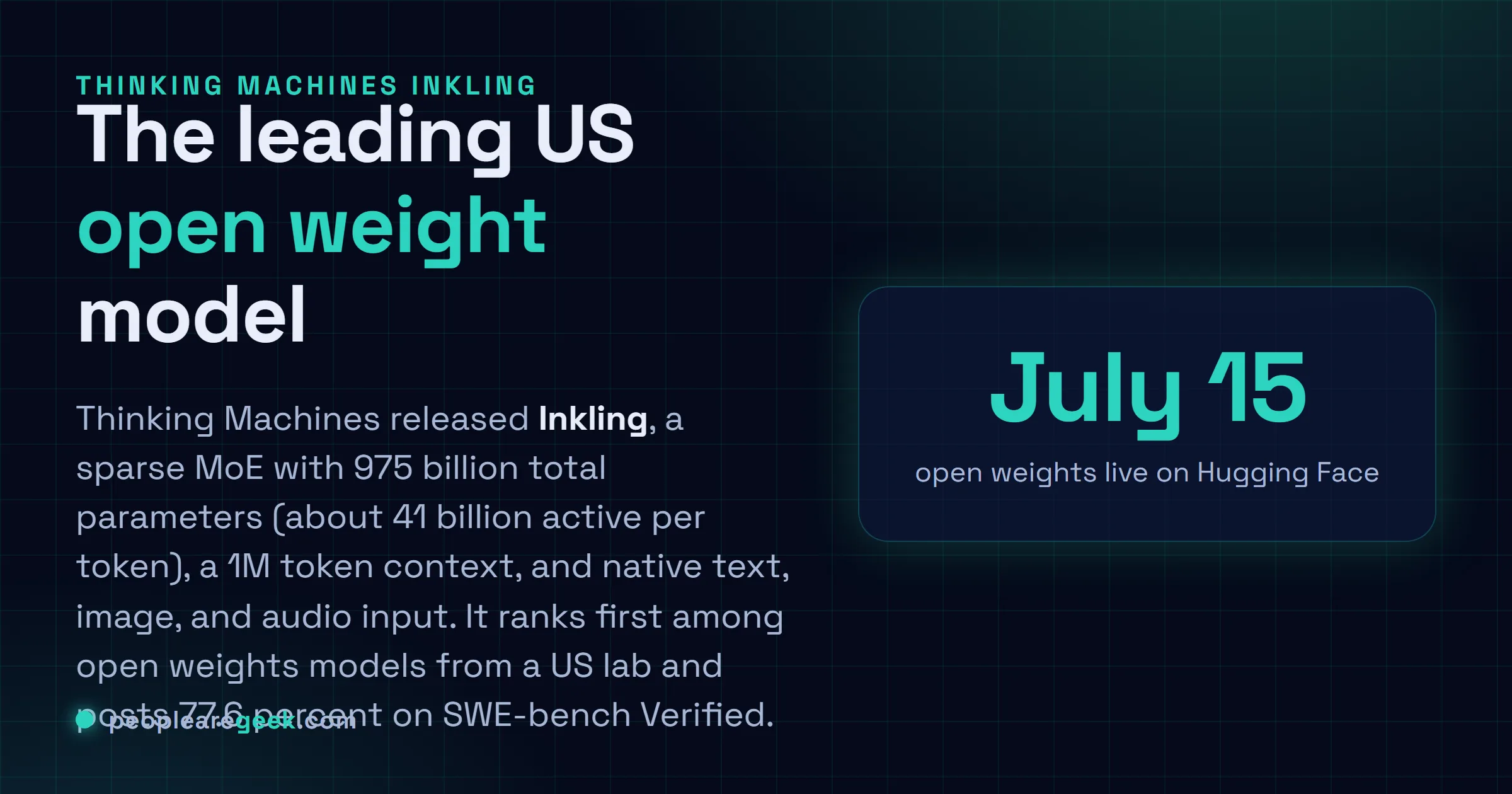
Thinking Machines Lab has released Inkling, and it arrives as the leading open weight model from a US lab. Inkling is a mixture of experts system with 975 billion total parameters, of which only 41 billion fire for any given token, and it reads a context window that stretches to one million tokens. The lab trained it from scratch on 45 trillion tokens spanning text, images, and audio. Announced on July 15, 2026, the weights are already on Hugging Face under an open license, with API access through the Tinker platform. For teams weighing whether to keep renting frontier intelligence or start owning it, this is the release to read closely.
The short answer
Thinking Machines Lab released Inkling, a sparse mixture of experts model with 975 billion total parameters and roughly 41 billion active per token. It reads a one million token context, takes text, images, and audio, and trained from scratch on 45 trillion tokens. Independent testing ranks it as the leading open weights model from a US lab, with 77.6 percent on SWE-bench Verified and strong reasoning scores. The weights are on Hugging Face now, with hosted access through Tinker.
New models arrive most weeks, and the sensible reflex is to wait for the noise to settle before touching anything. Inkling earns a closer look for a specific reason. It is a frontier grade model whose weights you can download today, from a young US lab, and that combination has been rare. An open model that trades blows with the closed leaders changes the arithmetic for anyone who has quietly wondered whether they will always be renting their intelligence from someone else's endpoint.
A US lab plants its flag in open weights
Thinking Machines Lab is the company founded by Mira Murati, formerly the chief technology officer at OpenAI, and Inkling is its first in house model. The lab did not take an existing base and polish it. It trained Inkling from scratch on 45 trillion tokens of text, images, and audio, which is why the model reasons across those modalities natively rather than through a bolted on adapter. The output side stays text only for now, but the input breadth matters for document, screenshot, and audio heavy workloads.
The strategic message is as loud as the technical one. Most of the strongest open weights models this year have come from Chinese labs, so a leading open release from a US team resets expectations about who ships in the open. Thinking Machines put the weights on Hugging Face under an open license, and offers a hosted path through its Tinker platform for teams that would rather call an API than stand up a cluster.
The architecture, and what actually runs
Nine hundred and seventy five billion parameters is the figure everyone repeats, and it is genuinely large. The honest way to read a mixture of experts model, though, is to look at what fires. Inkling routes each token through experts that sum to roughly 41 billion active parameters, so for the cost of a single forward pass it behaves far more like a mid sized model than its headline total implies. That is the entire point of the sparse design. You get the knowledge capacity of a giant while paying compute closer to something you can actually serve.
One feature worth flagging for builders is controllable thinking effort. Inkling lets you dial how many tokens it spends reasoning, and Thinking Machines says it can reach Nemotron 3 Ultra's Terminal Bench score using roughly a third of the tokens. On agentic workloads it averaged about 25 thousand output tokens per task against 43, 38, and 37 thousand for other open weights leaders. When you pay per token, that efficiency is not a footnote, it is the bill.
Where it lands on the benchmarks
Benchmarks are noisy and easy to overfit, so read these as a signal rather than a scoreboard. On the Artificial Analysis Intelligence Index, Inkling debuted around position 41, ahead of Nemotron 3 Ultra, which makes it the strongest open weights release from a US lab to date. On agentic coding it posts 77.6 percent on SWE-bench Verified, 54.3 percent on SWE-bench Pro Public, and 63.8 percent on Terminal Bench 2.1. On reasoning it reaches 97.1 percent on AIME 2026 and 87.2 percent on GPQA Diamond, with 29.7 percent on text only HLE that climbs to 46.0 percent when the model can use tools.
The one line summary making the rounds is that Inkling offers near frontier quality with weights you can hold. That is a useful shorthand, not a law of nature, and your own evaluations on your own workloads will tell you more than any leaderboard. Still, a top tier open result reshapes the conversation about how much you need to outsource.

Inkling-Small, the version you might actually run
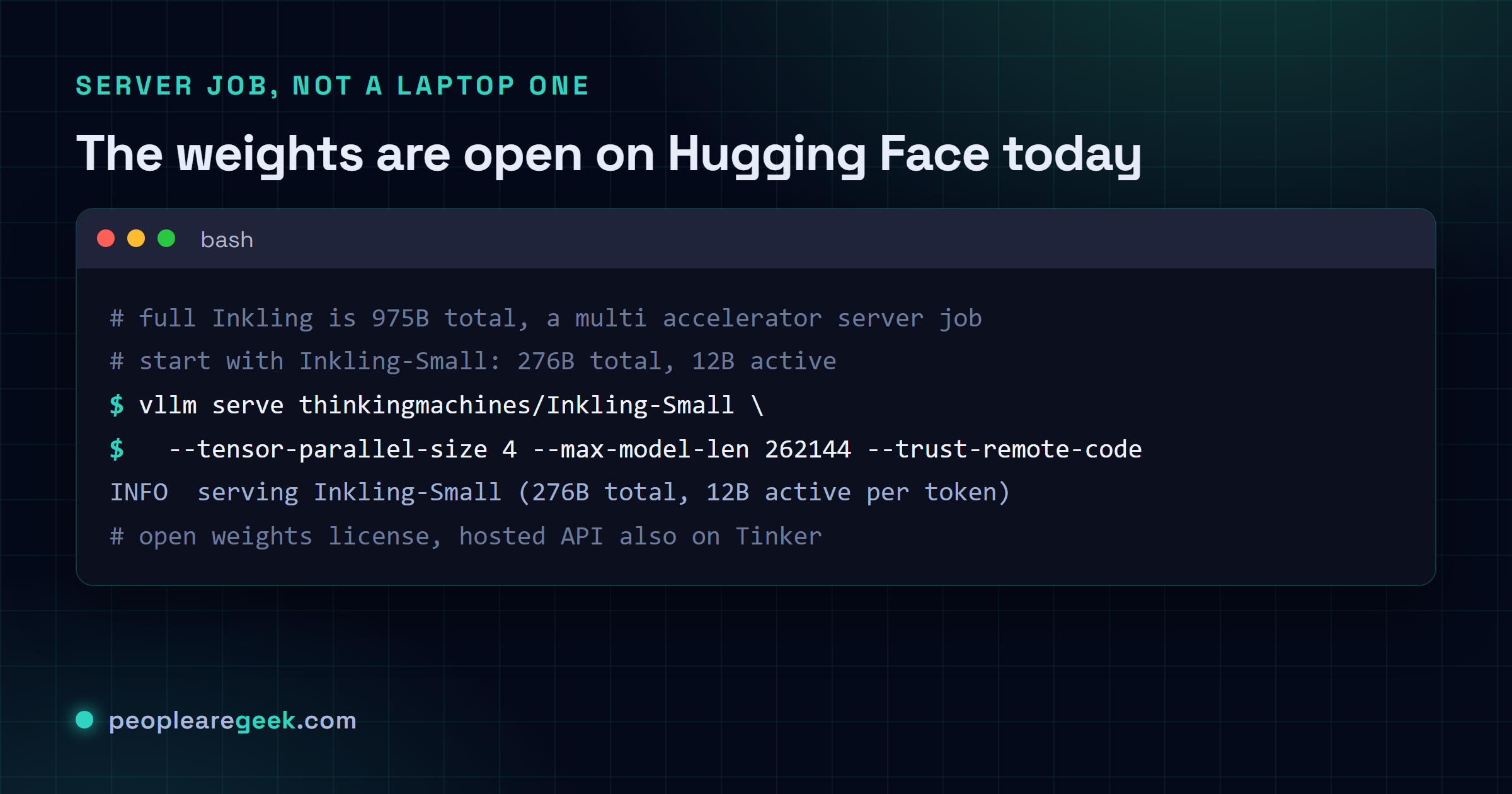
Alongside the full model, Thinking Machines previewed Inkling-Small, a 276 billion parameter variant with about 12 billion active. The interesting claim is that it matches or beats the full Inkling on several benchmarks, including 83.4 percent against 79.8 percent on IFBench, an instruction following test. For most teams the small model is the sensible entry point. It costs far less to serve, stays close to its larger sibling on real tasks, and fits hardware that stops well short of a full cluster.
If you plan to self host, the small model is where to begin. It drops into the usual open weights serving stacks, so you can stand it up, run your own evaluation set, and decide whether the extra capacity of the full model is worth the memory and the bill.
What to do with this
For most teams the move this week is not to rip anything out. It is to run Inkling, and especially Inkling-Small, against your real prompts and see whether it holds up on the work you actually do, particularly long context tasks and agentic coding, where its published numbers are strongest. Because the weights are open, you can keep sensitive workloads on hardware you control rather than shipping them to an external endpoint.
The longer arc is the one worth watching. A US lab shipping a leading open weights model narrows the gap between what you can rent and what you can own. That does not make the closed labs irrelevant, but it hands you leverage, a fallback, and a credible path to keeping your most sensitive intelligence in house.
Sources and further reading
- TechCrunch: Thinking Machines amps up its bet against one size fits all AI with Inkling
- Fortune: Mira Murati's Thinking Machines releases first AI model for broad use
- Artificial Analysis: Inkling, the new leading US open weights model
- Thinking Machines Lab: Introducing Inkling
- Sebastian Raschka: Inkling architecture and benchmark notes
Frequently asked questions
What is Inkling?
Inkling is the first in house large language model from Thinking Machines Lab, the company founded by former OpenAI chief technology officer Mira Murati. Announced on July 15, 2026, it is a sparse mixture of experts model with 975 billion total parameters, of which about 41 billion are active for any given token. It accepts text, images, and audio, outputs text, and reads a context window that reaches one million tokens. Thinking Machines trained it from scratch on 45 trillion tokens rather than fine tuning someone else's base.
Are the weights really open, and where do I get them?
Yes. Thinking Machines published the Inkling weights on Hugging Face under an open weights license, so you can download and serve the model on your own hardware. If you would rather not run it yourself, the company also offers hosted API access through its Tinker platform, where the context window is listed at 256 thousand tokens against the one million tokens available with the open weights.
How does Inkling score on benchmarks?
Independent testing puts Inkling at the top of the open weights field. On the Artificial Analysis Intelligence Index it debuted around position 41, ahead of Nemotron 3 Ultra, which makes it the strongest open weights release from a US lab so far. On agentic coding it posts 77.6 percent on SWE-bench Verified and 63.8 percent on Terminal Bench 2.1, and on reasoning it reaches 97.1 percent on AIME 2026 and 87.2 percent on GPQA Diamond. Treat benchmarks as one signal among several, not a final verdict.
What is Inkling-Small?
Inkling-Small is a lighter preview version with 276 billion total parameters and about 12 billion active. Thinking Machines says it matches or beats the full model on several benchmarks, including 83.4 percent against 79.8 percent on IFBench, an instruction following test. For many teams the small model is the more practical starting point, since it is far cheaper to serve while staying close to its larger sibling on real work.
Can I run Inkling on my own hardware?
The full 975 billion parameter model is a server job, not a laptop one. Even with only 41 billion parameters active per token, the full weights need to be resident in memory, so plan for a multi accelerator server or a rented cluster. Inkling-Small at 276 billion parameters is the easier target if you have serious but not cluster scale hardware, and it slots into the usual open weights serving stacks such as vLLM.