Amazon has asked the FCC to authorise up to 5,105 low Earth orbit satellites for a direct to device network, one that would talk to ordinary 4G and 5G phones without a special handset. The application came from Kuiper Systems, the entity behind Amazon Leo, and it landed at the end of July 2026. The technically interesting detail is the spectrum. Amazon plans to fly on Globalstar L-band and S-band, which it is buying, rather than borrowing a mobile operator's terrestrial bands. That choice explains most of what the network will and will not be able to do, and it is worth understanding before the marketing arrives.
The short answer
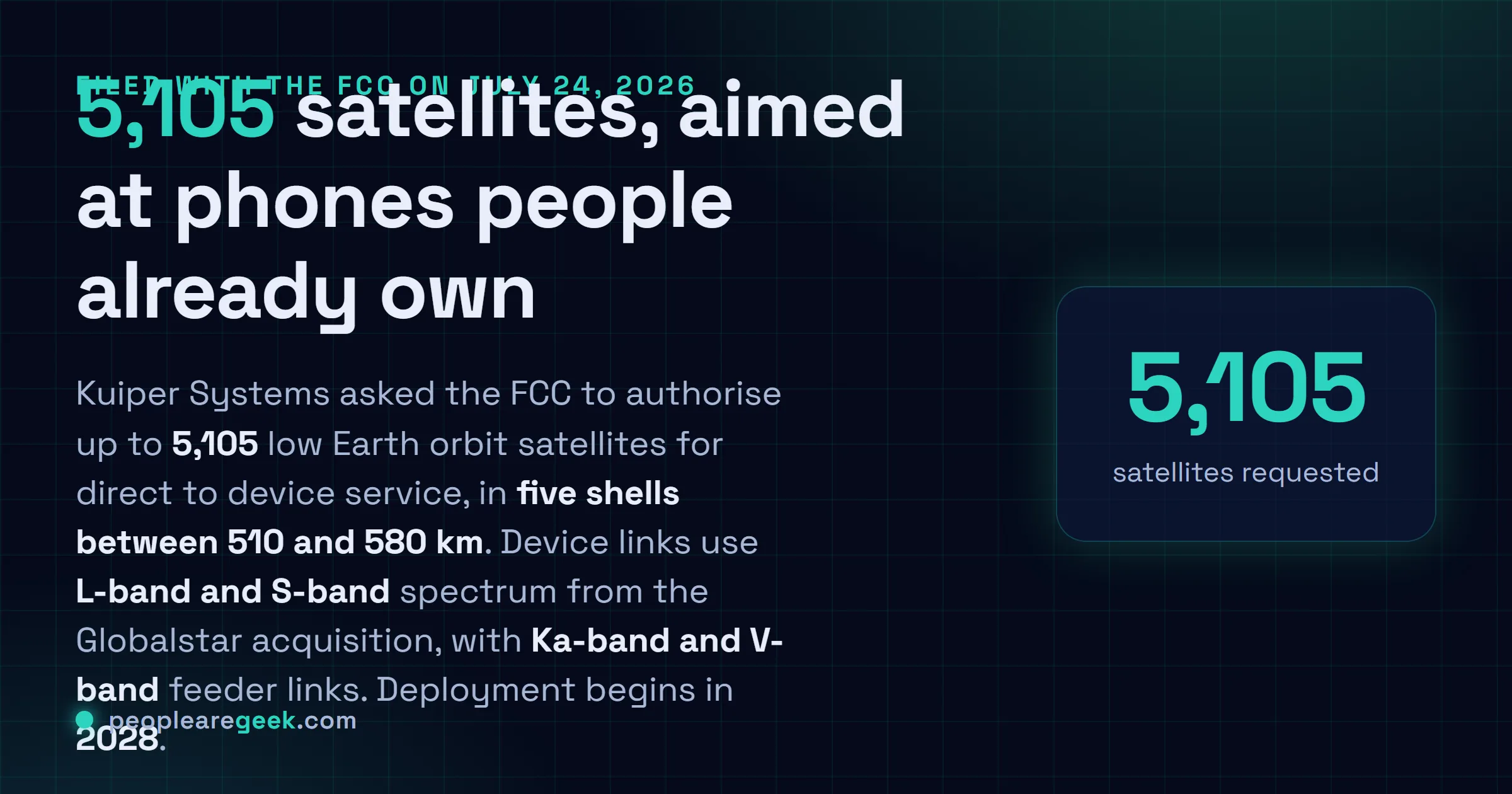
Kuiper Systems, the Amazon subsidiary operating Amazon Leo, applied to the FCC on July 24, 2026 for authority to deploy up to 5,105 low Earth orbit satellites for direct to device service. Device links use L-band and S-band spectrum coming from the Globalstar acquisition, with Ka-band and V-band for feeder links. Five shells sit between 510 and 580 km, three at mid latitude inclinations and two higher for polar coverage. Planned services span voice, messaging, data, emergency calling and IoT. Amazon already has more than 390 Leo broadband satellites in orbit, from a separate 3,236 satellite constellation.
Satellite to phone announcements tend to arrive with a picture of somebody making a call from a mountain, and the picture is never the interesting part. What decides whether one of these networks works is which slice of spectrum it flies on, and Amazon has just committed to an answer that is different from most of its competitors.
The filing
Kuiper Systems LLC, the Amazon subsidiary that operates Amazon Leo, filed with the FCC on July 24, 2026 for authority to deploy up to 5,105 low Earth orbit satellites providing direct to device service. The application covers voice, messaging, mobile broadband data, emergency calling and IoT services such as fleet tracking, delivered to smartphones and other mobile devices, with the stated focus on areas that terrestrial cellular does not reach.
Deployment starts in 2028. Satellite lifespans are given as about six to eight years.
This is separate from the Amazon Leo broadband constellation, which is planned at 3,236 satellites and already has more than 390 in orbit, with broadband service to initial coverage areas expected later in 2026.
How the constellation is laid out

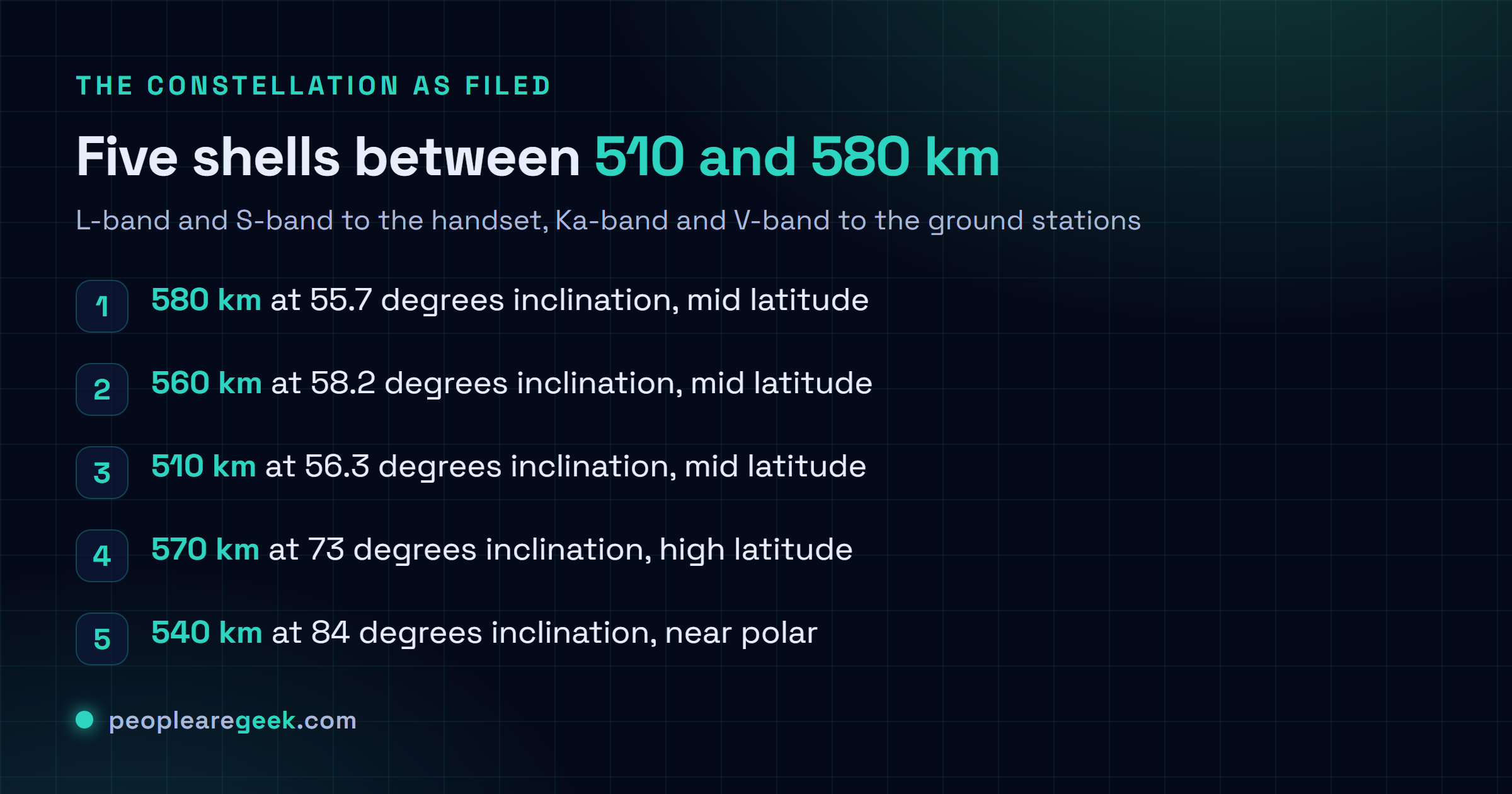
Five shells, all in a tight altitude band between 510 and 580 kilometres. Three of them handle mid latitudes, where most people live: 580 km at 55.7 degrees inclination, 560 km at 58.2 degrees, and 510 km at 56.3 degrees. The other two chase coverage rather than population, at 570 km and 73 degrees, and 540 km at 84 degrees for near polar service.
Spectrum splits into two roles. Device links, meaning the actual radio path to a handset, use L-band and S-band. Feeder links between satellites and ground stations use Ka-band and V-band. The satellites are described as carrying onboard signal processing, digital beamforming, adaptive modulation and optical inter satellite laser links.
That last item is worth noting for anyone who thinks about topology. Optical inter satellite links mean traffic can move between satellites without touching the ground, which reduces how many gateway sites you need and how much of the world's landmass you need regulatory permission to build on.
The spectrum choice is the strategy
There are two ways to get a signal from space into a phone that was not designed for it.
One is to reuse a mobile operator's own terrestrial cellular spectrum from orbit. The handset already supports those bands, so nothing changes on the device, but the satellite operator needs an agreement with a carrier in every single market, because that spectrum is licensed nationally to that carrier.
The other is to fly on mobile satellite service spectrum, which is what Amazon is doing with Globalstar's L-band and S-band. MSS allocations are globally harmonised and licensed to the satellite operator directly. Amazon does not need a carrier partnership in each country to have spectrum rights there, which removes an enormous amount of commercial friction from international rollout.
The price of that is bandwidth. MSS L-band and S-band allocations are narrow next to terrestrial cellular bands, and the amount of spectrum you hold caps the capacity you can deliver into a beam no matter how clever the modulation is. It also requires handset support for those bands, which is why the filing talks about compatible devices with satellite capable chipsets rather than any phone in a drawer.
So read the service list in that order of confidence. Emergency calling, messaging, voice and IoT telemetry fit a narrowband satellite link well, and that is where existing services already operate. Mobile broadband data to an unmodified handset is the ambitious end, and 2028 is when the first satellites go up, not when that capability arrives.
The Globalstar and Apple thread
None of this works without the Globalstar deal, agreed in April 2026 and valued at roughly $11 billion, or about $10.8 billion when the share exchange ratio was fixed on April 9, 2026. It brings Globalstar's satellite operations, ground infrastructure and, critically, its MSS spectrum licences. Closing is expected in 2027, subject to regulatory approval.
The Apple relationship comes with it. Apple put $450 million into Globalstar in 2022 to fund the constellation behind Emergency SOS via satellite, and took a 20% equity stake that Amazon is now buying out. Amazon has committed to honour and expand the arrangement under which roughly 85% of Globalstar's network capacity is reserved for Apple's satellite features, and the two have outlined further services on Leo: 5G via satellite, satellite weather, Apple Maps over satellite, sending photos in Messages while on satellite, and a satellite API for third party developers.
That last one is the item we would watch. A developer facing satellite API would turn intermittent, high latency, narrowband connectivity into something an application can be written against deliberately, rather than a fallback that surprises the app when it happens.
What it means if you build or operate networks
Nothing changes in your topology this year. Practically, three things are worth filing away.
Direct to device is becoming a coverage backstop rather than a novelty, so if you design for field devices, remote sites or vehicles, budget for a path that is narrowband, intermittent and measured in hundreds of milliseconds of latency rather than tens. Design the protocol for that, not for a degraded LTE link.
Spectrum consolidation is the real story of the filing. One company is assembling launch capacity, a broadband constellation, an MSS constellation and globally harmonised device spectrum in the same stack. That is a different competitive position from operating satellites alone.
And the chipset question decides the addressable market. This service needs handsets that support the relevant L-band and S-band, so adoption is gated by silicon in phones people actually own, on the same multi year replacement cycle that governs everything else in mobile.
Sources and further reading
- Amazon on how Leo plans to connect mobile devices from space
- GeekWire: Amazon Leo seeks FCC approval for 5,105 satellites
- Smart Maritime Network: Amazon Leo files for 5,105 satellite direct to device network
- US News and Reuters: Amazon Leo proposes constellation of over 5,000 satellites for direct to phone service
- Amazon: agreement to acquire Globalstar and partner with Apple
Frequently asked questions
What did Amazon actually file, and when?
Kuiper Systems LLC, the wholly owned Amazon subsidiary that operates Amazon Leo, filed an application with the US Federal Communications Commission on July 24, 2026, seeking authority to deploy up to 5,105 low Earth orbit satellites for a direct to device service. The filing surfaced in coverage the following week. It describes voice, messaging, mobile broadband data, emergency calling and Internet of Things services, including fleet tracking, delivered to smartphones and other mobile devices in areas without terrestrial coverage. Deployment is scheduled to begin in 2028. This is an application, not an authorisation, and the FCC process for a constellation this size is not quick.
How is the constellation arranged?
Five orbital shells, all between 510 and 580 kilometres. Three cover mid latitudes: 580 km at 55.7 degrees inclination, 560 km at 58.2 degrees, and 510 km at 56.3 degrees. Two higher inclination shells handle everything further from the equator, at 570 km and 73 degrees, and 540 km at 84 degrees for near polar coverage. Individual satellite lifespans are given as roughly six to eight years, which for a 5,105 satellite constellation implies a permanent replacement cadence rather than a one time build. The new fleet would operate alongside Globalstar's existing HIBLEO and C-3 constellations.
Which spectrum does it use, and why does that choice matter?
Device links use L-band and S-band, the mobile satellite service spectrum Amazon is acquiring with Globalstar. Feeder links to ground stations use Ka-band and V-band. The significance is regulatory rather than physical: MSS L-band and S-band allocations are globally harmonised and licensed to the satellite operator, so Amazon does not need a spectrum deal with a mobile operator in each country to light up service there. The alternative approach, used by other direct to device projects, reuses a terrestrial carrier's own cellular bands and therefore requires a partnership per market. Amazon's route trades that dependency for a narrower slice of spectrum.
Will this really deliver mobile broadband to a normal phone?
Treat the broadband language with caution. L-band and S-band MSS allocations are narrow compared with terrestrial cellular bands, and a satellite at 550 km sharing a beam across a wide footprint has a link budget that favours narrowband services. Messaging, voice, emergency calling and IoT telemetry fit that envelope comfortably. High throughput data to an unmodified handset is a much harder problem, and the filing describes an ambition across a constellation that starts launching in 2028. The engineering on Amazon's side is real, with onboard signal processing, digital beamforming, adaptive modulation and optical inter satellite links, but capacity per square kilometre is set by physics and spectrum, not by ambition.
Where does Apple fit into this?
Apple funded Globalstar's satellite buildout with a $450 million investment in 2022 and took a 20% equity stake, and Globalstar carries Apple's Emergency SOS and satellite messaging features. Amazon's agreement to acquire Globalstar, struck in April 2026 and valued at roughly $11 billion, includes buying out Apple's stake. Amazon has committed to honour and expand the arrangement under which about 85% of Globalstar network capacity is dedicated to Apple's satellite features, and the two companies have described further services to run on Leo, including satellite weather, Apple Maps over satellite, photos in Messages and a third party developer satellite API. The acquisition is expected to close in 2027, subject to regulatory approval.