AMD and Cerebras announced a partnership on Thursday, July twenty third, to run large model inference across two different kinds of chip at once, a design the industry calls disaggregated inference. AMD Helios racks, built on Instinct GPUs and EPYC CPUs, handle the heavy throughput work, while Cerebras and its Wafer-Scale Engine handle the fast token by token generation that users feel as latency. The companies say the pairing can reach up to five times the tokens per second per watt of a comparable setup. That number deserves a careful read, because it is modelled rather than benchmarked, and the baseline matters. Here is what disaggregated inference means and how honest the claim is.
The short answer
On Thursday, July twenty third, AMD and Cerebras announced a disaggregated inference partnership. AMD Helios racks handle the high throughput phase of serving a model, while the Cerebras Wafer-Scale Engine handles fast token generation, the part users feel as latency. The companies claim up to five times the tokens per second per watt of a comparable setup, though that number is modelled, not benchmarked, and the baseline is a Wafer-Scale Engine only system. The joint solution arrives first on Cerebras Cloud in the second half of 2026. The concept, splitting inference across specialized chips, matters more than the launch figure.
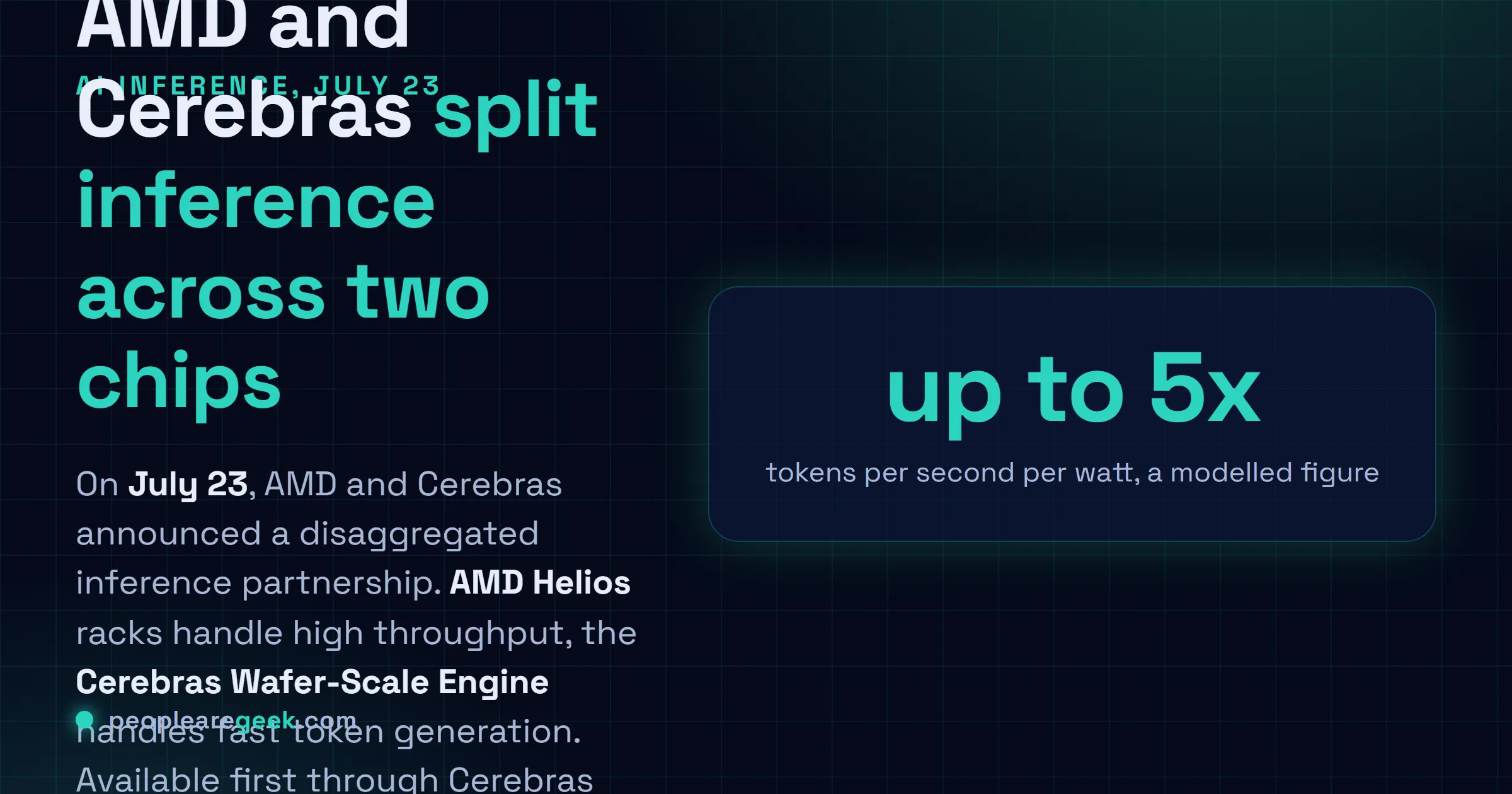
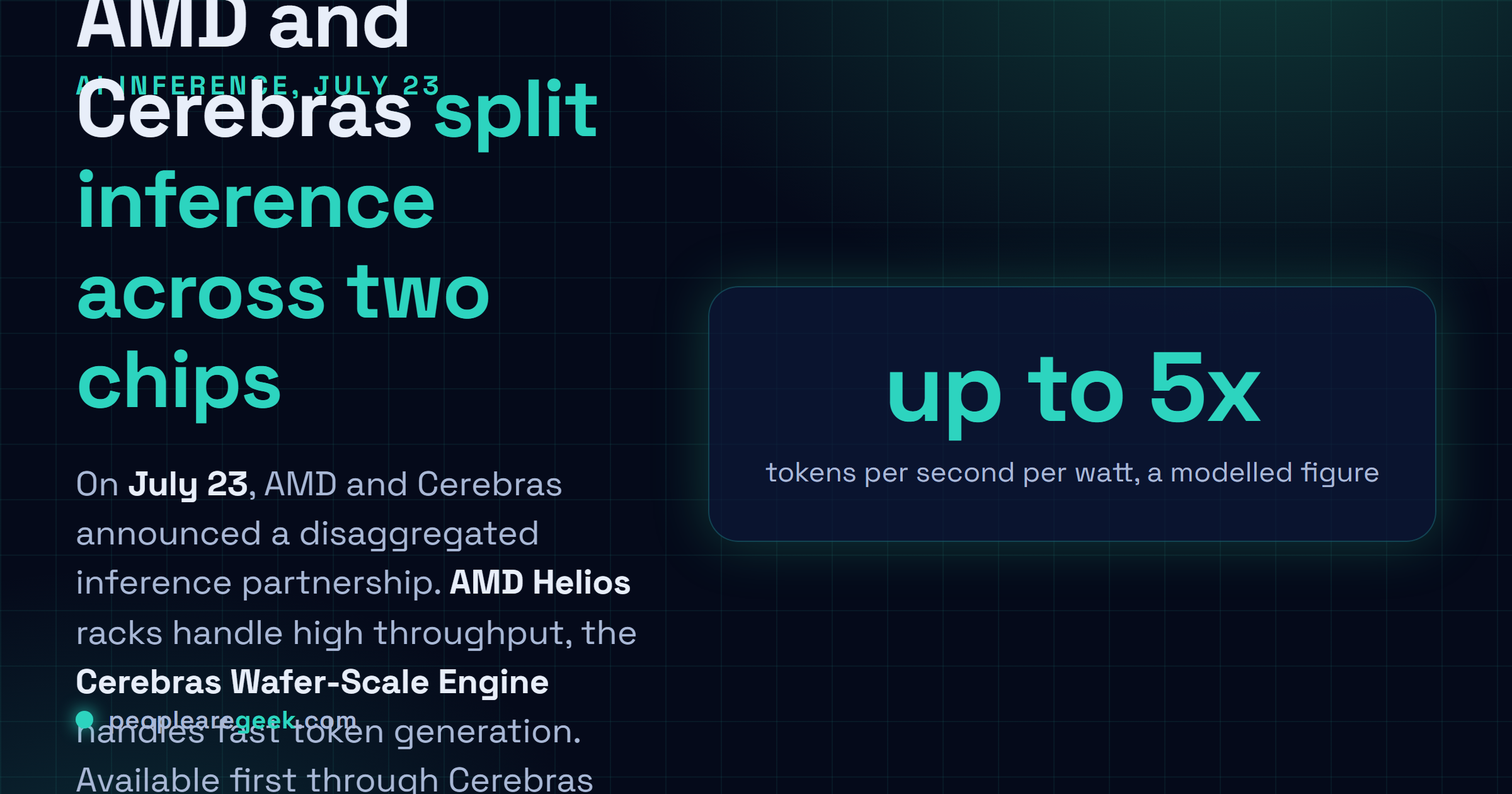
Most AI inference today runs on one kind of chip doing the whole job, and that is starting to look wasteful. On Thursday, July twenty third, AMD and Cerebras announced a partnership built on the opposite idea, split the work of serving a model across two chips, each picked for the part it does best. AMD brings Helios, its rack-scale system of Instinct GPUs and EPYC CPUs, for raw throughput. Cerebras brings the Wafer-Scale Engine, a single chip the size of a dinner plate, for fast token generation. The headline claim is up to five times the tokens per second per watt of a comparable setup. It is a real idea worth understanding, and a number worth reading closely.
What disaggregated inference actually means
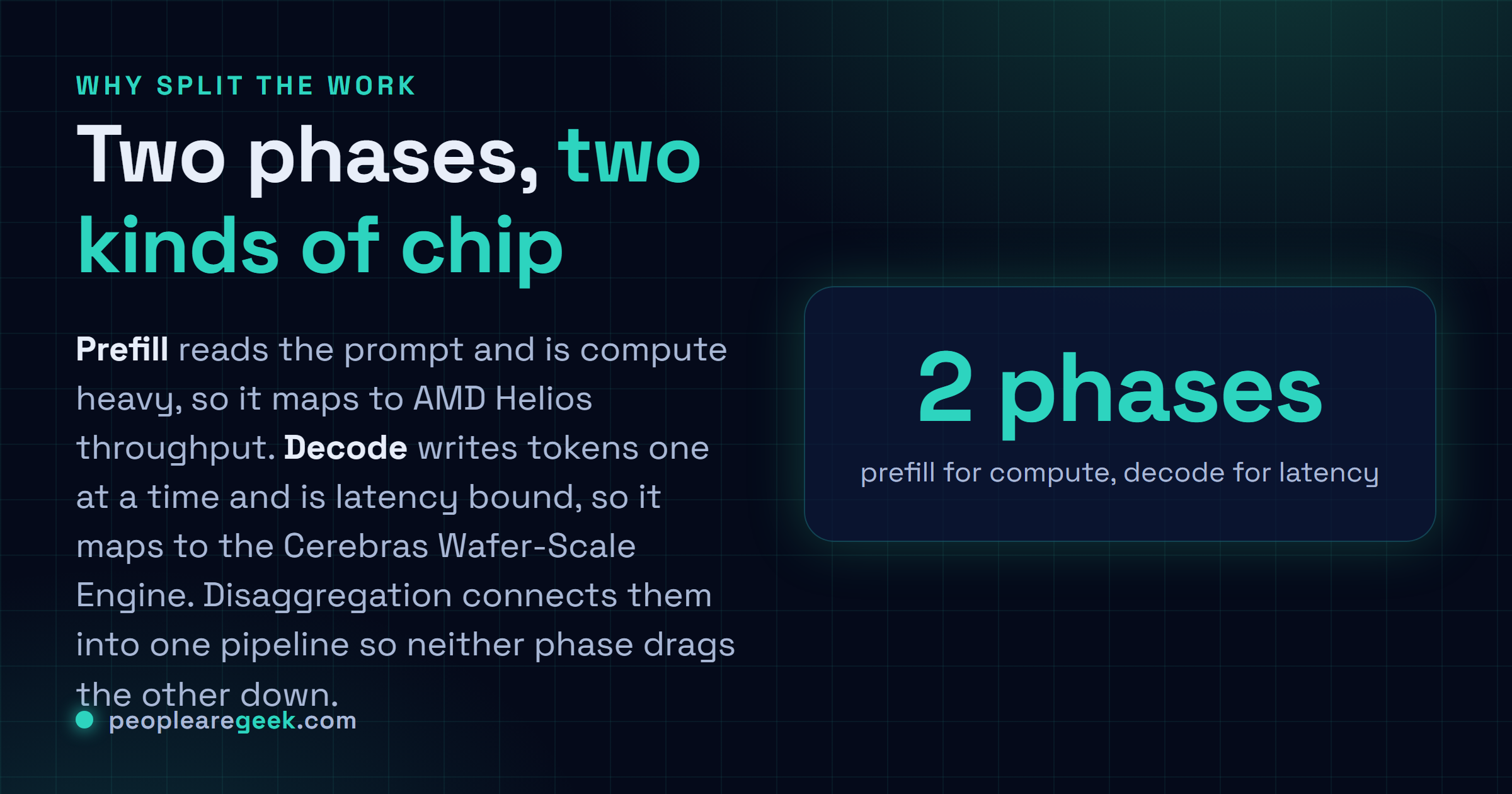
Serving a large language model is not one task, it is two. When you send a prompt, the model first reads it and builds its internal state, a compute heavy phase usually called prefill. Then it writes the reply one token at a time, and that phase leans far more on memory speed and latency than on raw compute. A single chip has to compromise between these two very different jobs.
Disaggregated inference stops compromising. It routes prefill to hardware good at throughput and token generation to hardware good at low latency, and connects them into one pipeline. In this partnership, AMD Helios handles the throughput heavy side, and the Cerebras Wafer-Scale Engine, which keeps an entire model resident in fast on chip memory, handles the token by token generation that users experience as responsiveness. Neither phase has to slow down for the other.
Read the footnote on the five times claim
The five times tokens per watt figure is the kind of number that deserves a second look, and the companies are reasonably upfront about it. It comes from modelling by AMD Performance Labs and Cerebras in July 2026, not from an independent benchmark. They measured tokens per second per kilowatt at a comparable interactivity point on the Kimi 2.6 one trillion parameter model.
The baseline is the detail that changes how you read it. The comparison is a Helios plus Wafer-Scale Engine system against a Wafer-Scale Engine only system. In other words, most of the gain comes from adding AMD throughput to the Cerebras side, which is exactly what the partnership is selling. That does not make the claim dishonest, it makes it a projection under stated assumptions. The right way to hold it is up to five times, modelled, on one model, against one baseline. When the service ships, the numbers to trust are the ones measured under real traffic.

When you can use it
This is not hardware you will buy and rack first. Cerebras plans to deploy AMD Helios in its own data centers, and the combined solution is expected to arrive first through Cerebras Cloud in the second half of 2026. Starting as a hosted service is actually convenient for anyone evaluating it, because you can rent the combined pipeline and measure it on your own workload instead of integrating two very different systems yourself.
Why it matters beyond this one deal
Even if you never touch this exact pairing, the pattern is the point. High end inference is moving away from one chip doing everything and toward pipelines that route each phase to specialized silicon, because that is how you cut cost per token and tame latency at scale. The deal also reinforces AMD as a serious second stack in AI compute, and every credible alternative at the platform layer tends to push serving prices down over time. Keep an eye on the independent benchmarks when Cerebras Cloud turns this on, and treat the launch figure as a claim to verify rather than a result to quote.
Sources and further reading
- AMD investor relations: AMD and Cerebras announce industry leading ultra low latency and high throughput AI inference solution
- GlobeNewswire: AMD and Cerebras announce industry leading AI inference solution
- Tom's Hardware: AMD and Cerebras partner on low latency, high throughput AI inference
- TECHi: AMD and Cerebras split AI inference in two, read the footnote
Frequently asked questions
What did AMD and Cerebras announce?
On Thursday, July twenty third, AMD and Cerebras announced a technical partnership to deliver a disaggregated AI inference solution. It combines AMD Helios rack-scale systems, built on Instinct GPUs and EPYC CPUs, with the Cerebras Wafer-Scale Engine. The two run as a single workflow, with the AMD side supplying high throughput and the Cerebras side supplying very fast token generation. The companies say the combined system can reach up to five times the tokens per second per watt of a comparable configuration. The joint solution is expected to be available first through Cerebras Cloud in the second half of 2026.
What is disaggregated inference?
Serving a large language model has two very different phases. First the model reads your prompt and builds its internal state, a compute heavy step often called prefill. Then it writes the answer one token at a time, a step bound more by memory speed and latency than by raw compute. Disaggregated inference splits these two phases onto separate hardware, each chosen for the phase it does best, instead of forcing one chip to do both. AMD Helios handles the throughput heavy work, and the Cerebras Wafer-Scale Engine handles the fast token generation, so neither phase drags the other down.
Is the five times tokens per watt claim reliable?
Treat it as a vendor projection, not a measured result. AMD and Cerebras say the figure comes from modelling by their own performance teams in July 2026, measuring tokens per second per kilowatt at a comparable interactivity point on the Kimi 2.6 one trillion parameter model. The baseline is the important detail. The comparison is a Helios plus Wafer-Scale Engine setup against a Wafer-Scale Engine only setup, so the gain largely reflects adding AMD throughput to the Cerebras side. It is a reasonable engineering claim, but it is modelled, and the honest reading is up to five times under specific assumptions, not a guaranteed real world number.
When and where will it be available?
Cerebras plans to deploy AMD Helios in its own data centers, and the joint disaggregated solution is expected to be available first through Cerebras Cloud in the second half of 2026. That means the earliest way to use it will be as a hosted service rather than hardware you rack yourself. For teams evaluating inference options, that lowers the barrier to trying it, since you can rent the combined pipeline rather than buy and integrate two very different systems on your own floor.
Why does this matter for infrastructure teams?
It signals where high end inference is heading, away from one chip doing everything and toward pipelines that route each phase to specialized hardware. Even if you never deploy this exact pairing, the pattern is worth understanding, because disaggregation is becoming a standard way to cut cost per token and improve latency at scale. It also strengthens AMD's position as a credible second stack in AI compute, and more competition among inference platforms tends to push serving prices down over time. Track the real benchmarks when the service ships, not just the modelled launch figure.