Empirik came out of Sequoia Capital on September 1, 2026 as an independent company with twenty one million dollars in seed funding, and a pitch aimed squarely at the gap every on call engineer already knows about. Observability tells you a system broke. It does not tell you which of the eleven changes merged that afternoon broke it, and it certainly does not tell you beforehand. Empirik works the other end of the timeline: it tracks changes as they are proposed, models where their effects will land across the estate, then waves through the safe ones and escalates the rest. We looked at what that means in practice.
The short answer
Empirik announced its spin out from Sequoia Capital on September 1, 2026 with a twenty one million dollar seed round from Sequoia, Canapi and Alumni Ventures. The product tracks infrastructure changes and infers their ripple effects across the wider estate, then permits low risk changes, applies guardrails to larger ones and flags dangerous updates for human review. It was incubated inside Sequoia from 2023 by Avon Puri, previously the firm's chief digital and information officer and before that in charge of infrastructure at Rubrik and VMware, with Sudheer Dhurjati. Kartik Chandrayana, previously chief product officer at Quantum Metric and an observability vice president at Salesforce, became chief executive in early 2026. Named customers include S&P Global and Guardant Health.
Ask anyone who has run a postmortem what the first useful question was, and it is almost never "what alerted". It is "what changed". The alert tells you the checkout service is returning errors. The change log tells you that somebody bumped a shared library, or widened a security group, or resized a node pool forty minutes earlier. Getting from the first fact to the second is most of the time spent in an incident, and every team does it by hand.
Empirik, which spun out of Sequoia Capital on September 1, 2026 with twenty one million dollars in seed funding from Sequoia, Canapi and Alumni Ventures, is built on the argument that the second fact should have been available before the first one existed.
Reading the change stream instead of the telemetry stream
The product tracks changes made to infrastructure and infers their potential ripple effects across the estate. That sentence is doing a lot of work, so it is worth unpacking what it implies. To predict where a change lands you need a model of what depends on what, kept current, spanning whatever mixture of cloud accounts, clusters, network policy and configuration management the organisation has accumulated. Building that model is the hard part, and it is the part nobody's architecture diagram contains accurately.
Given the model, the acting is comparatively simple, and the company describes three outcomes. Low risk changes are permitted. Larger ones get guardrails. Dangerous updates are flagged for human review. Anyone who has sat on a change advisory board will recognise that as the same triage a CAB performs, minus the weekly meeting and the spreadsheet.
Chief executive Kartik Chandrayana frames it as doing for infrastructure engineering what agentic tools did for software development, drawing an explicit comparison to the coding agents developers now use daily. That analogy sets a high bar, and it also sets a fair test: coding agents earned their place by being right often enough that reviewing their output cost less than doing the work, and a change gate earns its place the same way.
Why the founders' backgrounds are the interesting part
Empirik was incubated inside Sequoia from 2023, which is an unusual origin for an infrastructure product and a revealing one. Avon Puri was the firm's chief digital and information officer and, before that, ran infrastructure at Rubrik and at VMware. Sudheer Dhurjati is another Sequoia IT leader. This is a tool built by the people who were carrying the pager, inside an organisation whose own estate was the first test case.
Kartik Chandrayana joined as chief executive in early 2026 from Quantum Metric, where he was chief product officer, and previously ran observability as a vice president at Salesforce. That combination, operators who felt the problem plus a product leader who has shipped observability at scale, is a reasonable answer to the obvious objection: that predicting failures from change data is a research problem dressed up as a product.
The named launch customers are S&P Global and Guardant Health, alongside an unnamed large consumer packaged goods company and a number of startups. Three very different change cadences and three different regulatory postures is a healthier early customer list than three companies that look alike.
The two questions that decide whether this works
Calibration. A change gate lives or dies on its false positive rate. Escalate too much and engineers learn to click past it, at which point it is a compliance artefact rather than a control. Escalate too little and it is actively worse than no gate, because it has consumed the attention that a human review would have received. No launch announcement can answer this, and the only honest way to find out is to run it in advisory mode over changes you have already shipped and compare its verdicts against what actually happened. If it would have flagged your last three incidents and stayed quiet through the two hundred uneventful deploys around them, that is a real signal.
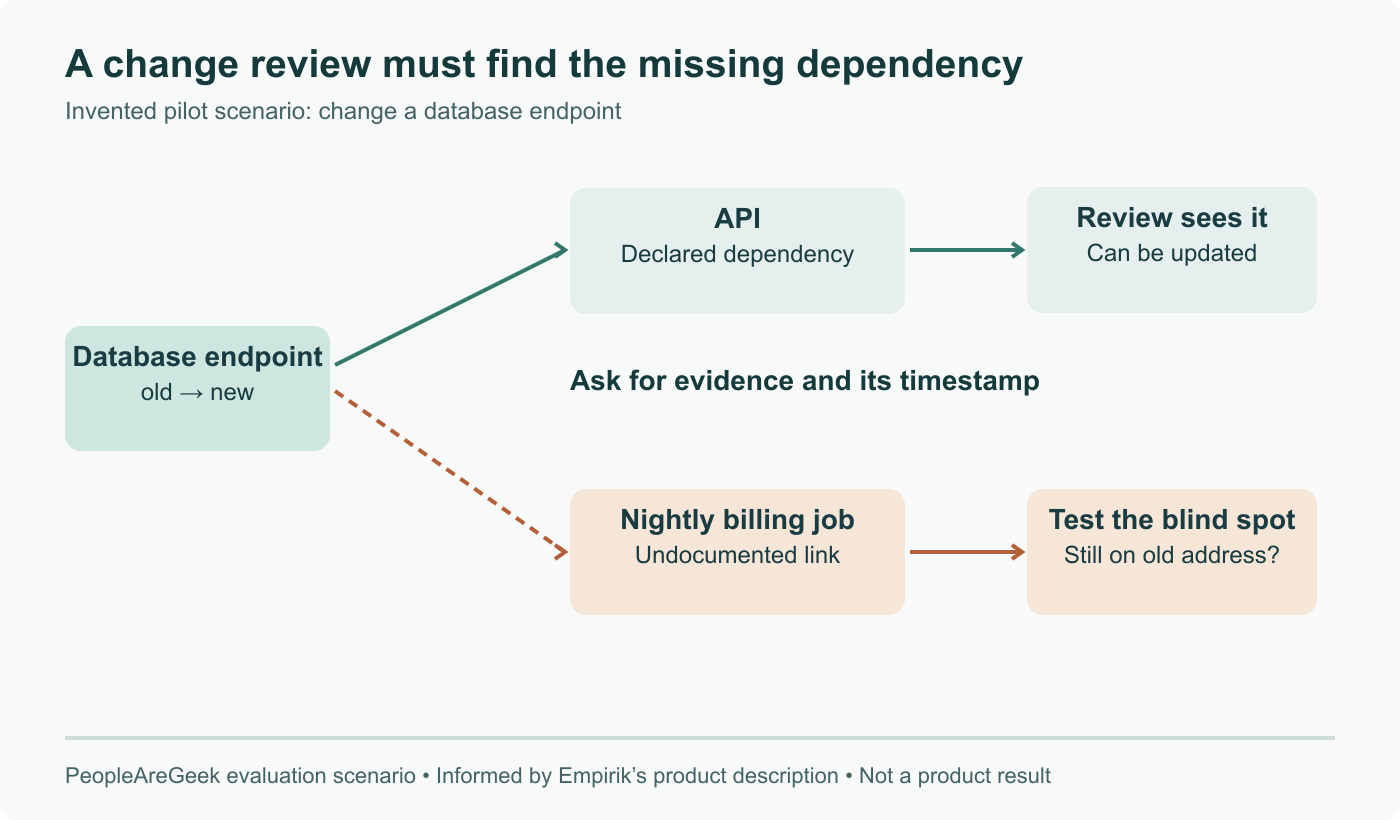
The dependency model. Every environment contains couplings that exist in nobody's diagram: the batch job that quietly depends on a DNS record, the service whose retry budget masks a slow dependency until the day it does not, the shared connection pool that two teams each believe they own. Those are exactly the couplings that produce surprising outages, and they are exactly the ones a model built from declared configuration will miss. How much of that a tool can infer from observed behaviour rather than declared intent is the technical question underneath the funding round.
None of this is hypothetical scepticism. Public incident write ups keep landing in the same place: a change that looked local turned out not to be. GitHub's August 17 outage traced back to a sidecar behaviour that nothing in the change itself flagged as risky, and that is the shape of failure a change gate is claiming to catch. Whether one can, at a false positive rate engineers will tolerate, is the thing to watch over the next year rather than the thing to conclude today.
Sources and further reading
- Sequoia-incubated Empirik launches with $21M to predict outages before they happen, TechCrunch, September 1, 2026
- Empirik raises $21M seed and spins out from Sequoia Capital, Techmeme, September 1, 2026
- Sequoia Spinout Empirik Raises $21M to Stop IT Outages Before First Alert Fires, Tech Times, September 1, 2026
Frequently asked questions
What does Empirik actually do?
It sits on the change side of the incident timeline rather than the alert side. The product tracks changes made to infrastructure, infers what those changes will ripple into across the rest of the estate, and then acts on that judgement: it lets low risk changes through, applies guardrails to larger ones, and flags dangerous updates for a human to look at. The framing the company uses is an autonomous infrastructure engineer for DevOps and site reliability teams, positioned the way coding agents are positioned for developers. In practical terms it is change intelligence with an opinion, not another dashboard.
Who is behind it and where did the money come from?
The seed round is twenty one million dollars from Sequoia Capital, Canapi and Alumni Ventures. Sequoia incubated the company internally in 2023 and it spun out as an independent business on September 1, 2026. The co-founders are Avon Puri, formerly chief digital and information officer at Sequoia and before that responsible for infrastructure at Rubrik and VMware, and Sudheer Dhurjati, another Sequoia IT leader. Kartik Chandrayana joined as chief executive in early 2026, coming from chief product officer at Quantum Metric and before that a vice president role in observability at Salesforce.
How is this different from the observability tools I already pay for?
Observability is fundamentally retrospective. It instruments a running system and reports what it is doing, which is invaluable during an incident and largely silent before one. The interesting claim here is a different input: instead of reading telemetry from production, read the stream of proposed changes and reason about their blast radius against a model of how the estate is wired together. Those are complementary rather than competing, and most teams already do a weak version of this by hand in change review. The question is whether an automated version is accurate enough that people stop overriding it.
Who is using it?
The named customers at launch are S&P Global and Guardant Health, plus an unnamed large consumer packaged goods company and a set of startups. That spread is worth reading: a financial data business, a clinical diagnostics business and a manufacturer are three very different change cadences and three very different regulatory postures, which suggests the product is being tested against more than one shape of estate rather than one friendly design partner.
What would make me trust a system like this in production?
Two things, and neither is in a launch announcement. The first is calibration: how often does it flag a change that turns out to be harmless, and how often does it wave through one that breaks something. A tool that escalates too much gets clicked past, and a tool that escalates too little is worse than nothing. The second is the model of your estate. Predicting ripple effects requires knowing what depends on what, and every real environment contains dependencies that exist in nobody's diagram. The honest way to evaluate this is to run it in advisory mode against changes you already shipped and compare its calls to what actually happened.