Anthropic updated Claude voice mode on Thursday, July twenty third, and the headline is simple, you can now talk to Opus and Sonnet, not only the lightweight Haiku model that has run voice since it launched in twenty twenty five. Voice mode starts with whatever model you last used in text chat and runs its fastest version by default, and a picker lets you switch mid conversation. The update also connects voice to Gmail, Google Calendar, Slack, Canva, and Notion, so you can reschedule a meeting or draft an email by speaking. It is rolling out in beta to everyone across the mobile, desktop, and web apps, and here is what actually changed and how to use it.
The short answer
Anthropic updated Claude voice mode on July twenty third so you can pick Opus, Sonnet, or Haiku instead of only the lightweight Haiku model. Voice starts from the last model you used in text chat and runs its fastest version, with a picker to switch mid conversation. It also connects to Gmail, Google Calendar, Slack, Canva, and Notion, so you can reschedule a meeting or draft an email by voice. The rollout is a beta for everyone across mobile, desktop, and web, with the full model choice reserved for paid plans.
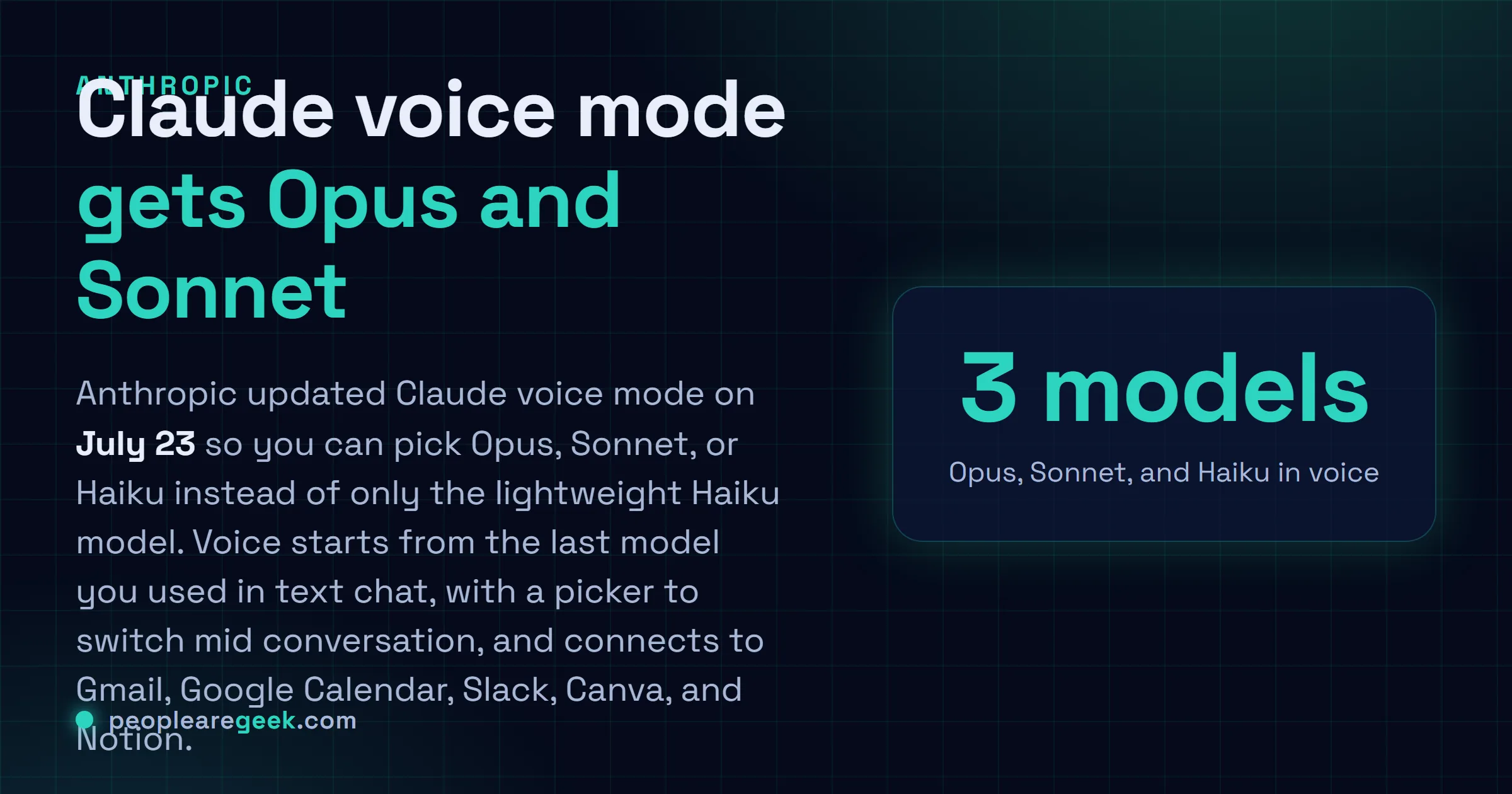
Talking to an assistant is only useful if the model behind the voice can actually keep up. Until this week, Claude voice mode ran on Haiku, the fast and light model, which is fine for a quick question and thin for anything that needs reasoning. On Thursday, July twenty third, Anthropic changed that, letting voice mode reach Opus and Sonnet too. For anyone who wanted to think out loud with the stronger models rather than type, that is the update.
What changed
The core change is model choice. Voice mode now runs Opus, Sonnet, or Haiku, where before it only ran Haiku. It picks a sensible starting point on its own, it begins with whatever model you last used in text chat and runs that model's fastest version by default. From there, a model picker lets you switch mid conversation, so you can drop to Haiku for speed or move up to Opus for a harder problem without ending the call.
The second change is reach. Voice now connects to Gmail, Google Calendar, Slack, Canva, and Notion, the same integrations Claude offers in text. Anthropic points to tasks like rescheduling a meeting or drafting an email by speaking. That turns voice from a question box into something that can take an action in a tool you already run.
The tiers, and what they mean for you
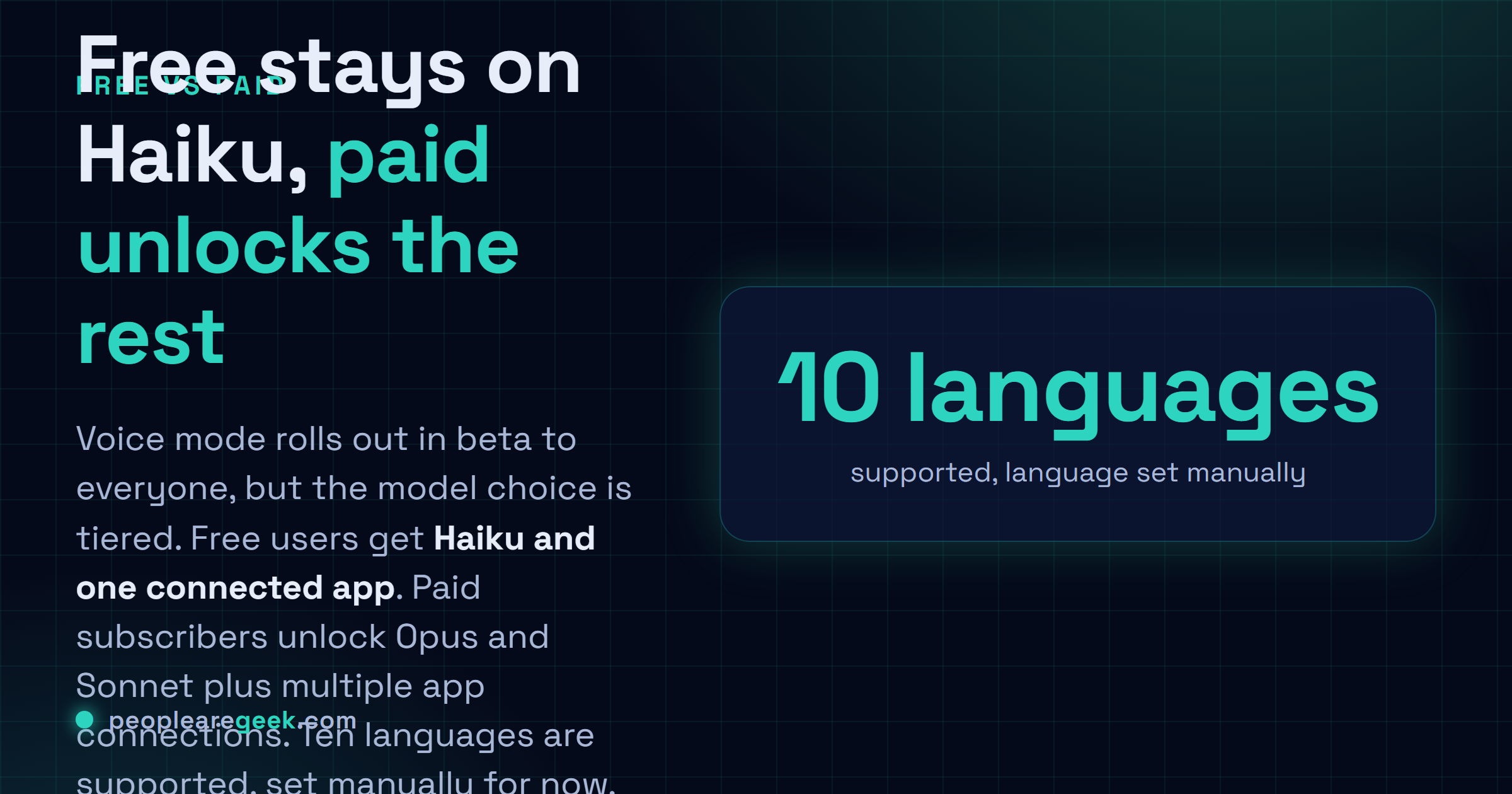
The rollout is a beta open to all users, but the good parts sit behind a paid plan. Free users get Haiku and one connected app. Paid subscribers get the full model choice, Sonnet and Opus included, plus multiple app connections. So if you are on a free plan, voice still works, you are simply limited to the light model and a single integration. To brainstorm with Opus by voice or wire up Gmail and Slack at the same time, you need a paid plan.
Language support lands at ten, English, French, German, Hindi, Indonesian, Italian, Japanese, Korean, Portuguese, and Spanish. One detail to plan around, you set the language manually for now rather than having voice detect it. If you switch between languages during the day, that manual toggle is the small friction to remember.

What did not change
It is worth being precise about the parts Anthropic left alone. The company said it made no changes to the underlying voice model and has not named its voice technology provider. So speech recognition and the synthesized voice you hear are the same as before. The upgrade is which language model is doing the thinking, and what that model can reach through connected apps. That distinction matters if you were hoping for a more natural sounding voice, because that is not what shipped, the intelligence behind the voice is.
How to get value from it this week
Start by checking which model voice defaults to, since it inherits your last text chat choice. If you want reasoning, open a text chat with Opus or Sonnet first, then switch to voice and it will carry that model in. Use the picker deliberately, Haiku when you want fast back and forth, Opus when you are working through something that needs care. Then connect one app you touch constantly, a calendar or your inbox, and try a real task by voice, rescheduling a meeting or drafting a reply. That is the fastest way to learn where speaking beats typing and where it does not.
Sources and further reading
- TechCrunch: Anthropic updates Claude voice mode with more capable models
- 9to5Mac: Anthropic upgrades Claude voice mode with more powerful models
- Unite.AI: Anthropic brings Opus and Sonnet to Claude voice mode
- Anthropic newsroom
Frequently asked questions
Which models can Claude voice mode use now?
As of July twenty third, voice mode can run Opus, Sonnet, or Haiku. Before this update it only used Haiku, the fastest and lightest of the three, which is what has powered voice since the feature launched in twenty twenty five. Now voice starts with whatever model you last selected in text chat and uses that model's fastest configuration by default, and a model picker lets you change models in the middle of a spoken conversation without leaving voice mode.
What can Claude do with connected apps by voice?
The update lets voice mode act across Gmail, Google Calendar, Slack, Canva, and Notion. Anthropic gives examples such as rescheduling a meeting or drafting an email by speaking, which means voice is no longer only a way to ask questions, it can take actions in the tools you already use. The connections are the same app integrations available in text chat, now reachable while you talk rather than type.
Is the new voice mode free?
It is rolling out in beta to all users, but with tiers. Free users get the Haiku model and a single connected app. Paid subscribers unlock the full model choice, so Sonnet and Opus, along with multiple app connections. If you are on a free plan and want to try Opus by voice or connect more than one app, you will need a paid plan. The rollout covers the mobile, desktop, and web apps.
Which languages does voice mode support?
Anthropic lists ten languages, English, French, German, Hindi, Indonesian, Italian, Japanese, Korean, Portuguese, and Spanish. One caveat worth knowing, you currently have to set your language manually rather than have voice detect it. If you work across languages, that manual switch is a small friction to plan around until automatic detection arrives.
Did Anthropic change the underlying voice technology?
No. Anthropic said it made no changes to the underlying voice model and has not disclosed its voice technology provider. What changed is which language models sit behind the conversation and what those models can reach, not how speech is recognized or synthesized. So the voice you hear is the same, the reasoning and the actions behind it are what got the upgrade.