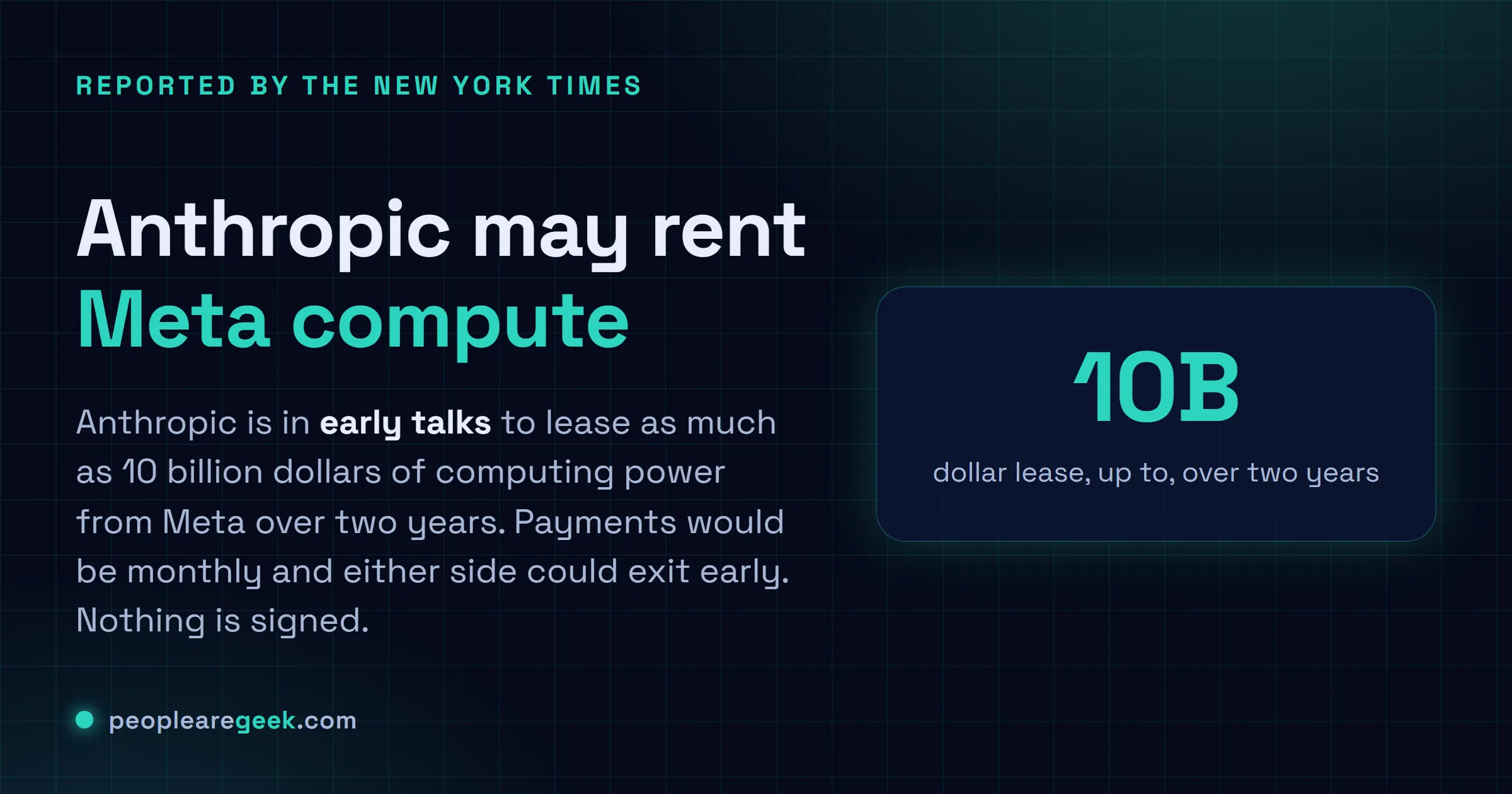
Anthropic is in early talks to lease computing power from Meta in a deal that could be worth as much as 10 billion dollars over two years, according to a New York Times report dated July 17, 2026. The talks are preliminary and the terms could still change, but the shape of the deal is telling: Anthropic would pay Meta in monthly increments, either side could exit early, and Meta would earn infrastructure revenue that has nothing to do with advertising. Days earlier, Meta had recruited a senior Amazon Web Services executive to help build what it calls Meta Compute. Put together, the two moves say the same thing: the company behind Facebook and Instagram wants to rent out its data centers, and one of the largest AI labs may become an early tenant.
The short answer
Anthropic is in early talks to lease as much as 10 billion dollars of computing power from Meta over two years, according to a New York Times report on July 17, 2026. Payments would come monthly and either side could walk away early. The move fits a bigger Meta plan called Meta Compute, a push to rent its data center capacity to outside customers and earn money that does not depend on ads. For anyone tracking where frontier models actually run, the list of possible landlords just got longer.
Compute has quietly become the hardest thing to buy in the AI business. Not talent, not data, not model ideas: raw capacity, the kind that comes as tens of thousands of accelerators wired together in a building with enough power and cooling to run them. That scarcity is why a report about two rivals maybe doing business together is worth reading closely. Meta and Anthropic are not natural partners, yet the shortage of capacity is pushing them toward each other.
What the report actually says
According to the New York Times, Anthropic is in early talks to lease computing power from Meta in a deal that could reach 10 billion dollars over two years. The key word is early. Nothing is signed, the terms could change, and both sides would keep the ability to exit any agreement before it runs its course. Anthropic would pay Meta in monthly increments rather than one large sum, which spreads the commitment and keeps the arrangement flexible on both ends.
Treat the number as a ceiling on a work in progress, not a done deal. Preliminary talks between companies this size fall through often, and the reported figure describes what the deal could be worth if it goes ahead at full scale, not a signed contract. Neither company has confirmed final terms.
Why Meta wants to be a landlord
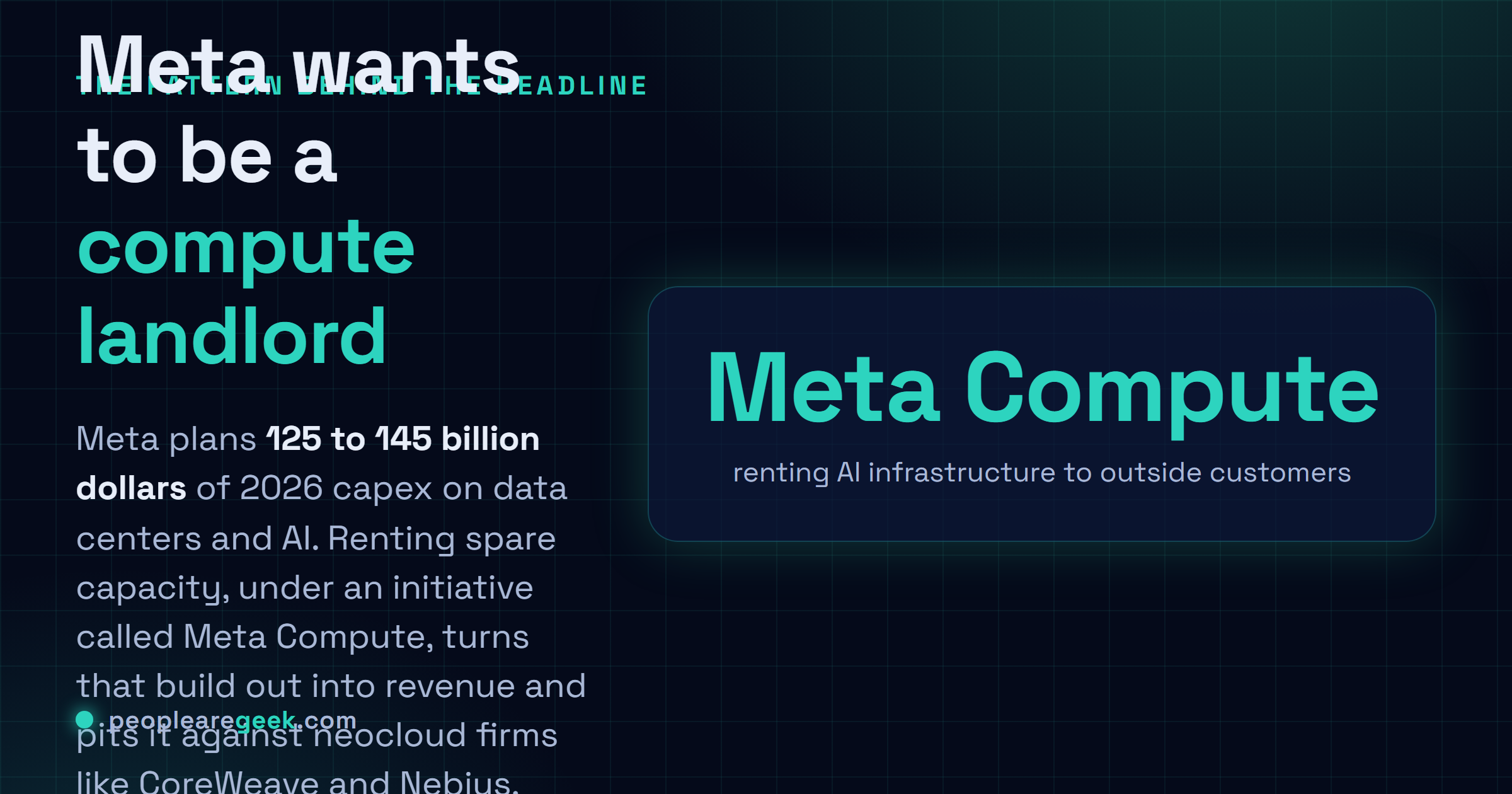
The more interesting part is not that Anthropic needs compute, which everyone knew, but that Meta is offering to sell it. Meta expects to spend between 125 and 145 billion dollars in capital expenditure during 2026, and much of that goes into data centers, networking equipment, and the accelerators inside them. That is an enormous fixed cost built primarily to serve Meta own products.
Renting the spare capacity changes the math. It turns a cost center into a revenue line, one that does not rise and fall with the advertising market that still funds most of the company. It also drops Meta into direct competition with the neocloud providers, the specialist firms such as CoreWeave and Nebius that exist to rent high end AI capacity by the hour. Meta is gathering this ambition under a name, Meta Compute, and the Anthropic talks would be one of its first marquee customers.

The AWS hire that fits the pattern
The compute talks did not appear in isolation. In mid July, Meta recruited Dave Brown, a senior Amazon Web Services executive with close to nineteen years at the cloud division, who is leaving Amazon at the end of July to join Meta infrastructure team under Santosh Janardhan. His reported mandate is to scale data centers and help stand up Meta Compute, the potential cloud service that would rent AI infrastructure to outside customers.
Hiring one of the most experienced infrastructure operators in the cloud business is not what you do to run your own servers a little better. It is what you do when you intend to sell infrastructure as a product, with the reliability, billing, and customer commitments that implies. The Brown hire and the Anthropic talks are two readings of the same intention.
What this means if you run infrastructure
You are not going to provision a Meta Compute region tomorrow, but the direction of travel is worth tracking.
- The supply of high end capacity is widening. For years the credible places to rent large scale AI compute were a short list of hyperscalers plus a few neoclouds. A company with Meta balance sheet entering the market adds real supply, which over time tends to help availability and pricing for everyone renting.
- Multi provider is becoming the default. Anthropic already spreads workloads across several suppliers, and a Meta lease would be one more line in that mix rather than a single dependence. The lesson for smaller teams is the same at smaller scale: assume you will run across more than one provider, and design for portability early.
- Watch the terms, not just the headline. Monthly payments and early exit clauses are the interesting details here. In a market where capacity is scarce and prices move, flexible commitments matter as much as the sticker number. When you sign for compute, the exit and scaling terms are worth as much scrutiny as the rate.
None of this is settled. The talks are early and could end quietly. But the story is a clear marker of where the industry sits in the summer of 2026: capacity is the bottleneck, the labs need more of it than any one supplier can give, and companies sitting on huge data center estates increasingly see renting them out as a business worth building.
Sources and further reading
- Reuters via Yahoo Finance: Meta and Anthropic in talks for potential 10 billion dollar compute lease deal
- Bloomberg: Meta in talks to sell computing power to Anthropic, NYT reports
- CNN Business: Meta in talks to rent some of its AI infrastructure to Anthropic
- GeekWire: Departing AWS exec Dave Brown is reportedly joining Meta as parent mulls its own cloud
- Data Center Dynamics: AWS cloud lead Dave Brown heads to Meta, report
Frequently asked questions
What exactly is being reported about Anthropic and Meta?
According to a New York Times report on July 17, 2026, Anthropic and Meta are in early talks over a deal in which Anthropic would lease computing power from Meta. The reported value is up to 10 billion dollars over two years, paid in monthly increments. The discussions are preliminary, the terms could change, and both companies would be able to exit any agreement early. Neither company has confirmed final terms.
Why would Meta rent out its own compute?
Meta expects to spend between 125 and 145 billion dollars in capital expenditure during 2026, much of it on data centers, networking gear, and AI accelerators. Renting spare capacity turns that build out into a revenue line that does not depend on advertising, and it puts Meta in direct competition with neocloud providers such as CoreWeave and Nebius. The company is organizing this ambition under an initiative it calls Meta Compute.
How does this compare to Anthropic other compute deals?
The reported Meta deal would be smaller than the arrangement Anthropic reached with SpaceX in May 2026, under which Anthropic is set to pay roughly 45 billion dollars over three years for computing resources. Anthropic already spreads its workloads across multiple providers, so a Meta lease would be another line in a diversified compute supply rather than a single bet.
What does this signal for the wider cloud market?
It signals that the largest AI labs need more capacity than any single provider can comfortably supply, and that companies with big data center footprints see compute leasing as a serious business. If a firm like Meta becomes a landlord for AI infrastructure, the supply of high end capacity widens beyond the traditional cloud giants, which matters for pricing, availability, and where frontier models actually run.