The GNU Compiler Collection released GCC 16.2 on August 7, carrying 102 known bug fixes over GCC 16.1 and, deliberately, nothing else. The upstream description is regression fixes and documentation only, which is the least exciting sentence the project can write and also the most useful one. GCC 16 arrived at the end of April with a new Algol 68 front end, C++20 on by default and AMD Zen 6 support, and the interesting question for anyone shipping software has never been what the .1 release could do. It is when the .1 release stops surprising you. That is what a .2 is for.
The short answer
GCC 16.2 was released on August 7 as the second release in the GCC 16 series. Upstream describes it as regression fixes and documentation only, and the release carries 102 known bug fixes over 16.1 with no single change standing out. Nothing in the language front ends, the supported targets or the optimiser behaviour changes. It is a drop in replacement for GCC 16.1 and it is now the version of the series worth building with.
There is a particular kind of software release that gets no coverage because there is nothing to say about it, and those are usually the releases you want on your build machines. GCC 16.2 is one of them. It shipped on August 7, it fixes 102 known bugs, and it does not do anything else on purpose.
What is in it, and why the emptiness is the point
The GCC project's own status line for the 16.2 release is regression fixes and documentation only. That phrase is a policy rather than a summary. Once a GCC series branches, the rule for what may land on that branch tightens progressively, and by the second release the bar is narrow: something that used to work and now does not, or a documentation correction. New features go to the development branch and arrive in the next major series.
The count is 102 known bug fixes over GCC 16.1, spread widely enough that no individual change stands out. That flatness is worth reading carefully rather than skipping. A point release dominated by one dramatic fix usually means one dramatic bug, and that is a worse situation than a hundred small ones. A long tail of unrelated fixes is what a healthy stable branch produces: many people used the compiler on real code, each of them found something different, and each got repaired without disturbing anything else.
It also tells you what a .2 release cannot give you. GCC uses regression in a specific sense, meaning behaviour that worked in an earlier release and broke. An internal compiler error on code that used to compile qualifies. Wrong code generation where an older GCC was correct qualifies and is the most serious category the project tracks. A conformance gap that has been there for five years does not qualify, and neither does a missed optimisation that was never performed. If you are waiting on either of those, you are waiting for GCC 17, and that is the stable branch working as designed rather than failing you.
The series this is stabilising
GCC 16 opened on April 30 with a genuinely varied feature set, which is the context that makes a quiet .2 valuable.
An Algol 68 front end landed, which is delightful and almost certainly irrelevant to your work, though it does demonstrate that GCC's front end interface still absorbs entire languages decades on. Experimental HTML output for diagnostics arrived, rendering compiler errors as a browsable page instead of terminal text, which is aimed squarely at C++ template errors and the kind of deeply nested instantiation trace that scrolls past a screen buffer. AMD Zen 6 support went in on the target side, along with OpenMP improvements.
The change most likely to affect an existing codebase is quieter than any of those: C++20 became the default dialect. Default changes are the ones that reach people who were not paying attention, because they arrive during a routine upgrade rather than when someone opts in. Code that compiled under the previous default can meet new keywords, changed overload resolution or stricter rules it never had to satisfy before. Anyone who hit that in 16.1 and pinned -std= to move on is exactly who benefits from three months of other people's bug reports being fixed.
Cadence, and what to do about it
The 2026 release list shows the model clearly. GCC 16.1 opened the newest series on April 30. GCC 15.3 followed on June 12, GCC 14.4 on June 26, and GCC 16.2 now in August. Three branches received updates within ten weeks of each other.
That parallelism is the reason a distribution can ship GCC 14 as its system compiler in 2026 without being stranded. The branch is old but it is not dead, and fixes keep flowing to it. For comparison, GCC 15.2 shipped on August 8 last year, one day off the same calendar slot, so the summer point release is a settled rhythm rather than an accident.
For practical purposes, the decision splits three ways depending on how you get your compiler.
If you run a rolling distribution, do nothing. GCC 16.2 will arrive on its own within days or weeks, and since it is a drop in replacement for 16.1 there is no migration to plan.
If you run a fixed release distribution, your system compiler is not moving and should not. The entire package archive was built with it, and swapping it mid cycle means rebuilding everything rather than upgrading one package. Most such distributions ship newer GCC as a parallel toolchain package if you need it, and that is the path to take rather than fighting the system one.
If you build your own toolchain, this is the version of the series to build. The only reasons to compile it yourself are needing a specific fix immediately, targeting hardware newer than your distribution's compiler recognises, or testing your project against a newer series early. All three are legitimate, and none of them is free, since a self built toolchain is a thing you now maintain.
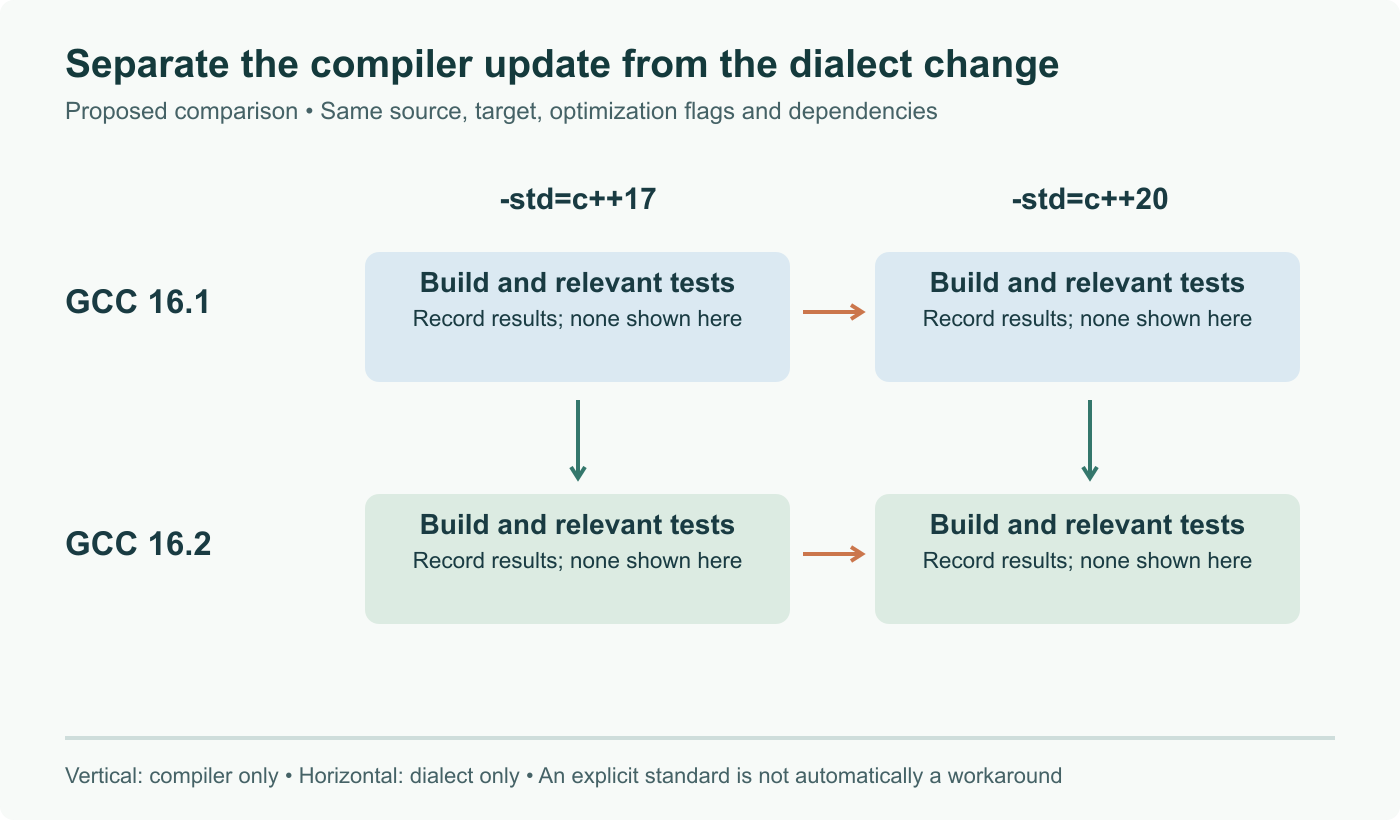
The one action worth taking regardless is checking whether anything you pinned back in May, a -std= flag or a disabled warning added to get past a C++20 default change, can now come out. Three months of regression fixes is the moment those workarounds are most likely to have expired, and workarounds nobody revisits are how a codebase quietly accumulates settings that no longer have a reason.
Sources and further reading
- GCC 16.2 released, GNU Compiler Collection, August 7, 2026
- GCC 16.2 released with more than 100 fixes, Phoronix, August 7, 2026
- GCC 16 release series changes, new features and fixes
- GCC development plan and release branch policy
- GCC bug reporting and the regression classification
Frequently asked questions
Do I need to upgrade if GCC 16.1 works for me?
Not urgently, but the cost is close to zero and the direction is one way. A GCC point release contains only regression fixes and documentation, so there are no new warnings to silence, no optimisation behaviour changes to revalidate and no language feature that suddenly becomes available and tempts someone into using it. That is the whole design of the release: it is meant to be a drop in replacement for the version before it. The practical case for moving is that the 102 fixes are overwhelmingly things that were reported by people who hit them, which means each one is a bug someone actually stepped on rather than a theoretical defect. If your build works today, one of those fixes is a bug you have not hit yet. Upgrade when your normal toolchain refresh comes round, and do not treat it as an event.
What actually counts as a regression fix?
In GCC's terminology a regression is something that worked in an earlier release and stopped working, which is a narrower category than a bug. An internal compiler error on code that previously compiled is a regression. Wrong code generation where an older GCC produced correct output is a regression, and it is the most serious class the project tracks. A missed optimisation that was never performed in the first place is not, nor is a longstanding standards conformance gap. The distinction matters because it tells you what a .2 release cannot do for you. If you filed a bug about GCC rejecting valid code that GCC 15 also rejected, that fix goes into the next major release rather than into 16.2, because the stable branch policy exists to make the branch boring rather than to make it complete.
What was in GCC 16 in the first place?
The GCC 16 series opened on April 30 with a substantial feature set. The headline additions were an Algol 68 front end, which is unusual and mostly interesting as a demonstration that the front end interface still absorbs new languages, and experimental HTML output for diagnostics, which renders compiler errors as a browsable page rather than a wall of terminal text. On the target side GCC 16 brought support for AMD Zen 6. For C++ developers the notable change was C++20 becoming the default dialect, which is the change most likely to matter to an existing codebase, because it moves without anyone asking. GCC 16.2 does not touch any of this. It makes the same features less likely to break.
How does this fit GCC release cadence, and what comes next?
GCC runs on a yearly major cadence with point releases through the year, and multiple release branches stay alive at once. The pattern is visible in 2026 alone: GCC 16.1 opened the series on April 30, GCC 15.3 followed on June 12 and GCC 14.4 on June 26, and now GCC 16.2 in August. Older branches keep receiving fixes long after the newest branch exists, which is what makes it reasonable for a distribution to sit on GCC 14 for a stable release without being abandoned. For comparison, GCC 15.2 shipped on August 8 last year, so the mid summer point release is a fairly settled rhythm rather than a coincidence. Expect further 16.x releases before GCC 17 opens next spring.
Will my distribution pick this up, or should I build it myself?
It depends on the distribution's model, and for most people waiting is correct. A rolling distribution will pick up 16.2 within days to weeks. A fixed release distribution will not move its system compiler at all during a release cycle, because the system compiler is what the entire package archive was built with, and changing it mid cycle is not a compiler upgrade so much as a rebuild of everything. Those distributions typically offer newer GCC alongside the default through a parallel toolchain package. Building GCC yourself is worth doing when you need a specific fix now, when you are targeting hardware newer than your distribution's compiler knows about, or when you want to test your project against the next series early. Otherwise the maintenance is not free and the benefit is small.