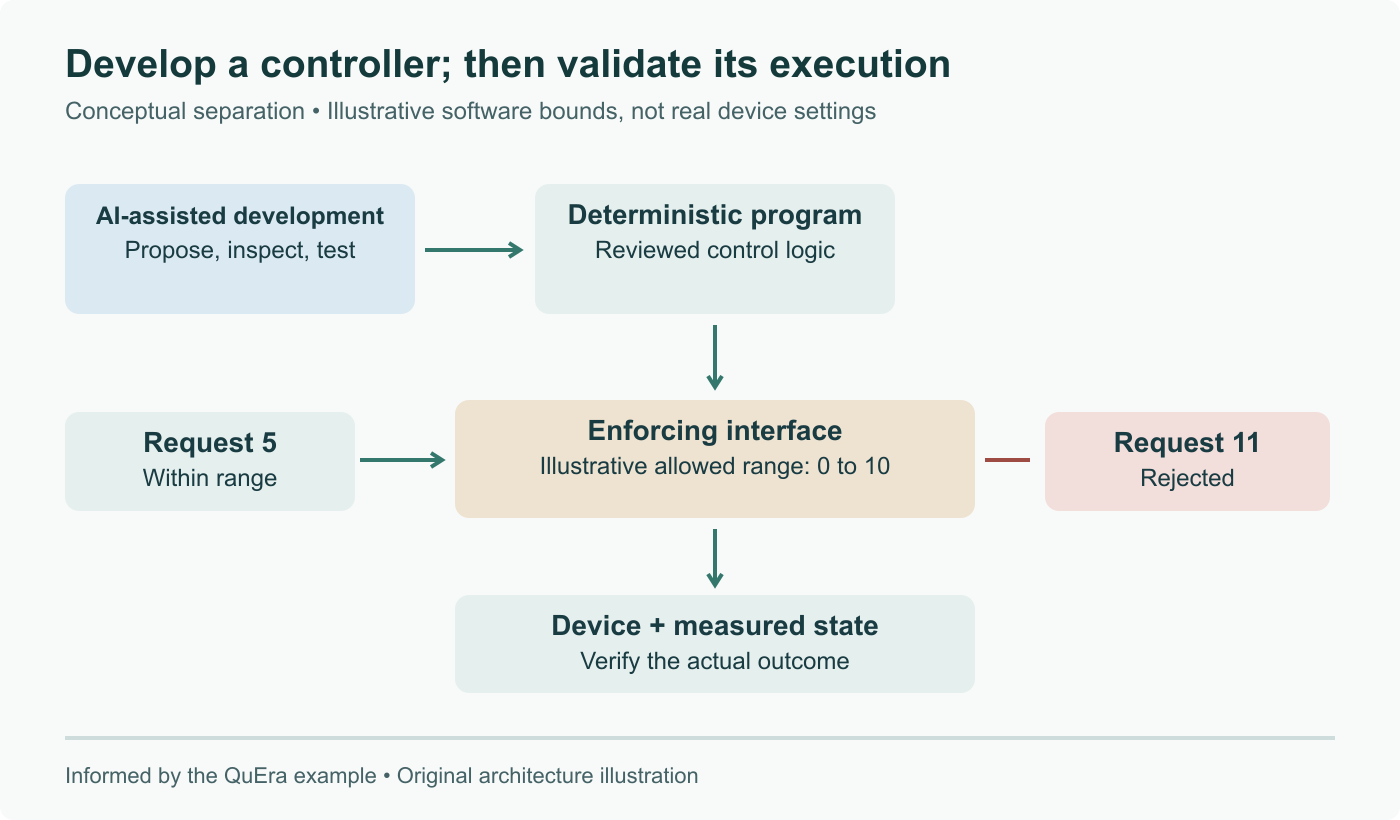
Anthropic opened a research preview of the Model Hardware Standard on Thursday August 27, 2026, a specification that lets an AI agent drive real laboratory and factory equipment. The interesting part is not the demo footage. It is the shape of the thing: a standardised driver layer that speaks primitive read and write commands, devices that announce themselves and their limits instead of needing a bespoke translator, and safety bounds enforced in the driver rather than in the model. Partners include Genentech, QuEra Computing, Carnegie Mellon and HHMI Janelia, and the numbers they report are concrete. Integration work that took weeks now takes hours. Anthropic says it plans to open source the specification, without giving a date.
The short answer
Anthropic published a research preview of the Model Hardware Standard on Thursday August 27, 2026. It is a specification for describing, discovering and safely commanding physical devices so that an AI agent can operate them. The stack is a standardised driver layer with read and write primitives, devices that broadcast themselves and their limits, natural language metadata an agent can parse, and three orchestration paths including the Model Context Protocol. Access is application based and limited to selected labs and manufacturers. Anthropic says it intends to open source the specification later, with no date attached.
Every lab that has tried to automate anything knows the same joke. The robot arm speaks one dialect, the plate reader speaks another, the thermocycler speaks something a vendor invented in 2011, and the glue between them is a Python script written by a postdoc who graduated two years ago. Anthropic's new specification is an attempt to stop writing that script.
What the standard actually specifies
Strip the framing and there are four pieces.
A standardised driver layer sits between the operating system and the hardware, and it deals in primitives: read, write. That is deliberately small. The complexity of a liquid handler does not belong in the transport. Devices then broadcast themselves in a common format, so an agent discovers what is on the bench without a custom translator program per instrument. This is the piece that collapses integration time, and it is the same trick that made USB tolerable.
Each device exposes states and procedures. A state is a condition the machine can report, something like a plate sitting at position three. A procedure is an operation it can perform, such as aspirating a volume. Machines talk to each other through a shared memory dictionary rather than round tripping every fact through the model, which is what keeps a multi instrument run at a usable speed. Finally, devices carry natural language metadata tags: weight, safe ranges, capabilities, travel limits, written in prose that an agent parses directly. It is an odd choice on paper and a sensible one in practice, because the alternative is yet another schema nobody fills in correctly.
Three ways to drive it, and MCP is only one
Orchestration is not the standard's job, and this is where the layering gets misread. An agent reaches the hardware through one of three mechanisms: the Model Context Protocol, a command line interface, or plain code files and APIs. They are meant to work together, with MCP acting as the path an orchestrating agent takes rather than as the foundation everything sits on.
That matters if you are building. The specification does not force you to adopt an agent framework. It gives the device a mouth, and you choose how to listen.
The partner numbers are the real story
Announcements about agents doing physical work usually arrive with a video and no measurements. This one arrived with measurements, which is the reason to take it seriously.
QuEra Computing pointed it at relocking a titanium sapphire laser, a fiddly and frequently manual job on a neutral atom quantum computer. Before, a relock took 150 seconds and succeeded 58 percent of the time. After an overnight optimisation loop, it took 6 seconds and succeeded 96 percent of the time, later reported at 99.3 percent. Tuning the PID loop cut RMS error from 15.7 mV to 1.55 mV.
Carnegie Mellon connected a CyBio Felix liquid handler, a Varioskan LUX plate reader, a Spinnaker robotic arm and monitoring cameras in eight hours, against the weeks a vendor integration normally consumes, and reported roughly a threefold speedup on serial dilution versus doing it by hand. They also tested the result against six induced failure conditions, which is the part of a demonstration that usually gets left out.
The University of Washington brought up six instruments in under a week, including a qPCR thermocycler, HPLC, robotic arms and liquid handlers, and removed the need for someone to watch plates manually. Genentech automated a BCA protein assay and tuned flow rates to about 140 microlitres per second for water at 0.016 RMSE, and 10 microlitres per second for bovine serum albumin at 0.181 RMSE. Tetsuwan Scientific ran 9,143 individual dispenses across 300 transfer types and reported a 12 percent improvement in multi dispense precision against the manufacturer specification.
Where the safety actually sits
The design decision worth copying is that hardware limits are enforced in the driver, not by the agent. A model cannot talk its way past a bound it does not control. Devices report their states continuously, so a supervising process can see the physical world rather than infer it, and error recovery routines handle the ordinary failures, including computer vision watching for bubbles in a liquid line. High risk operations sit behind human approval gates, and Anthropic notes those gates currently fire more often than they need to. An overcautious interlock is the right failure mode for a first preview.
The published limitations are unusually frank. Claude struggles with the physical, chemical and biological intuition that troubleshooting a bench actually requires. Spatial reasoning still needs expert oversight. Non programmable devices are simply out of scope. The compute cost of continuously monitoring an instrument has not been settled.
What to do with this today
Almost nobody reading this can use it yet. Access is by application only, the specification text is not public, and there is no general availability date. What you can do is read the architecture, because it is the clearest statement so far of how agent driven hardware ought to be layered: dumb transport, self describing devices, limits in the driver, orchestration left to the caller.
It also fits a pattern the last year has made obvious. The interesting work in agents has stopped being about the model and started being about the interfaces around it, from protocol revisions that make tool calls stateless to open training stacks shipping on cheap robot hardware and whole body control models for humanoids. A specification that lets a microscope introduce itself belongs on that list.
Anthropic says it will open source the standard once the preview partnerships mature. Until then, the honest status is a well documented research preview with good numbers and a closed door.
Sources and further reading
- Previewing the Model Hardware Standard, Anthropic, August 27, 2026
- Anthropic pushes into physical world with new standard to help AI agents operate machines, CNBC, August 27, 2026
- Anthropic tests a new standard for Claude to work with factory and lab hardware, TNW
- Anthropic newsroom
Frequently asked questions
Is the Model Hardware Standard the same thing as MCP?
No, though they are related and they are meant to be used together. The Model Context Protocol is one of three ways an agent can drive a device under this specification, alongside a command line interface and ordinary code files or APIs. The Model Hardware Standard sits lower down: it defines how a physical device is described, discovered and safely commanded, using a driver layer that exposes primitive read and write operations. MCP is the transport an orchestrating agent might reach for; the standard is the vocabulary the machine itself speaks. Treating them as competitors misreads the layering.
Do I need Claude to use it?
Anthropic describes the specification as model agnostic and says any agent harness can reach it over standard protocols, so in principle no. In practice every published partner result used Claude, and Anthropic is candid that the model is the limiting factor for the physical intuition the work needs. The honest reading is that the wire format does not care which model you run, but that the quality of the results still depends heavily on the model doing the reasoning. If you build against it today, expect to run your own evaluation rather than assume parity.
Can I get access right now?
Not openly. The research preview is application based, through the standard's own site, and access is limited to a selected group in science, robotics and advanced manufacturing. The specification was not open source at launch and no general availability date was given. Anthropic states an intention to open source it once the preview partnerships mature. For anyone outside a lab or a manufacturing floor, the practical move is to read the published partner results, note the architecture, and wait for the specification text rather than to plan an integration.
What stops an agent from breaking an expensive instrument?
Safety limits live in the driver layer rather than in the agent, which is the design decision that matters most here. A device publishes its own bounds, weight, travel and safe ranges, as natural language metadata the agent can read, and the driver refuses commands outside them regardless of what the model asked for. Devices also report states, so a supervising process can see where a plate or an arm actually is. On top of that, high risk operations sit behind human approval gates. Carnegie Mellon tested the setup against six deliberately induced failure conditions.
Which devices and vendors already work with it?
The named preview list is broad for a first phase. Instruments include two photon microscopes and femtosecond lasers at HHMI Janelia, titanium sapphire laser systems at QuEra Computing, qPCR thermocyclers and HPLC at the University of Washington, and liquid handlers, plate readers and robotic arms at Genentech and Carnegie Mellon. On the vendor side, Tecan, QIAGEN, Danaher, Automata, Doosan Robotics, Universal Robots and MBF Bioscience are listed, along with software libraries from Amazon Web Services, Hugging Face and Raspberry Pi.