DevNews

Apple Asks a Court to Freeze OpenAI's Hardware Work For Now

On this page
  1. What is being alleged, and by whom
  2. Why the injunction request is the interesting part
  3. What it would and would not do
  4. The part that applies to the rest of us
  5. Sources and further reading

Apple has asked a US judge to bar OpenAI and two former Apple employees from accessing, using or disclosing the confidential information at the centre of its trade secrets lawsuit, and to order expedited discovery while the case proceeds. The motion was reported on August 4 and follows the suit Apple filed last month over what it alleges was a campaign to obtain hardware designs, CAD files and manufacturing details. OpenAI has called the allegations false and the lawsuit unnecessary. A hearing on both the injunction and the discovery request is scheduled for October 1, 2026.

The short answer

Apple has moved for a preliminary injunction that would bar OpenAI and two former Apple employees from accessing, using or disclosing the confidential information at the heart of its trade secrets case, and has asked for expedited discovery plus depositions from OpenAI and IO Products. Apple argues it will be irreparably harmed without one. OpenAI says the allegations are false. A hearing on both motions is set for October 1, 2026, and no court has ruled on any of it.

Oct 1the 2026 hearing date on the injunction and discovery motions
2former Apple employees named alongside OpenAI in the motion
Aug 4the date the filing was reported
Answer card: Apple has moved for a preliminary injunction against OpenAI and two named former Apple employees in its trade secrets case over consumer hardware, seeking expedited discovery and depositions from OpenAI and IO Products, with a hearing scheduled for October 1 2026 and OpenAI publicly disputing the allegations.
Where the Apple and OpenAI trade secrets case stands. Source: court filing coverage from JURIST, AppleInsider and 9to5Mac. PNG

Most litigation between large technology companies is background noise you can safely ignore for two years. Occasionally one of them asks the court to change something now rather than later, and that is a signal about how the party sees its own position.

Apple has filed a motion for a preliminary injunction against OpenAI and two former Apple employees now working there, asking the court to bar them from accessing, acquiring, using or disclosing the confidential information it identifies in its trade secrets suit. Apple is also seeking expedited discovery and depositions from OpenAI and from IO Products, the commercial arm associated with its hardware effort. The filing was reported on August 4, and a hearing on both motions is scheduled for October 1, 2026.

What is being alleged, and by whom

Apple sued last month, alleging that OpenAI orchestrated an effort to obtain confidential hardware information, including design documents, CAD files and manufacturing detail, and that this benefited OpenAI's move into consumer hardware. Two individuals are named: Chang Liu, previously a senior system electrical engineer, and Tang Yew Tan, described as a vice president of product design for iPhone and Apple Watch.

OpenAI has disputed this publicly, saying the allegations are based on false information and are completely unnecessary, after earlier characterising the lawsuit as careless, aggressive and oddly personal.

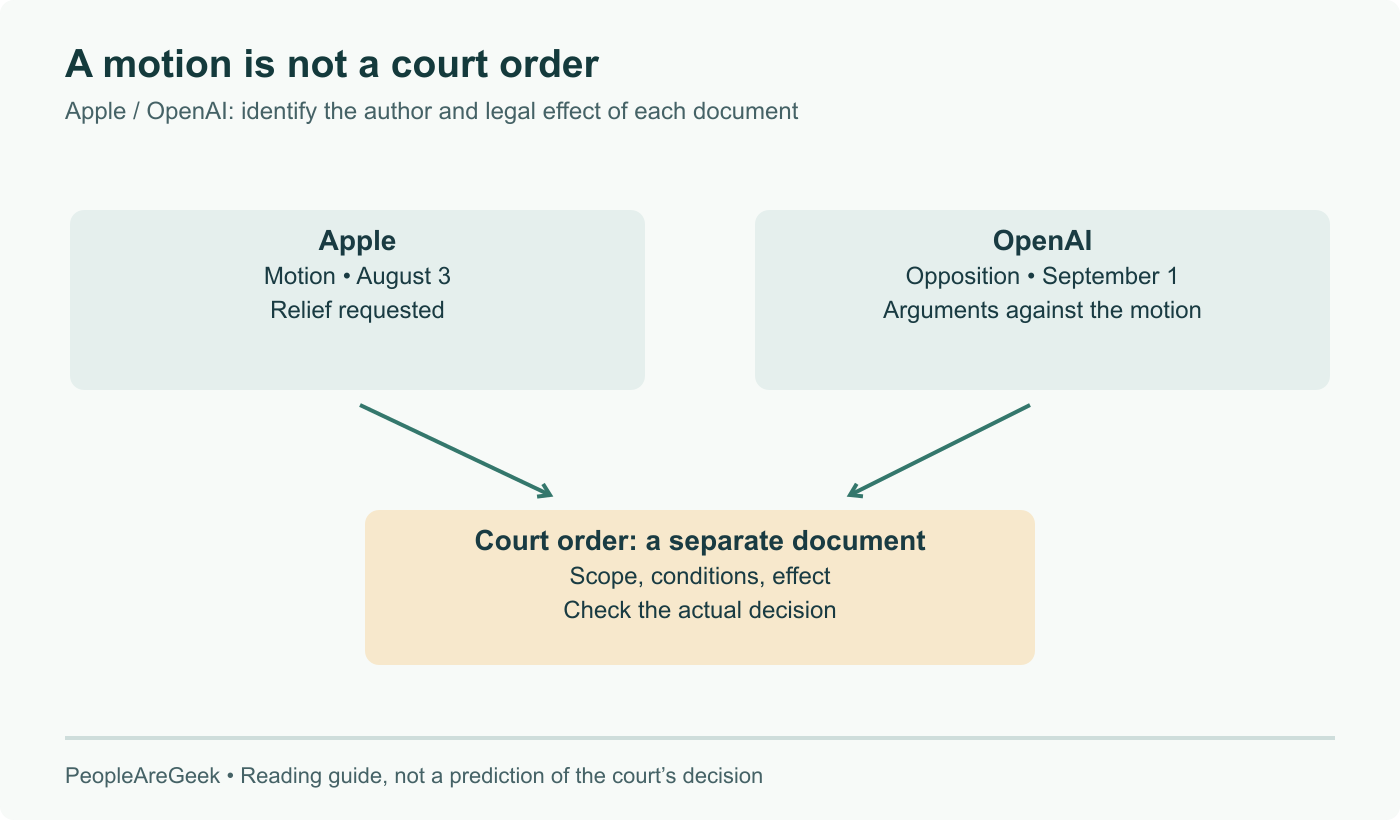
Nothing here has been decided. A complaint is a set of allegations, a motion is a request, and the court has ruled on neither.

Why the injunction request is the interesting part

Numbered card showing the sequence in the Apple and OpenAI trade secrets dispute: Apple files suit in July 2026 alleging misappropriation of hardware design information, OpenAI publicly disputes the allegations, Apple moves for a preliminary injunction and expedited discovery reported on August 4 2026, and a hearing on both motions is scheduled for October 1 2026.
The sequence so far, with the only fixed future date on the record. PNG

A damages claim says a wrong happened and money can settle it. An injunction request says something different: that waiting for the end of the case is itself the problem.

That is why the standard is high. A court weighing this generally wants to see that the moving party is likely to succeed on the merits and that the harm from waiting cannot be repaired by a payment later. Apple's filing leans on exactly that second point, arguing irreparable harm.

The expedited discovery request sits alongside it for a practical reason. Trade secret cases turn on what specifically moved, when, and through what device or account. Those answers live in logs, storage and devices, and the value of getting them early is that memories and systems are closer to the events.

What it would and would not do

Read the ask precisely, because coverage tends to compress it into a headline about blocking a product.

The order Apple wants restrains access to and use of identified confidential information. It does not, on its face, prohibit OpenAI from developing consumer hardware. If granted, the realistic effect is friction rather than a stop: separations between teams, individuals moved away from particular work, engineering paths documented carefully enough to hold up under later scrutiny. That is costly and slow in a market where being late is the expensive outcome, which is a fair explanation of why both sides are fighting at this stage rather than waiting for trial.

The part that applies to the rest of us

Very few readers will ever be named in a filing like this. Rather more will change jobs between companies that compete, and the practical lesson from every case in this genre is the same and it is unglamorous.

Take nothing. Not files you wrote yourself, because writing something at work does not make it yours. Not test data, not schematics, not vendor pricing, not a contact list exported the week before you resigned. Assume that every sync, every personal cloud upload and every USB mount is recorded somewhere, because in modern corporate environments it generally is, and those records are what these cases are actually built on.

What you are entitled to keep is your own skill and general knowledge, and that is not a small thing. Courts distinguish between knowing how to design a class of product and holding a former employer's specific design. Staying on the right side of that line is mostly a matter of arriving at the new job with nothing in your hands.

Sources and further reading

Frequently asked questions

What is a preliminary injunction and why does Apple want one?

A preliminary injunction is a court order restricting what a party may do while the case is still being decided, rather than after. Apple is asking for one because the remedy it would get at the end of a trade secrets trial, money, does not undo the thing it says it is worried about: information moving into a competing product that then ships. That is the argument behind the phrase in the filing about being irreparably harmed. Courts do not grant these lightly. The moving party generally has to show it is likely to win on the merits and that waiting would cause harm no later payment can repair, which is a materially higher bar than surviving a motion to dismiss.

Who are the two former employees named?

Reporting names Chang Liu, previously a senior system electrical engineer at Apple, and Tang Yew Tan, described as a vice president of product design for iPhone and Apple Watch. Both are now at OpenAI. The seniority is the part that matters legally rather than the names, because the closer someone sat to the design of shipping hardware, the stronger an argument that what they carry in their head and their files overlaps with what a court would call a trade secret. Nothing in a filing is a finding. These are allegations Apple has made and OpenAI disputes.

What has OpenAI said?

OpenAI has responded publicly that the allegations are based on false information and completely unnecessary, having earlier described the lawsuit itself as careless, aggressive and oddly personal. That is a denial rather than a legal answer, and the substantive response will be the opposition brief filed ahead of the hearing. Worth remembering when reading coverage of either side: at this stage, both companies are making arguments in public and in filings, and the court has decided nothing.

Does this actually stop OpenAI building hardware?

Not as filed. What Apple is asking for is an order against accessing, acquiring, using or disclosing the specific confidential information it identifies, along with expedited discovery and depositions from OpenAI and its commercial hardware arm, IO Products. That is narrower than a ban on building a device. The practical effect of an order like that, if granted, is usually procedural friction rather than a stop: cleanroom separations, people pulled off work, engineering decisions that have to be documented in a way that survives later scrutiny. That is expensive and slow, which is part of why parties fight hard at this stage.

If I move between competing employers, what should I take from this?

The boring advice is the correct advice, and it is easier to follow before you leave than after. Do not take files, including files you personally wrote, because authorship is not ownership and a copy on personal storage is the single most damaging fact in cases like this. Do not take contact lists, drawings, test data or vendor terms. Assume anything you sync is logged. What you cannot leave behind is your own skill and general knowledge, and that is legitimately yours to use. The line courts care about is between knowing how to design something and possessing your former employer's specific design, and the cleanest way to stay on the right side is to arrive with nothing but yourself.