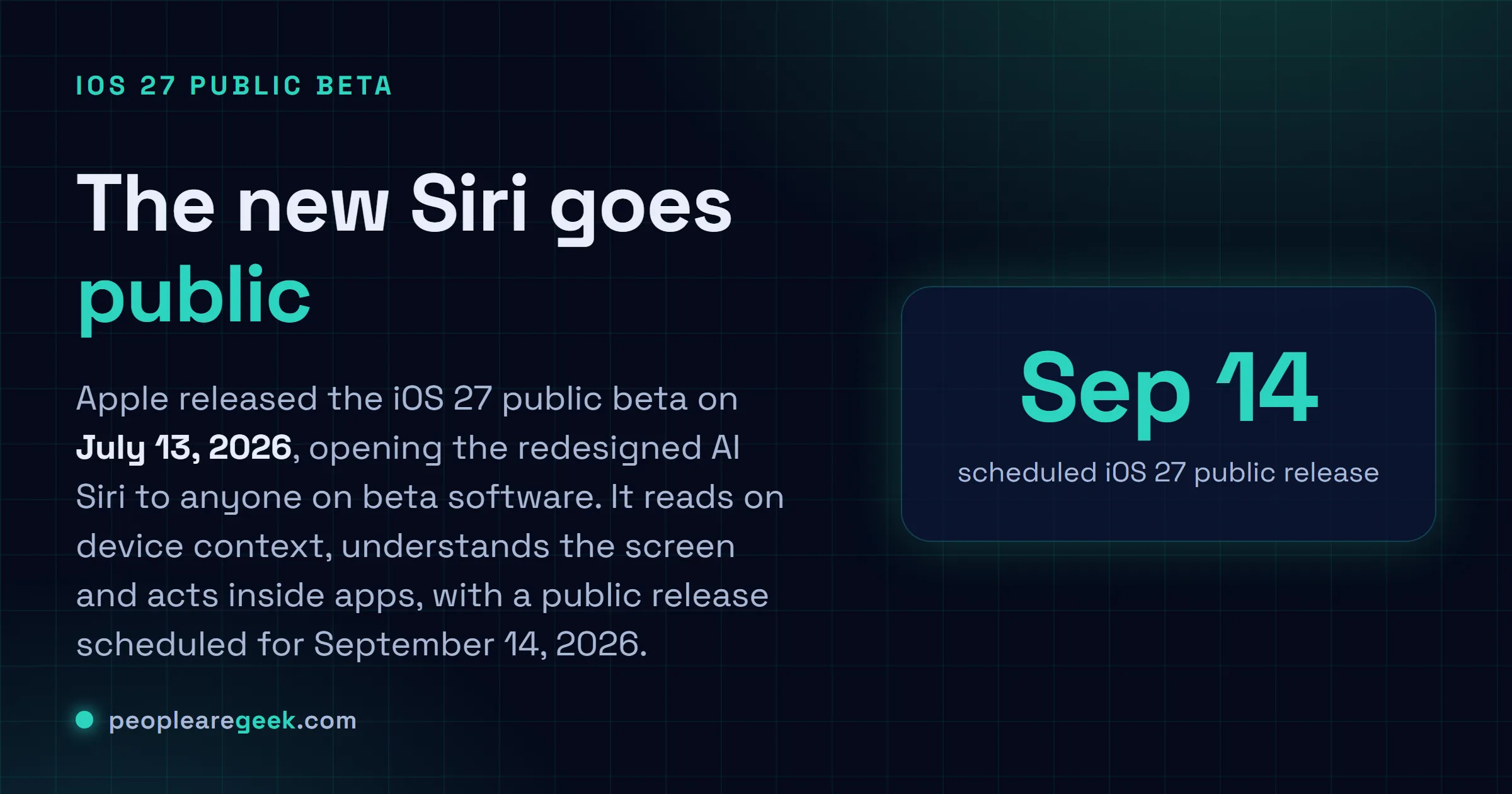
Apple released the iOS 27 public beta on July 13, 2026, and with it the redesigned Siri that had been gated behind a developer waitlist. Anyone on the public beta can now try a Siri that reads personal context on the device, understands what is on screen and acts inside apps, with general release set for September. The consumer story is the assistant finally growing up. The story for us is quieter and more concrete: the new Siri only reaches your app through App Intents, Apple deprecated SiriKit at WWDC in June, and the migration clock is now running for real.
The short answer
Apple released the iOS 27 public beta on July 13, 2026, opening the redesigned AI Siri to anyone willing to run beta software. The assistant reads on device personal context, understands what is on screen and takes actions inside apps, with a public release scheduled for September 14, 2026. For developers the key change is structural: Siri now reaches apps only through App Intents, and Apple deprecated the older SiriKit framework at WWDC on June 9, 2026. The capabilities you expose through App Intents are the capabilities the new Siri can use.
There are two ways to read this release, and they point in different directions. To most people, Apple finally shipped the Siri it promised, and the headline is that the assistant now understands context. To anyone who ships an iOS app, the headline is a framework decision that quietly determines whether the new Siri can do anything with your software at all.
What actually went out
Apple released the first iOS 27 public beta on July 13, 2026, built on the same code as developer beta 3. Until now the redesigned Siri had been limited to developers and gated behind a waitlist. The public beta removes that gate for anyone comfortable running pre release software, and it is the first time a general audience can use the new assistant. The public launch of iOS 27 is scheduled for September 14, 2026.
The assistant itself is the version Apple has been describing since spring. It can pull on personal context held on the device, including emails, photos and messages, understand what is currently on screen, take actions inside apps and answer from general world knowledge. The pitch is an assistant that completes tasks that span several apps, rather than one that answers a single question and stops.
Apple has described the plumbing as a hybrid of on device models and larger models for harder work, and several reports say a customised version of Google's Gemini handles some of the heavier reasoning. Apple has been deliberately vague about the exact division. For building an app, the model behind the curtain matters far less than the doorway into your app, which brings us to the part that actually changes your work.

The part that changes your work
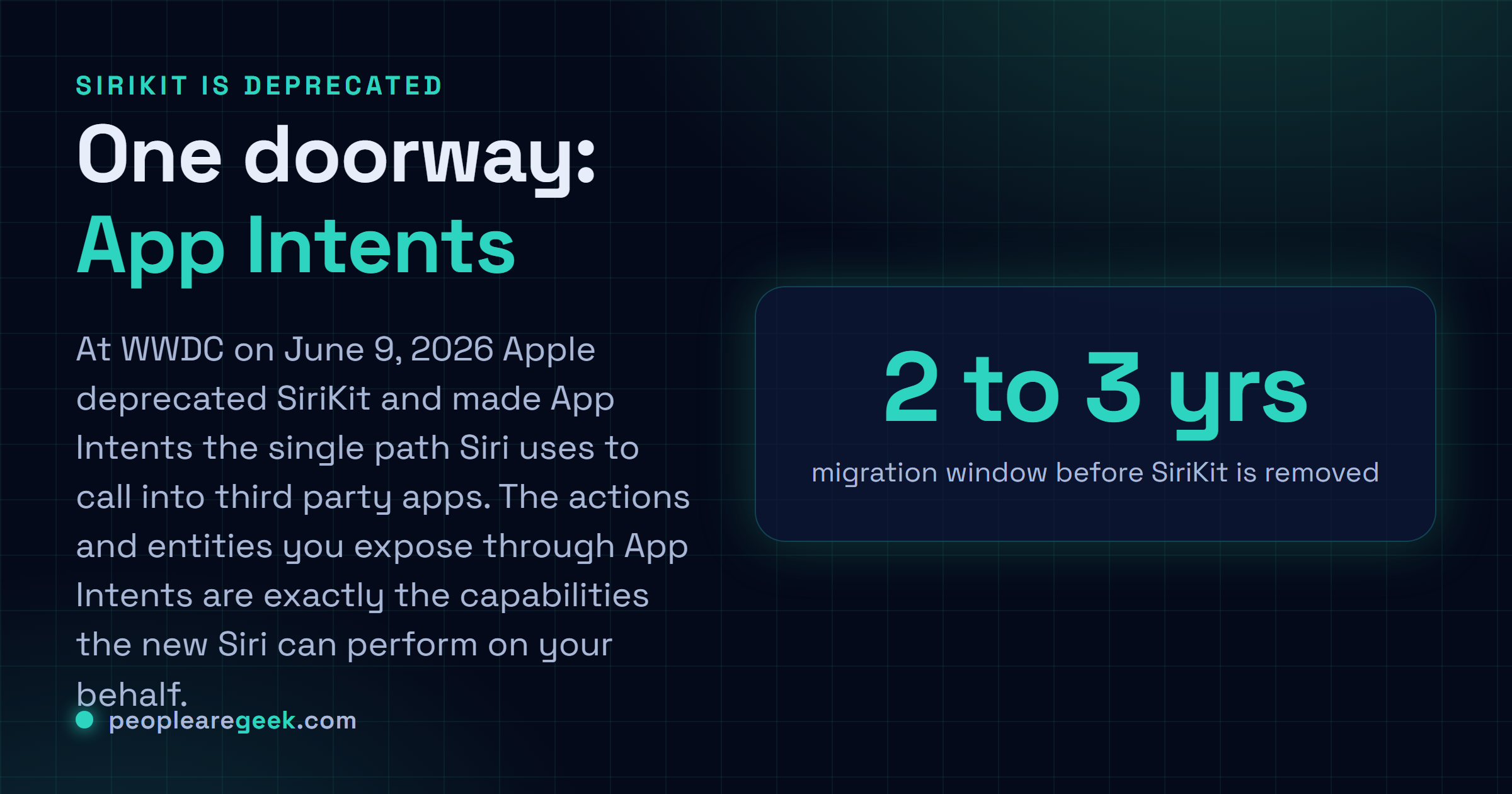
The new Siri reaches third party apps through exactly one framework, App Intents. At WWDC on June 9, 2026, Apple formally deprecated SiriKit, the older intents system, and made App Intents the single supported path for Siri to call into an app. If your app still exposes its capabilities through SiriKit, the redesigned assistant effectively cannot see them.
This flips how you should think about Siri support. With App Intents, you define the actions your app can perform and the entities it works with, and those definitions become the vocabulary Siri can use on your behalf. The surface you model is the surface the assistant can act on, no more and no less. An app that exposes three well designed intents gives the new Siri three real capabilities. An app that exposes none is invisible to it, however good the assistant gets.
Apple has signalled a migration window of roughly two to three years before SiriKit is removed, so nothing breaks the moment iOS 27 ships this autumn. That grace period is easy to misread. The version of Siri your users will actually reach for is the App Intents one, so the deadline that matters is the day your users expect the assistant to work with your app, not the distant day Apple deletes the old framework.
What we would do about it
If you maintain an iOS app with any voice or shortcuts story, treat this beta as the signal to start the App Intents work now, while the public release is still weeks away and you can test against a broad audience. Model the handful of actions that make sense for someone to trigger by voice or from the assistant, expose them as intents with clear parameters, and try them against the beta on a real device.
If your app has no Siri story at all, this is a reasonable moment to decide whether it should. The barrier is lower than SiriKit ever made it, because App Intents is the same framework that already powers Shortcuts, widgets and Spotlight actions. The work you do to expose an intent pays off in several places at once, and one of those places is now an assistant that a large number of people are about to have in their pocket by default.
Sources and further reading
- TechCrunch: Apple opens its new Siri AI to everyone with the iOS 27 public beta
- 9to5Mac: iOS 27 public beta is here with Siri AI, iPhone speed upgrades, and more
- MacRumors: Apple announces when iOS 27 and revamped Siri AI will be released
Frequently asked questions
What did Apple release on July 13, 2026?
Apple released the first iOS 27 public beta on July 13, 2026, using the same build as developer beta 3. It puts the redesigned AI Siri in front of public beta testers for the first time, after months during which the feature was gated behind a developer waitlist. The public release of iOS 27, and of the new Siri, is scheduled for September 14, 2026.
What can the new Siri actually do?
The redesigned Siri can draw on personal context stored on the device, such as emails, photos and messages, understand what is currently on screen, take actions inside apps and ground its answers in general world knowledge, much like a modern chatbot. The goal is an assistant that can complete multi step tasks across apps rather than answer one off questions.
Why does this matter for developers?
The new Siri reaches third party apps only through the App Intents framework. At WWDC on June 9, 2026, Apple formally deprecated SiriKit and made App Intents the single path for Siri to call into an app. If your app still relies on SiriKit intents, the new assistant cannot see or use those capabilities, so the surface you expose through App Intents is exactly the surface Siri can act on.
How long do developers have to migrate?
Apple has signalled a migration window of roughly two to three years before SiriKit support is removed, so nothing breaks the day iOS 27 ships. That said, the assistant that users will actually reach for is the App Intents one, so the practical deadline is when your users expect Siri to work with your app, not when Apple finally deletes the old framework.
Is the new Siri powered by Apple or a partner model?
Apple has described a hybrid approach that combines its own on device models with larger models for harder requests, and multiple reports say a customised version of Google's Gemini handles some of that heavier reasoning. Apple has kept the exact split deliberately vague. For a developer the backing model matters far less than the interface, which is App Intents either way.