ARCTIC has launched a ten channel PWM fan controller, and the Linux driver for it was written by ARCTIC and merged upstream months before the hardware went on sale. It arrives in Linux 7.2, due as stable in the second half of August, exposed through the standard hwmon interface so lm-sensors and anything built on it can read fan speeds and set PWM per channel with no vendor tooling. In a product category where Linux support normally means somebody reverse engineering a USB protocol two years after launch, a vendor arriving with the driver already merged is the part worth noting.
The short answer
ARCTIC launched its Fan Controller on July 28, 2026, with mainline Linux support already in place. The company published an open source hwmon driver in March and it was merged for Linux 7.2, expected stable in the second half of August. The board drives ten PWM fans individually over an internal USB 2.0 header, powered by SATA, at up to 2 A per channel and 4.5 A total. Fan speeds and PWM values are exposed through the standard hwmon interface, so lm-sensors and existing fan control tooling work unmodified.


The usual sequence for a device like this is well known to anyone who has tried to control fans on Linux. The product ships with a Windows utility, the Linux users file an issue, and eighteen months later somebody who bought one and captured its USB traffic posts a driver. ARCTIC skipped that entirely and did the driver first.
What ARCTIC actually shipped
The Fan Controller is a small board, 86 by 55 by 14 millimetres, mounted magnetically or with adhesive. It takes power from a SATA connector and data from an internal USB 2.0 header, and it drives up to ten PWM fans individually. That word is doing the work: a fan splitter distributes one control signal to several fans, while this addresses each channel separately and reads back its own tachometer.
Electrically it supplies up to 2 A per channel with a total ceiling of 4.5 A. That total is the number to look at before you plan a build, because ten high static pressure radiator fans at full tilt will reach it well before ten ordinary case fans do.
It lists at 16.99 euros, with launch pricing seen closer to 12. On Windows it works with the familiar third party utilities, Fan Control, SpeedFan and SignalRGB among them.
The driver was upstream before the product

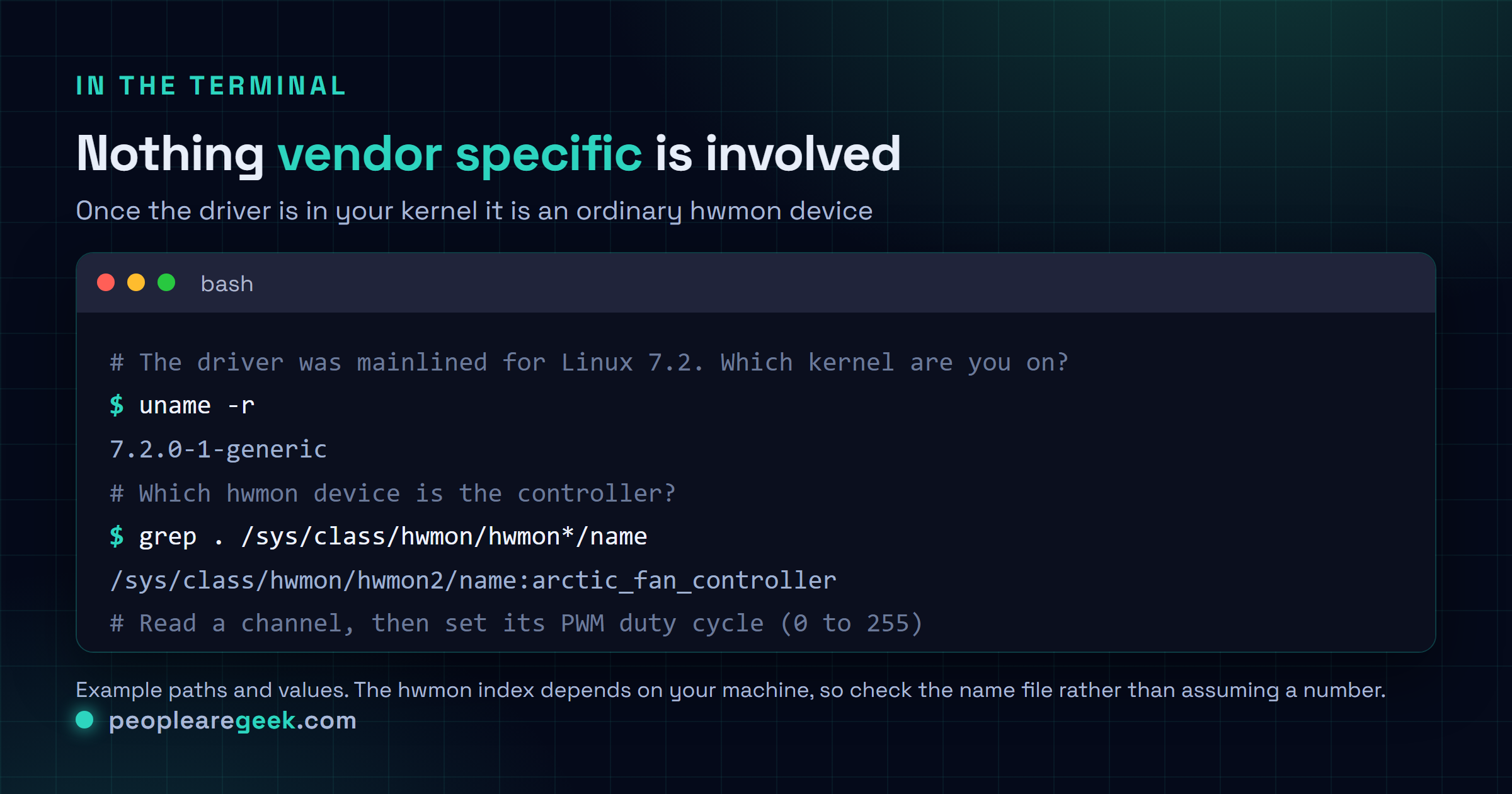
ARCTIC published an open source Linux driver for the controller back in March, several months before launch, and it was merged for Linux 7.2. That kernel is expected as stable during the second half of August 2026.
The device presents itself as a USB HID device. The driver is an hwmon driver, which is the part that matters for how you use it: it reads RPM values from each of the ten channels and writes PWM values back through the kernel's standard hardware monitoring subsystem. That is the same subsystem your CPU package temperature and your motherboard fan headers already report through.
The consequence is that there is nothing to integrate. Run sensors from lm-sensors and the channels appear. Point fancontrol, or any desktop fan curve tool that drives PWM through sysfs, at the relevant paths and it works, because those paths are the ordinary ones. No daemon, no vendor agent, no configuration file describing a proprietary protocol.
Why this is unusual
Fan controllers, RGB hubs and AIO pumps are a category where Linux support has historically been a community project. Somebody buys the hardware, records its USB traffic, infers the protocol and writes a driver, and it works until the vendor revises the firmware without telling anyone. The results are often excellent and always fragile, because they rest on inference and on one person's continued interest.
A driver written by the engineers who designed the device, submitted to the kernel mailing list and reviewed there, does not carry that fragility. Support becomes a property of the kernel rather than of a volunteer, and firmware revisions are the vendor's problem to keep compatible.
That is a modest thing for one fan controller and a meaningful precedent for the category. The cost to ARCTIC was one hwmon driver, which is not a large piece of code, and the return is that every Linux review of the product starts from it working.
Whether you need ten channels
Honest answer: many people do not. Most motherboards offer four to seven headers, several of them ganged onto shared control, and if your three case fans on a stock curve are quiet enough then nothing here helps.
The case for it is the workstation or homelab tower where different fans face genuinely different loads. Intake, exhaust, a radiator and a drive cage all want different curves tied to different sensors, and a shared header cannot express that. Ten independent channels driven from hwmon, by whatever policy you already run, can. At under twenty euros, that is a cheaper path to per fan control on Linux than any alternative we are aware of.
The one thing to verify first is your kernel. Linux 7.2 is not out yet, and if you run an enterprise distribution the wait after that could be long.
Sources and further reading
- Phoronix: ARCTIC launches its new fan controller that already has mainline Linux support
- Phoronix: ARCTIC Cooling publishes ARCTIC Fan Controller driver for Linux
- PATCH v2, hwmon: add driver for ARCTIC Fan Controller
- Basic Tutorials: ARCTIC Fan Controller specifications and pricing
- Kernel documentation: hardware monitoring subsystem
Frequently asked questions
What is the hardware, exactly?
The ARCTIC Fan Controller is a small board, 86 by 55 by 14 millimetres, that drives up to ten PWM fans individually rather than fanning one signal out to ten headers. Power comes from a SATA connector and data from an internal USB 2.0 header on the motherboard, so it presents to the host as a USB device rather than sitting on the motherboard's own fan control. Each channel can supply up to 2 A, with a total output ceiling of 4.5 A across the board, which is the number to check if you are driving high static pressure fans rather than case fans. It mounts magnetically or with adhesive, and lists at 16.99 euros with launch pricing seen nearer 12.
How does the Linux support actually work?
The device enumerates as a USB HID device, and ARCTIC's driver is an hwmon driver that reads RPM from each channel and writes PWM values back. That means it appears in the standard kernel hardware monitoring subsystem, the same place your CPU temperatures and existing fan headers already live, so tools that speak hwmon see it without modification. In practice you run sensors from lm-sensors and the channels are simply there, alongside everything else. Anything that already drives PWM through sysfs, including fancontrol and the various desktop fan curve utilities, works on the same paths rather than needing a vendor specific integration.
Which kernel do I need?
The driver was mainlined for Linux 7.2, which is expected as a stable release during the second half of August 2026. If you are on an earlier kernel you either wait, backport, or build the module yourself, since ARCTIC published the driver publicly back in March before it went upstream. Distribution availability follows the usual pattern: rolling releases will pick it up quickly once 7.2 lands, while a long term support distribution will get it whenever it next rebases its kernel, which for an enterprise release could be a considerable wait. Check what your kernel actually reports rather than what the box claims.
Why does a vendor written driver matter here?
Because of what normally happens in this category. Fan controllers, RGB hubs and AIO pumps are usually shipped with a Windows utility and nothing else, and Linux support arrives later if a community developer buys one, captures its USB traffic and works out the protocol. That process produces drivers that are correct until the vendor silently revises the firmware. A driver written by the people who designed the device, submitted upstream and reviewed on the kernel mailing list, does not carry that fragility, and it means the device is supported by the kernel rather than by one volunteer's continued interest in it.
Is ten channels actually useful?
It depends on whether you care about curves or just about noise. Most motherboards give you four to seven fan headers and group several of them onto shared control, so fans that face different thermal loads end up following the same curve. Ten independently addressable channels let a workstation or a homelab tower run intake, exhaust, radiator and drive cage fans on separate profiles, driven from hwmon by whatever policy you already use. If you run three case fans on a stock curve and are happy, this solves a problem you do not have. If you have ever wanted a specific fan to respond to a specific sensor, it is the cheapest way we have seen to get there on Linux.