Microsoft has confirmed the end date for buying VMware on Azure without a Broadcom contract. The Azure VMware Solution SKUs that bundled VCF licensing retire on August 30, 2027, and the pay as you go nodes that still carry an included license only run unchanged through October 31, 2026. After that you bring your own VMware Cloud Foundation subscription, purchased directly from Broadcom, into the AVS VCF BYOL option instead. That option already exists in all thirty nine AVS regions and is priced below the bundled version, so this is a procurement change rather than a technical migration. The clock is what matters.
The short answer
Microsoft has confirmed that the Azure VMware Solution SKUs bundling VCF licensing retire on August 30, 2027. Selling them stopped after October 15, 2025, license included pay as you go nodes run unchanged only through October 31, 2026, and Reserved Instances bought on or before October 15, 2025 keep running to the 2027 date. The replacement is AVS VCF BYOL with a portable VCF subscription bought from Broadcom, available in all thirty nine AVS regions at a lower Azure price than the bundled SKU.
Running VMware on a hyperscaler used to be the way to avoid a Broadcom negotiation. Microsoft has now published the date that stops being true on Azure, and there is a second date well before it that a lot of estates will hit first.
Three dates, and only one of them is 2027
The headline is that the AVS license included SKUs retire on August 30, 2027. Read only that and you conclude you have a year and a half. Most teams do not.
Microsoft stopped selling Azure VMware Solution with VCF subscriptions included after October 15, 2025. Any node added since then already required a VCF subscription you supplied yourself, so for many organisations the bundled licensing is already a legacy footprint rather than the current buying motion.
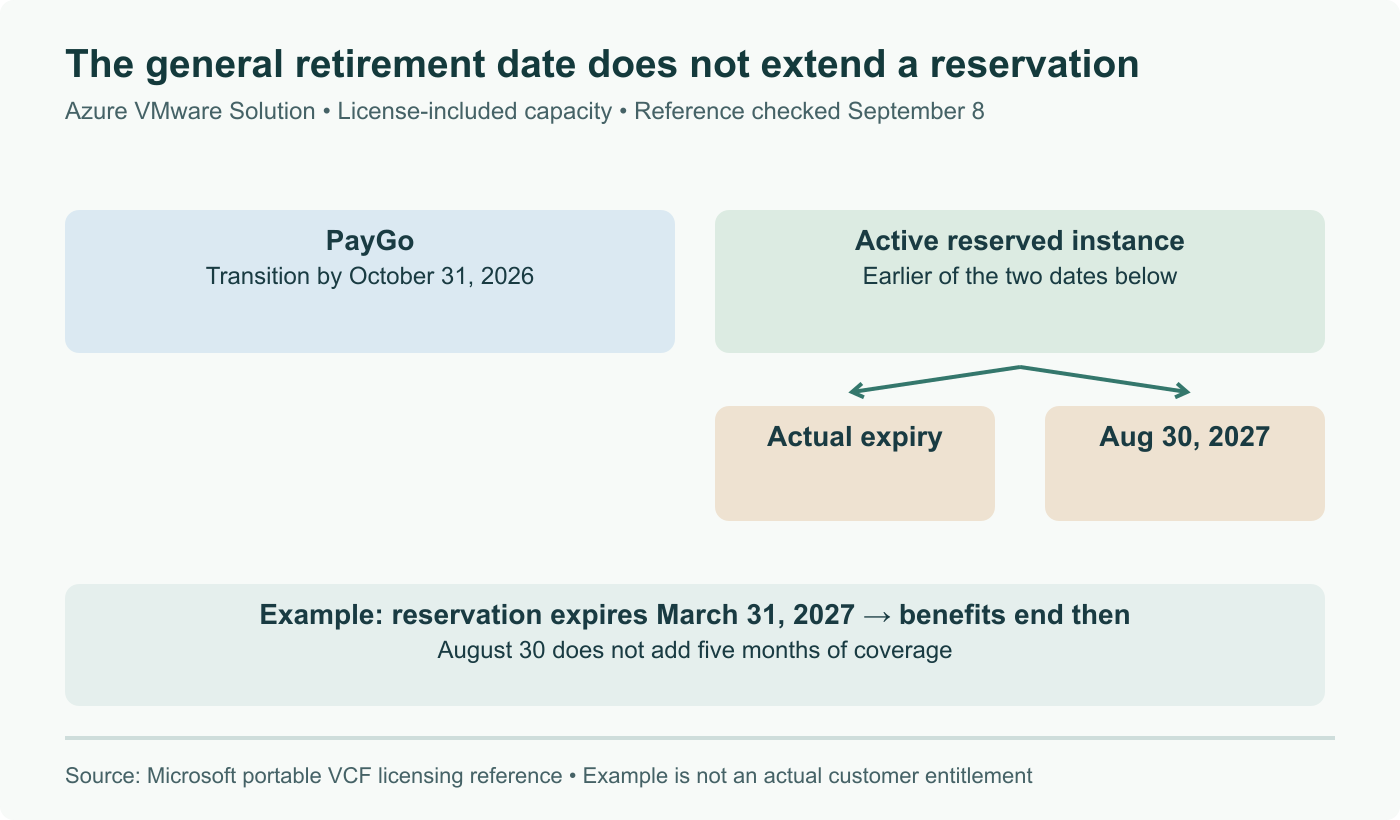
Then comes the date that actually bites. License included pay as you go nodes can continue to operate without any licensing or product change through October 31, 2026. That is roughly fourteen months from now, and it applies to exactly the kind of capacity that gets spun up flexibly and forgotten.
The 2027 date belongs to a narrower group. If you bought Azure VMware Solution Reserved Instances on or before October 15, 2025, you keep running with no licensing or product change until August 30, 2027, when the license included SKUs retire outright.
So the first job is not planning a migration. It is working out which of those three sentences describes your estate, because the difference between them is nearly a year of runway.
This is Broadcom policy arriving on Azure
Microsoft is not the origin of this change and does not present itself as such. Broadcom altered its VMware licensing policies across all hyperscaler platforms to require customers to bring their own portable subscription for VMware Cloud Foundation, effective with its fiscal year that began on November 1, 2025.
That policy removed the hyperscalers ability to package VMware licensing inside their own service. It is not an Azure specific arrangement: Google Cloud published equivalent guidance for VMware Engine, and the other large providers have moved the same way. AVS was one of the last places where a customer could keep using vSphere, vSAN and NSX at scale without holding a VCF contract, which is precisely why its retirement is worth noting.
The underlying commercial logic is not hidden either. Since acquiring VMware, Broadcom has concentrated on VCF as a single bundle and no longer sells a standalone low end server virtualisation product, and it is comfortable with smaller customers leaving.
The service is not changing, which is the good news
It is worth separating the licensing story from a technical one, because they are easy to conflate and only one of them requires engineering time.
Microsoft states plainly that these updates are about licensing only and that there are no product changes to how Azure VMware Solution works. It continues to deliver AVS as a fully managed VCF private cloud, taking care of infrastructure and VMware host level software management, patches and upgrades. Your vCenter is the same vCenter. Your NSX topology does not move.
The replacement path is AVS VCF BYOL, where you supply a portable VCF subscription bought from Broadcom. Microsoft says that option is live in all thirty nine AVS regions worldwide, and that it is priced lower than AVS with a bundled VCF subscription.
That last detail deserves care. The Azure line item goes down. Whether your total spend goes down depends on the Broadcom quote, which is the number you do not control and cannot benchmark easily. Treat the lower Azure price as a partial offset, not as a saving.
What we would do in the next fortnight
Start with an inventory that answers one question per node: bundled licensing or BYOL, and pay as you go or Reserved Instance. That is a short exercise and it tells you whether your deadline is October 2026 or August 2027.
If you have no existing Broadcom contract, open that conversation now through a channel partner. Procurement is the long pole here, not configuration, and the closer you get to a hard cutover date the less negotiating position you have. Microsoft advises allowing plenty of time to purchase VCF licences and complete the transition, which is the polite version of the same point.
There is also a decision worth making deliberately rather than by default. For some organisations this is a renewal. For others it is the moment to price the alternatives, because a forced procurement cycle is the cheapest opportunity you will get to compare Hyper-V, Proxmox, Nutanix or a straightforward move to native Azure workloads against a VCF bundle you may not need in full. Answering that question in early 2027, with a cutover date behind you, is considerably more expensive than answering it now.
Sources and further reading
- UPDATED: Broadcom VMware Licensing Changes, What Azure VMware Solution Customers Need to Know, Microsoft Community Hub, updated August 18, 2026
- Broadcom VMware Licensing Changes, What Azure VMware Solution Partners Need to Know, Microsoft Community Hub
- Microsoft ends one of the last ways to buy VMware without big bundles, The Register, August 20, 2026
- Broadcom VCF licensing changes for VMware Engine, Google Cloud Blog
Frequently asked questions
What exactly is retiring, and when?
The Azure VMware Solution SKUs that include VCF licensing retire on August 30, 2027. Two earlier dates matter more day to day. Microsoft stopped selling AVS with VCF subscriptions included after October 15, 2025, so no new capacity has shipped that way for months. And license included pay as you go nodes can continue operating with no licensing or product change only through October 31, 2026. Reserved Instances bought on or before October 15, 2025 are the exception, and they run unchanged all the way to the August 2027 retirement.
Is Azure VMware Solution itself going away?
No. Microsoft is explicit that these updates are about licensing only and that there are no product changes to how the service works. AVS continues as a fully managed VCF private cloud on Azure, with Microsoft handling infrastructure and VMware host level software management, patches and upgrades. The vCenter, vSAN, vSphere and NSX components stay where they are. What changes is who you buy the VMware entitlement from, and therefore what your renewal conversation looks like.
What is AVS VCF BYOL and is it more expensive?
It is the bring your own licence version of the same service: you buy a portable VMware Cloud Foundation subscription from Broadcom and apply it to AVS nodes. Microsoft says the option is available in all thirty nine AVS regions worldwide and that it is priced lower than AVS with a bundled VCF subscription. Whether your total cost goes up or down therefore depends entirely on what Broadcom quotes you for the portable subscription, not on the Azure side of the bill.
Why is Microsoft doing this now?
Because Broadcom changed the rules for every hyperscaler, not just Azure. From the start of its fiscal year on November 1, 2025, Broadcom requires customers to bring their own portable VCF subscription to cloud services, which removed the hyperscalers ability to resell VMware licensing inside their own offers. Google Cloud published equivalent guidance for VMware Engine. Microsoft is closing out the transition period that policy created rather than making a strategic decision of its own.
What should we actually do about it?
Establish which of the three dates applies to your estate, because the answer depends on whether you are on pay as you go nodes or on Reserved Instances bought before October 15, 2025. If you have no Broadcom contract, start that conversation early, since securing a portable VCF subscription through a channel partner is the long pole and the price is the part you do not control. Then decide honestly whether you are renewing VMware or leaving it, because a forced procurement cycle is the cheapest moment you will ever get to evaluate the alternative.