Blacksmith announced a $45 million Series B on August 12, 2026, led by Peak XV Partners at a $550 million valuation, with Y Combinator and GV following on. The product is narrow and easy to describe: dedicated machines that run your existing GitHub Actions workflows after a one line change, with caching and storage built for CI rather than borrowed from general purpose cloud. The company claims hardware roughly twice as fast as GitHub hosted runners at about 60 percent less cost. What makes the round worth reading is the growth curve behind it, from around 800 customers last September to more than 6,000 now.
The short answer
Blacksmith announced a $45 million Series B on August 12, 2026, led by Peak XV Partners at a $550 million valuation, with Y Combinator and GV participating. It sells dedicated GitHub Actions runners, adopted with a one line workflow change, claiming roughly double the speed of GitHub hosted runners at about 60 percent less cost. Customers grew from around 800 last September to more than 6,000, including Supabase, Clerk, Ashby and Mercury, with CI job volume rising 5 to 10 percent week over week.
Ask an engineering team where their day goes and you will hear about meetings. Look at the timestamps and a surprising amount of it is spent watching a yellow dot spin next to a pull request.
The round
Blacksmith closed a $45 million Series B led by Peak XV Partners, announced on August 12, 2026, at a $550 million valuation. Existing investors Y Combinator and GV took part. With a $3.5 million seed and a $10 million Series A behind it, total funding stands at $58.5 million.
The money goes mostly into machines. The company says it currently operates hundreds of thousands of cores and intends to grow that footprint about tenfold in the coming months, with engineering hiring in New York and San Francisco. That ratio, capital into compute rather than into headcount, is a reasonable signal that the constraint really is capacity.
Adoption is the more persuasive number. Around 800 customers at the Series A last September, more than 6,000 now, with named users including Supabase, Clerk, Ashby and Mercury, and CI job volume growing 5 to 10 percent week over week since January. Growth like that in infrastructure usually means the switching cost is near zero, and here it is: the migration is a one line change to the runs-on field in a workflow file.
Why continuous integration became the pinch point
Writing code got dramatically easier. Validating it did not. That is the CEO's framing, and it is the whole market thesis in two sentences.
The mechanics are simple enough to see in your own repository. Assisted development raises pull requests per engineer. Each pull request runs the same suite it always ran, on the same runners, at the same speed. Nothing in that pipeline scaled with the change in input rate, so the queue absorbs the difference, and queue time is a tax paid simultaneously by everyone on the team.
This is the same imbalance that has been repricing the whole toolchain. A day before this round, CodeRabbit raised $143 million at a $1.5 billion valuation to automate the reading of those pull requests. The pattern is consistent: generation is cheap, and every downstream step that has to confirm the generated thing is correct is now oversubscribed. Review is one such step. Test execution is another.
Before you swap your runners
The honest question is not whether Blacksmith's machines are faster. It is whether machine speed is what your pipeline is actually waiting on.
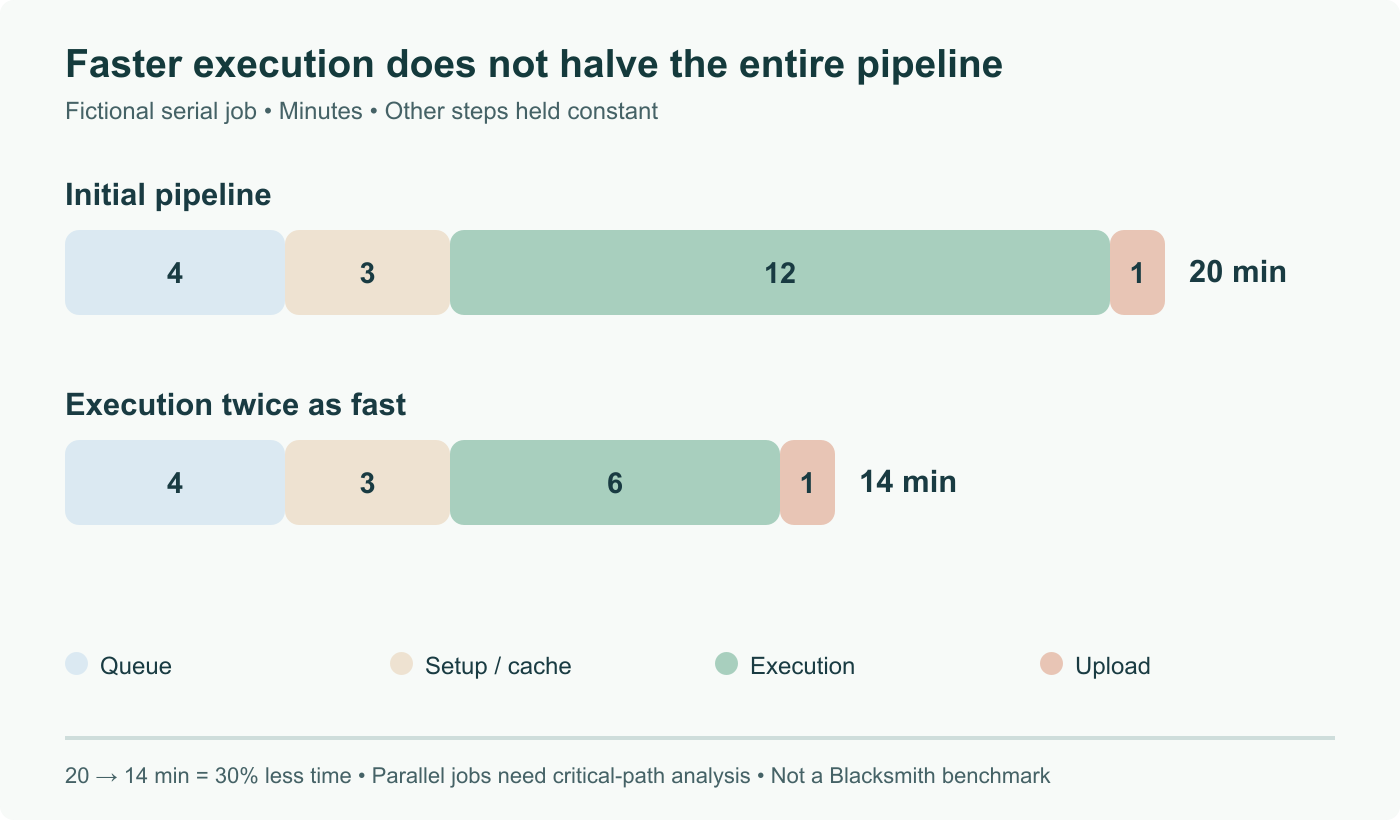
Take one slow run and break the wall clock into five buckets: queue, setup, cache restore, execute, upload. Compute bound work such as compilation, big test suites and container builds lives in execute, and that is where faster cores pay off directly. If instead your largest slice is cache restore or image pull, you have a data movement problem, and a faster CPU will shave a fraction of a slice that was never the issue. Plenty of pipelines discover their real bottleneck is a dependency graph that runs stages in sequence for no reason anyone still remembers.
Two guards worth keeping. Treat the published comparisons, roughly twice the speed at about 60 percent less cost, as vendor figures on vendor workloads, and reproduce them on your own repository before signing anything. And keep the workflow file vendor neutral: the exit is as cheap as the entry precisely because the integration is one standard line, so avoid quietly accumulating provider specific cache actions and runner labels in branch protection until it is not.
The part that is not about runners
Blacksmith is also shipping Codesmith, a cloud coding agent for delegated tasks, and describes Codesmith QA, an autonomous testing product, as in development.
The strategic reasoning is easy to follow. A company that runs your validation step sees every change your organisation makes, which is a strong place from which to sell the validation itself rather than just the hardware underneath it. Whether that turns into a durable product is a different question from whether the runners are quick, and it is one to judge on behaviour once it ships, not on the announcement. For now the thing being bought by 6,000 companies is boring and legible: the same jobs, on better machines, for less money.
Sources and further reading
- Blacksmith Raises $45M Series B from Peak XV Partners as AI Generated Code Drives Demand for Faster Code Validation, PR Newswire, August 12, 2026
- Blacksmith Raises $45M Series B, BigDATAwire, August 12, 2026
- Blacksmith raises $45 million at $550 million valuation, Indian Startup News, August 13, 2026
- Blacksmith Raises $45 Million Series B At $550 Million Valuation, Pulse 2, August 2026
- Blacksmith Raised $45M Series B Funding for Faster Code Validation, Software Testing Magazine, August 2026
Frequently asked questions
What are the terms of the round?
A $45 million Series B led by Peak XV Partners, announced on August 12, 2026, at a $550 million valuation, with existing investors Y Combinator and GV taking part. It follows a $3.5 million seed and a $10 million Series A, bringing total funding to $58.5 million. The stated use of proceeds is mostly compute: the company says it runs hundreds of thousands of cores today and plans to expand that footprint roughly tenfold in the coming months, alongside engineering hires in New York and San Francisco.
What does the product actually do?
It replaces the machines your GitHub Actions jobs run on. Instead of GitHub hosted runners, jobs execute on Blacksmith's own hardware, with caching and storage designed for continuous integration workloads specifically rather than adapted from general purpose cloud instances. Migration is a one line change to the runs-on field in a workflow file, which is the detail that explains the adoption curve. The published claims are hardware about twice as fast as GitHub hosted runners at roughly 60 percent lower cost. Those are vendor figures, and CI performance depends heavily on your cache behaviour, so measure rather than assume.
Why is CI suddenly a growth market?
Because the number of changes going through it went up and the pipeline did not get faster. Assisted development produces more pull requests per engineer, and every pull request triggers the same test suite it always did. CEO Aditya Jayaprakash puts it plainly: writing code has gotten dramatically easier, validating it has not. That imbalance shows up as queue time, and queue time is felt by every engineer on the team at once. It is the same pressure that funded [automated code review at a $1.5 billion valuation](/articles/coderabbit-143-million-series-c-1-5-billion/) a day earlier.
Is a faster runner really the fix for a slow pipeline?
Sometimes, and it is worth knowing which case you are in before paying. Faster cores help when your jobs are genuinely compute bound, such as compilation, large test suites and container builds. They help much less when the wall clock is dominated by cache restore, image pulls, network waits or a dependency graph that serialises stages that could run in parallel. Look at a slow run and split the time into queue, setup, cache, execute and upload. If execute is not the largest slice, better hardware buys you a fraction of the smallest number in the list.
What is the lock in risk?
Lower than most infrastructure switches, which is deliberate. Because the integration point is the runs-on line in a standard GitHub Actions workflow, the workflows themselves stay portable and reverting is the same one line change in the other direction. The realistic dependencies to watch are the ones you add afterwards: provider specific cache actions, self hosted runner labels baked into branch protection rules, and secrets or network paths configured only in the new environment. Keep the workflow file vendor neutral and the exit stays cheap.
What are Codesmith and Codesmith QA?
Blacksmith's expansion beyond runners. Codesmith is a cloud coding agent that takes delegated tasks and builds, tests and fixes code, and Codesmith QA is an autonomous testing product the company describes as in development. The strategic logic is that the company already sits where every change gets validated, which is an unusually good position from which to sell the validation itself. Whether that vertical move works is a separate question from whether the runners are fast, and it is the part of the story to judge on shipped behaviour rather than on announcement.