The Financial Times reported on August 7 that ByteDance is pre-training a model with as many as 10 trillion parameters, citing three people familiar with the project. That would be more than three times the size of Moonshot's Kimi K3, currently among the largest Chinese models at roughly 2.8 trillion. It is a striking figure and a fairly weak one, because parameter count on its own predicts very little about what a model can do. The model is in early pre-training, ByteDance has not confirmed it, and no release timetable exists. We went through what the number is worth.
The short answer
The Financial Times reported on August 7 that ByteDance is pre-training a model of up to 10 trillion parameters, citing three people familiar with the project. That is more than three times Moonshot's Kimi K3 at roughly 2.8 trillion. Industry estimates put Anthropic's Mythos 5 near 8 trillion and Fable 5 near 5 trillion. The run is early, pre-training at this scale usually takes three to six months, and post-training follows. ByteDance has not confirmed the model or announced a date. No active parameter count, compute budget or evaluation results have been reported, which is what would make the number meaningful.
Every few months a parameter count arrives and gets treated as a scoreboard. This one is genuinely large, and it deserves both halves of an honest reading: it is a real signal about where compute is being committed, and it is close to useless as a prediction of how good the resulting model will be.
What was reported
The Financial Times said on August 7 that ByteDance is pre-training a model with as many as 10 trillion parameters, citing three people familiar with the work. For scale, Moonshot's Kimi K3 sits at roughly 2.8 trillion and is among the largest Chinese models currently in circulation, so the reported figure is more than three times that. Industry estimates place Anthropic's Mythos 5 near 8 trillion, with its more widely available sibling Fable 5 near 5 trillion, and it is worth being explicit that those are estimates rather than published numbers.
ByteDance has not publicly identified the model and has not announced when or whether it will be released. The company's AI work runs through the Doubao assistant, already widely used in China, and the Seed team.
One detail sits slightly apart from the rest: founder Zhang Yiming has reportedly told staff not to rely on distillation, the practice of training a smaller model on a stronger model's outputs. That is a strategy statement rather than a technical one, and a fairly expensive strategy at that.
Why the number tells you less than it looks like
There are three figures that would make 10 trillion meaningful, and none of them was reported.
The first is the active parameter count. Almost every model at this scale is a mixture of experts, which means only a subset of the weights participates in producing any given token. A 10 trillion parameter model might activate a few hundred billion per forward pass, and that active figure is what governs serving cost and, to a large extent, capability. Total parameters describe the wardrobe. Active parameters describe what gets worn.
The second is the training compute budget. A very large model fed too few tokens is undertrained, and it will lose to a smaller model that got a fuller diet. Scale only pays when the data and the compute scale with it, which is a constraint that has embarrassed more than one ambitious run.
The third is data quality and mix, the least visible input and one of the most decisive. It is also the one nobody discloses.
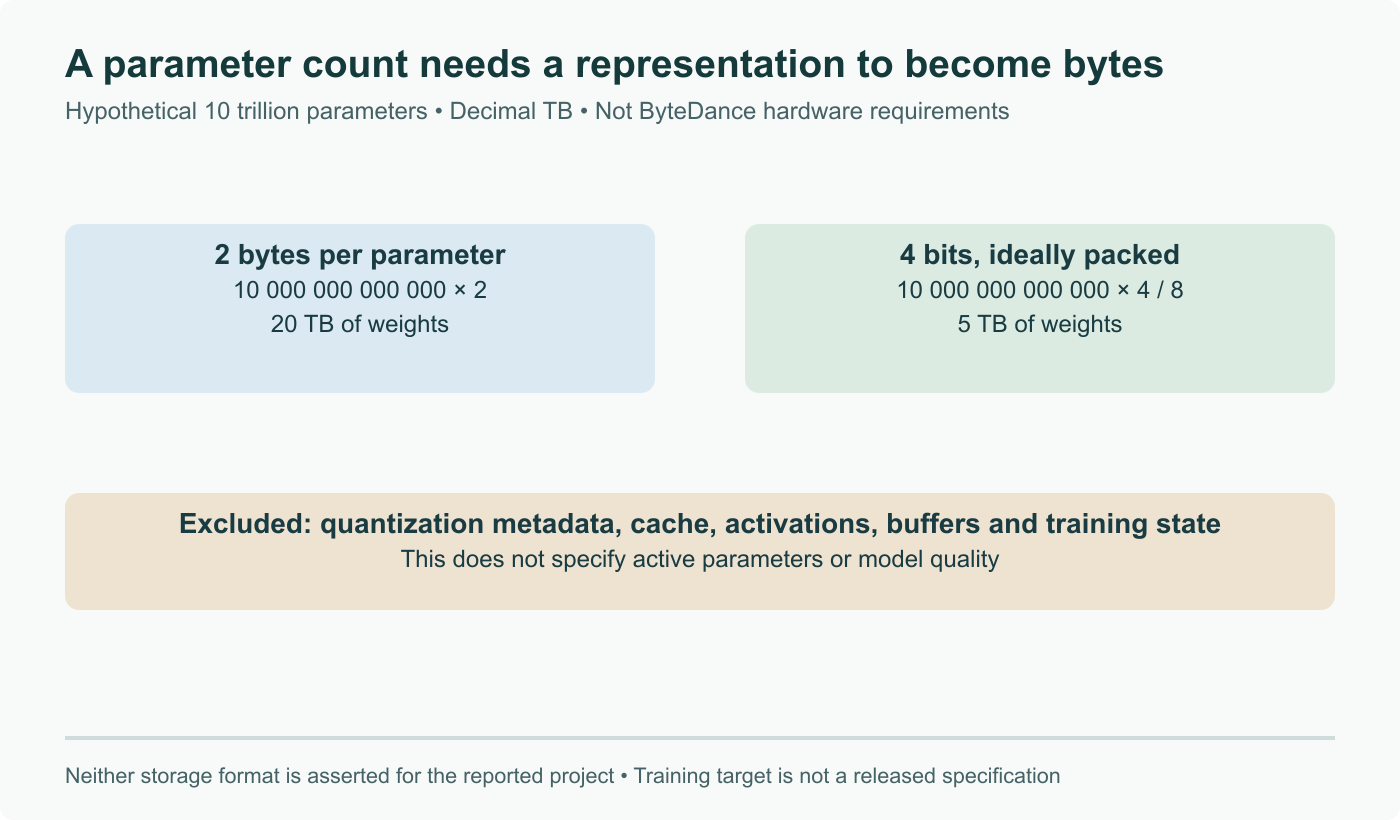
Absent all three, plus any evaluation results, 10 trillion is a fact about how much storage the weights occupy.
The part that does carry information
The hardware implication is concrete. Moonshot is reported to have trained Kimi K3 on roughly 20,000 NVIDIA chips at around 2.8 trillion parameters. A run at 10 trillion means a materially larger cluster, or a similar one tied up for far longer, and either way it means ByteDance currently has frontier scale compute pointed at a single project.
That is the sentence worth carrying away, because it holds regardless of how the model turns out. Constraints on access to the newest accelerators have not stopped Chinese firms from assembling training clusters at this scale. Whether that reflects stockpiles, domestic silicon, capacity rented abroad, or simply better utilisation of installed hardware is not something the reporting settles, and confident claims either way are guesses.
The instruction against distillation points the same direction. Distillation is the efficient path: train a smaller model on a stronger one's outputs and arrive somewhere decent quickly. It also inherits a ceiling from the teacher. Choosing to build capability directly, at 10 trillion parameters, is a decision to spend far more in exchange for the possibility of being ahead rather than reliably behind.
How to read the next one of these
There will be another number in a few weeks, and the same discipline applies. Ask for the active parameter count before the total. Ask what the training token budget was. Ask for evaluations on tasks you care about, run by someone other than the lab. If those are missing, what you have is a procurement signal rather than a capability claim, which is still interesting but interesting about something else.
For anyone building on top of these models, the practical position has not changed this week. Nothing has shipped, no benchmarks exist, and ByteDance has not confirmed the project. Related reading on how the disclosed figures have moved: our coverage of Qwen3.8-Max at 2.4 trillion parameters and of Anthropic's Fable 5 and Mythos 5.
Sources and further reading
- ByteDance Is Training a 10 Trillion Parameter AI Model, Financial Times reports, MLQ News, August 7, 2026
- ByteDance is training a 10 trillion parameter model to chase the frontier, TNW, August 7, 2026
- ByteDance Is Training a 10 Trillion Parameter Model To Chase the Frontier, Slashdot discussion
- ByteDance trains 10 trillion parameter AI model, The News
- ByteDance Trains AI With Up to 10 Trillion Parameters, but Raw Counts Cannot Measure the Gap, XenoSpectrum
Frequently asked questions
Why is a parameter count a poor guide to how good a model will be?
Because it measures capacity, not capability, and the gap between the two is where all the engineering lives. Three numbers matter at least as much and none of them was reported here. The first is the active parameter count: most large models today are mixtures of experts, meaning only a fraction of the weights participate in any single forward pass, so a 10 trillion parameter model might activate a few hundred billion per token and cost accordingly. The second is the training compute budget, because a very large model trained on too few tokens is undertrained and will lose to a smaller model that got a fuller diet. The third is data quality and mix, which is the least glamorous input and reliably one of the most decisive. Without those, 10 trillion is a fact about a file size rather than a claim about performance.
How does this compare with what is already out there?
On raw count it would be the largest disclosed figure by a clear margin. Moonshot's Kimi K3 sits around 2.8 trillion parameters and is among the biggest Chinese models in circulation, so 10 trillion is more than three times that. Industry estimates place Anthropic's Mythos 5 near 8 trillion and its more widely available sibling Fable 5 near 5 trillion, though those are estimates rather than published figures and should be read as such. The comparison worth making is not the ranking but the trajectory: the top of the range has roughly tripled in about two years, which tells you the scaling bet is still being placed by people with the compute to place it, in China as much as in the United States.
What does early pre-training mean for timing?
It means nothing ships for a while. Pre-training a model of this size typically runs three to six months of continuous compute, and that is only the first stage. What follows is the post-training work, the fine tuning and alignment and evaluation cycles, which for a frontier system is a substantial project in its own right rather than a finishing touch. ByteDance has not publicly identified the model, has not announced a release timetable, and may not release it at all in the form being trained now, since large runs get abandoned or restarted more often than the public record suggests. Treat the report as a signal about where compute is being pointed today, not as a product announcement with a date attached.
What hardware does a run like this take?
More than the comparison point, which is itself substantial. Moonshot is reported to have used roughly 20,000 NVIDIA chips to train Kimi K3 at around 2.8 trillion parameters, so a run at 10 trillion implies a considerably larger cluster or a considerably longer occupancy of a similar one. That is the part of the story with the most concrete implications, because it says Chinese firms are still assembling clusters at frontier scale despite the constraints on access to the newest accelerators. Whether that comes from stockpiled parts, domestic silicon, capacity rented outside the country, or better utilisation of what is already installed is not something the report settles, and anyone claiming certainty about the mix is guessing.
Why does the instruction to avoid distillation matter?
Because it says something about intent that the parameter count does not. Distillation trains a smaller model on the outputs of a stronger one, which is an efficient way to reach a good result quickly and a structurally limiting one, since the student inherits a ceiling from the teacher and rarely exceeds it on anything that matters. Founder Zhang Yiming reportedly told staff not to lean on it. Read alongside a 10 trillion parameter pre-training run, that reads as a decision to build frontier capability directly rather than to chase it cheaply, which is a much more expensive commitment and a much slower one. It is also the only way to end up ahead rather than permanently one step behind, so as a strategic statement it is coherent even before any results exist to judge.