CachyOS published its August 2026 media refresh on August 9, and the interesting part is not on the desktop. The command line installer picked up experimental support for the installation profiles of a forthcoming CachyOS Server Edition, which is a genuinely surprising direction for a distribution built around desktop and gaming performance tuning. Alongside that, the project has been rewriting its own tooling: the chwd kernel manager back end moved from C++ to Rust, the Cachy Update tray applet moved to Rust as well, and the Shelly graphical package manager was rewritten from C sharp to Zig, dropping a managed runtime from the default install.
The short answer
The CachyOS August 2026 release landed on August 9 and does two things worth noting. Its command line installer gained experimental installation profiles for a forthcoming CachyOS Server Edition, a direction nobody expected from a distribution built around desktop and gaming tuning. And the project continued moving its own tooling off older languages: chwd, the kernel manager back end, went from C plus plus to Rust, the Cachy Update tray applet went to Rust, and the Shelly graphical package manager was rewritten from C sharp to Zig, removing a managed runtime from the default install. The graphical installer and welcome screen also picked up fixes.
Monthly media refreshes are usually the least newsworthy thing a rolling distribution does. The packages were already current, the ISO was not, and rebuilding it is housekeeping. The CachyOS release published on August 9 is an exception, and the reason is buried in the command line installer.
That installer now carries experimental support for the installation profiles of a CachyOS Server Edition. The edition itself does not exist yet, no feature list has been published and no date has been given, but you do not refactor an installer to accommodate server profiles as an idle exercise.
A performance desktop distribution looking at servers
CachyOS is Arch based and its entire proposition is tuning. Kernels built with alternative schedulers and optimisation flags, packages compiled for newer x86 microarchitecture levels, and defaults that save you assembling all of it yourself. That combination found an audience on desktops and in gaming, where the difference is visible and the risk of a rolling release is one machine.
A server edition is a different argument, and the surprising thing is how reasonable it is once you separate the tuning from the desktop.
Compiling for x86-64-v3 or v4 is arguably easier to defend on a fleet of identical machines you specified and control than on a laptop you might replace next year. Scheduler work matters as much to a database under load as to a game. None of that requires a display server, and none of it stops being true when the machine goes in a rack.
The rewrites are the other half of the story
Three of the project's own tools changed language this cycle, and the pattern is consistent.
chwd, the back end behind kernel and hardware handling, moved from C plus plus to Rust. The Cachy Update system tray applet moved to Rust as well. Neither rewrite adds a feature, and neither is supposed to. What they buy is memory safety in components that run with privilege, and a codebase where the project's tooling shares one set of patterns instead of several.
Shelly, the default graphical package manager, is the more interesting one. It moved from C sharp to Zig, and the consequence is not about the language so much as what came with the old one. A C sharp application needs a managed runtime, and shipping one in a default desktop install means every user carries that dependency whether anything else on the system uses it or not. The Zig rewrite removes it: smaller install, lower memory for a tool that sits resident, and one less runtime to track across a rolling release.
There is a maintenance argument underneath all three. A distribution whose own tools are written in languages its packagers already handle is easier to keep coherent than one that drags in a whole ecosystem for a single application.
The desktop side, briefly
The graphical installer and the welcome screen picked up improvements and fixes, desktop profiles were adjusted, and the gaming guide documentation was updated. This is the ordinary content of a monthly refresh and none of it changes what an existing installation does, since the packages reached rolling users weeks ago.
What we would do
Nothing yet if you are watching for the server edition, and there is a real question to settle before you do.
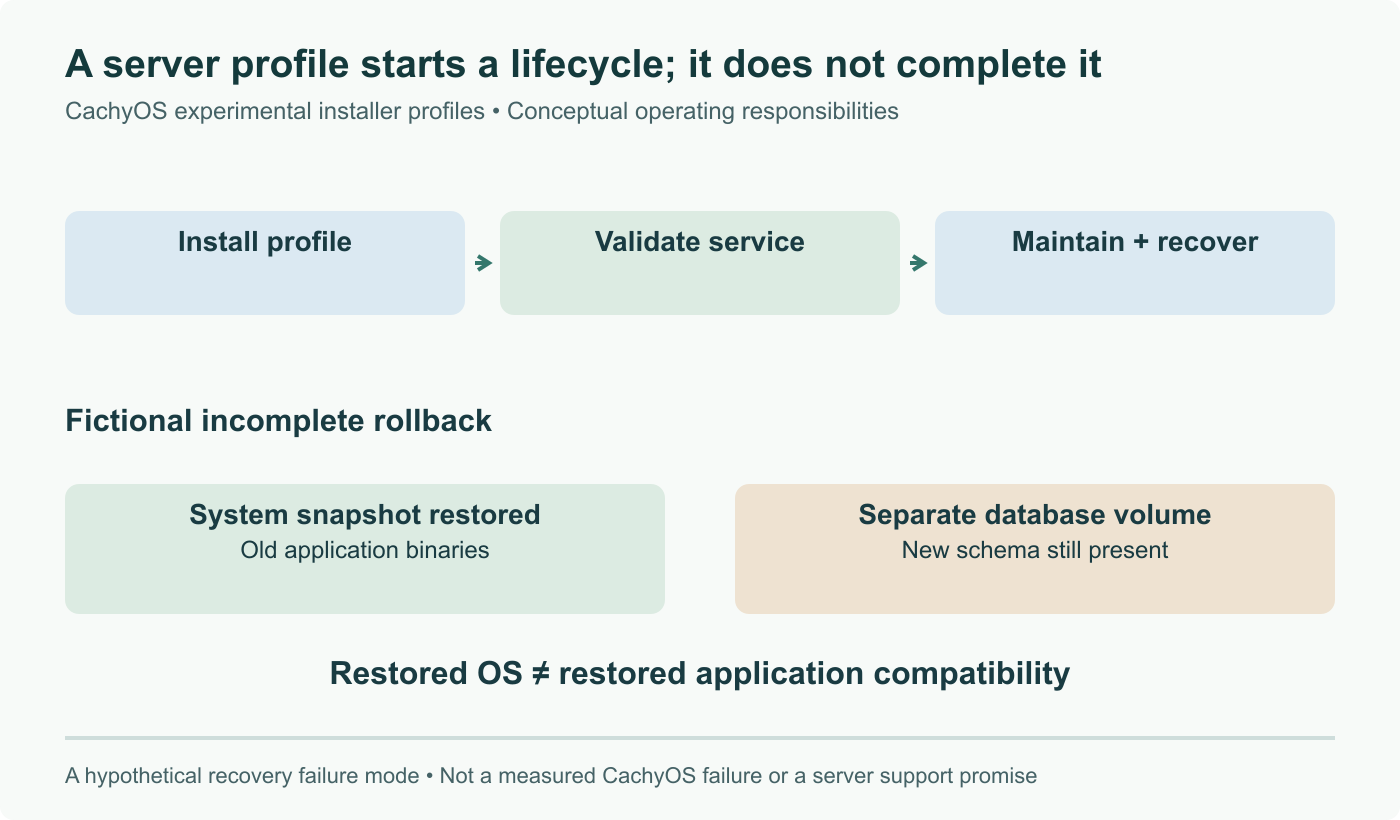
Whether a rolling release belongs on a server depends far more on your update discipline than on which distribution you pick. Current kernels and libraries without waiting for a distribution cycle is a genuine benefit if you need recent hardware support. A moving target is the cost: unattended upgrades stop being acceptable, snapshots before updating stop being optional, and you need a rollback path you have tested rather than one you assume works. Arch based systems handle this well with btrfs snapshots and a bootloader entry, which CachyOS already arranges by default, and that is probably why a server edition is plausible at all. Our guide to choosing a Linux distribution in 2026 works through that trade in more detail.
If you already run CachyOS, this release changes nothing about your machine. Rolling users have had these packages for weeks, and the media refresh matters only for new installs.
Sources and further reading
- CachyOS August 2026 release preps for upcoming Server Edition, Phoronix, August 9, 2026
- CachyOS ISO release for August 2026 improves the installer and desktop profiles, 9to5Linux
- CachyOS August 2026 release announcement
- CachyOS August 2026 release thread on the project forum
- The CachyOS project
Frequently asked questions
What is CachyOS and why would a performance desktop distribution want a server edition?
CachyOS is an Arch based distribution whose entire pitch is aggressive performance tuning: kernels built with different schedulers and optimisation flags, packages compiled for newer x86 microarchitecture levels, and sane defaults for people who would otherwise assemble all of that by hand. That has made it popular for desktops and gaming. A server edition is a different proposition, and the reason it is not absurd is that the same compiler flags and scheduler work apply to workloads with no display at all. Compiling for x86-64-v3 or v4 is arguably more defensible on a fleet of identical machines you control than on a laptop you might replace. Whether it is a good idea to run a rolling release on servers is the real question, and it is a separate one.
Is the Server Edition available now?
No. What shipped on August 9 is experimental support in the command line installer for Server Edition installation profiles, which is the plumbing that has to exist before an edition can be released. The project has not published a feature list, a target kernel, or a date. Treat this the way you would treat any preparatory work in a changelog: it confirms the direction and tells you nothing about the arrival. If you want to follow it, the CachyOS release blog and forum announcements are where the detail will appear first, and the installer changes are visible in the current media if you want to look at what is being staged.
Why does moving the package manager from C sharp to Zig matter?
Because of what comes with C sharp rather than because of the language itself. A C sharp application needs a managed runtime, and shipping one in a default desktop install means every user carries that dependency whether or not anything else on the system uses it. Moving Shelly to Zig removes it. The practical effects are a smaller install, lower memory use for a tool that sits resident, and one less runtime to keep updated across a rolling release. There is a maintenance argument too: a distribution whose own tools are written in a language its packagers already support is easier to keep coherent than one that pulls in an ecosystem for a single application.
What is chwd and what changes now that it is written in Rust?
chwd is the back end behind kernel and hardware handling on CachyOS, the piece that works out what a machine needs and manages it. The rewrite from C plus plus to Rust does not add features and is not meant to. What it buys is memory safety in a component that runs with privilege and touches hardware detection, plus a codebase that the project's other Rust tooling can share patterns with. Rewrites like this rarely produce anything a user notices on the day, which is exactly why they get done during a quiet release rather than a busy one. The honest summary is that this is maintenance investment, not a feature.
Should I put a rolling release distribution on a server?
Our position is that it depends far more on your update discipline than on the distribution. A rolling release gives you current kernels and libraries without waiting for a distribution cycle, which is genuinely useful if you need recent hardware support or a new userspace feature. It also gives you a moving target, which means unattended upgrades are a bad idea, snapshots before updating stop being optional, and you need a rollback path you have actually tested. Arch based systems make that manageable with btrfs snapshots and a bootloader entry, and CachyOS ships that kind of arrangement by default. If you cannot commit to reading update notes and testing before rolling to a fleet, a fixed release distribution remains the correct answer.