OpenAI confirmed on Wednesday, August nineteenth, 2026 that ChatGPT Ads will start serving in 31 European countries on Monday, August twenty fourth. Only the Free and Go plans are affected, while Plus, Pro and Enterprise stay ad free. The detail worth reading twice is what feeds ad selection at launch: the topic of the conversation you are currently having, approximate location, device type, time of day and language. Past chats and stored memories are explicitly excluded. Personalization using chat history exists but requires explicit consent, and declining it changes which ads you see rather than whether you see any.
The short answer
OpenAI confirmed on Wednesday, August nineteenth, 2026 that ChatGPT Ads expands to 31 European countries on Monday, August twenty fourth. Ads reach the Free and Go plans while Plus, Pro and Enterprise stay ad free. At launch, selection uses the current conversation topic, approximate location, device type, time of day and language, with past chats and stored memories excluded. Personalization from chat history requires explicit consent, and declining it changes which ads appear rather than removing them.
The interesting thing about ChatGPT Ads arriving in Europe is not that it happened. It is how little the launch configuration actually knows about you.
What is changing, and when
OpenAI confirmed on Wednesday, August nineteenth, 2026 that ChatGPT Ads will expand to 31 European countries. Serving begins on Monday, August twenty fourth. The named markets include Germany, France, Spain, Italy, Sweden, Norway, Denmark, the Netherlands and Austria, and this is the largest expansion of the programme so far.
The scope is limited by plan. Ads appear for people on the Free plan and on Go, the low cost tier that sits around eight euros a month. Plus, Pro and Enterprise subscriptions stay ad free.
For anyone using ChatGPT at work through a paid seat, that is the end of the story. For anyone comparing tools on a free account, it is the start of one, because from Monday the free product in Europe is a different surface than the paid product, and a trial run on the free tier is no longer a clean look at what a subscription would feel like.
The five signals
Ad selection at launch draws on the topic of the conversation currently in progress, approximate location, device type, time of day and language. That is the whole list.
Past chats and stored memories are explicitly not used at launch. OpenAI has been specific about this, and multiple outlets covering the announcement report the same set of signals.
This is contextual advertising in the old sense of the term. The system responds to the question in front of it rather than to a profile assembled over months. Ask about camping equipment and the relevant ad is about camping equipment, not because ChatGPT remembers your hiking trip in April but because the current conversation is about tents.
There is a real privacy difference between those two designs, and it is worth naming it plainly rather than treating all advertising as one undifferentiated thing. A system that reads the current conversation is still reading the current conversation. But it is not accumulating, and accumulation is what makes profile based targeting feel invasive and what makes a breach of an ad system consequential.
Consent, and the switch that is not an off switch
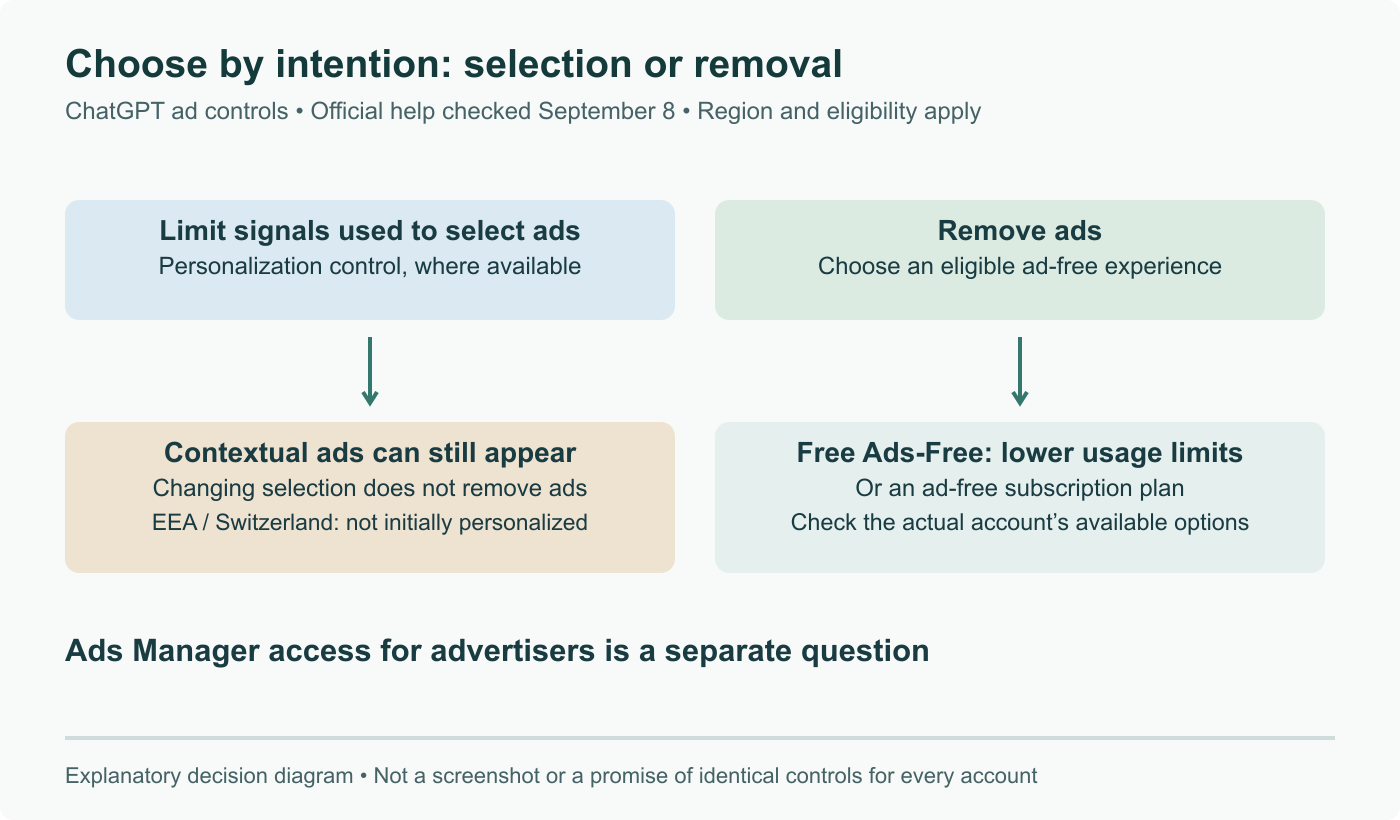
Personalized advertising that draws on chat history and stored memories exists, and it requires explicit consent. European users who do not want their chat history used for targeting can decline.
Declining does not remove ads. It changes which ads appear. Users who opt out continue to see contextual ads selected from the launch signals. The only route to no advertising is a paid plan.
That distinction deserves more attention than it has been getting, because consent dialogs have trained everyone to read a refusal as an exit. Here it is a preference. The honest framing is that Europeans on free tiers are choosing between contextual ads and personalized ads, not between ads and no ads.
The regulatory backdrop explains the shape. GDPR requires explicit consent for personalized targeting unless a company can demonstrate a legitimate interest instead, which is why Europe received this after other markets and why the default landed on the contextual side. Consent based personalization on top of a contextual baseline is the least legally fragile arrangement available, and it is the one that shipped. Europe has been steadily setting the terms for this class of product, as we saw when the EU AI Act transparency rules took effect.
What advertisers get, and what they do not
Advertisers receive aggregated performance information: overall views, clicks, that category of metric. OpenAI states that advertisers do not receive users' chats, chat history, memories or personal details, and that no customer data is sold.
Two further commitments sit alongside that. Ads are always clearly labeled and kept separate from ChatGPT's answers. And advertising does not influence the answers ChatGPT provides.
The second is the one that matters most and the one nobody outside OpenAI can verify. An assistant people trust for recommendations is a fundamentally different advertising surface than a search results page, because the answer itself is the product. Keeping a firm wall between paid placement and generated response is the entire basis on which this is acceptable, and it is a design commitment rather than an observable property. Worth watching over months, not judged in a week.
Access for advertisers starts through the OpenAI Ads Solutions team, agency partners and technology partners. Self service through an Ads Manager is planned to follow.
Why a developer audience should care
Three reasons, none of them about seeing an ad.
The first is evaluation hygiene. If your team is comparing assistants on free accounts in Europe from Monday, you are no longer comparing like with like across tiers. Note it in whatever document records the decision.
The second is that this is the clearest signal yet about how the economics of consumer AI are resolving. Inference costs money, free tiers are enormous, and subscription revenue has never covered the gap. Advertising is the answer the industry reached for in every previous cycle, and the pricing pressure has been visible for a while, including when OpenAI cut GPT-5.6 Luna pricing sharply weeks after launch. Expect competitors to follow rather than to differentiate on staying ad free.
The third is precedent. A contextual first, consent gated design that ships successfully across 31 European jurisdictions becomes the template every other assistant copies. If it holds up with regulators, this is roughly what advertising inside AI products will look like for the next several years.
Sources and further reading
- ChatGPT Ads expands across Europe, OpenAI, August 19, 2026
- OpenAI says ads are coming to ChatGPT in Europe next week, TechXplore, August 19, 2026
- OpenAI To Launch ChatGPT Ads In 31 European Markets On August 24, Dataconomy, August 19, 2026
- OpenAI builds offerings on consent as it expands ChatGPT ads to Europe, Digiday, August 2026
- OpenAI is bringing ChatGPT ads to 31 European countries, The Next Web, August 2026
Frequently asked questions
Which plans see ads, and which do not?
Ads appear for users on the Free plan and on Go, the low cost tier priced around eight euros a month. Plus, Pro and Enterprise subscriptions remain ad free. That split matters if you or your team use ChatGPT for work, because the paid business tiers are outside the change entirely, and the practical route to no ads is a subscription rather than a setting. It also means anyone evaluating ChatGPT on a free account in Europe from Monday onwards is evaluating a different product surface than a Plus subscriber sees, which is worth knowing before you draw conclusions from a trial.
What signals decide which ad I am shown at launch?
Five, and the list is short on purpose. The topic of the conversation you are currently having, your approximate location, your device type, the time of day and your language. Past chats and stored memories are explicitly not used at launch. That makes the launch behaviour contextual rather than profile driven: the system reacts to what you are asking about right now, not to what you asked about last month. It is closer to the way ads worked on a search results page than to the behavioural targeting most people expect from a modern advertising system.
Can I turn ads off by declining personalization?
No, and this is the point most coverage glosses over. Personalized advertising that draws on chat history and memory requires explicit consent, so you can decline it. Declining changes which ads you are shown, not whether you are shown ads. Users who opt out still see contextual ads chosen from the launch signals. If you want no advertising at all, the mechanism is upgrading to Plus, Pro or Enterprise. Treating the consent prompt as an off switch is the mistake to avoid, because it is a targeting switch.
What do advertisers actually receive?
Aggregated performance information such as overall views and clicks. According to OpenAI, advertisers do not receive users' chats, chat history, memories or personal details, and no customer data is sold. OpenAI also states that ads are always clearly labeled and kept separate from ChatGPT's answers, and that advertising does not influence the answers ChatGPT provides. That last claim is the one with the longest tail: it is a statement about product design that users cannot verify from the outside, and it is the assurance that the whole arrangement rests on.
Why did Europe get this after other markets?
The General Data Protection Regulation requires explicit consent for personalized targeting unless a company can demonstrate a legitimate interest instead. Building a consent flow that stands up to that, across 31 jurisdictions with their own regulators and their own interpretations, is slower than shipping the same feature elsewhere. The design that emerged is a reasonable read of the constraint: run contextual ads by default, which need far less justification, and gate history based personalization behind an explicit yes. Whether the regulators agree is a separate question and one that will take longer than a week to answer.