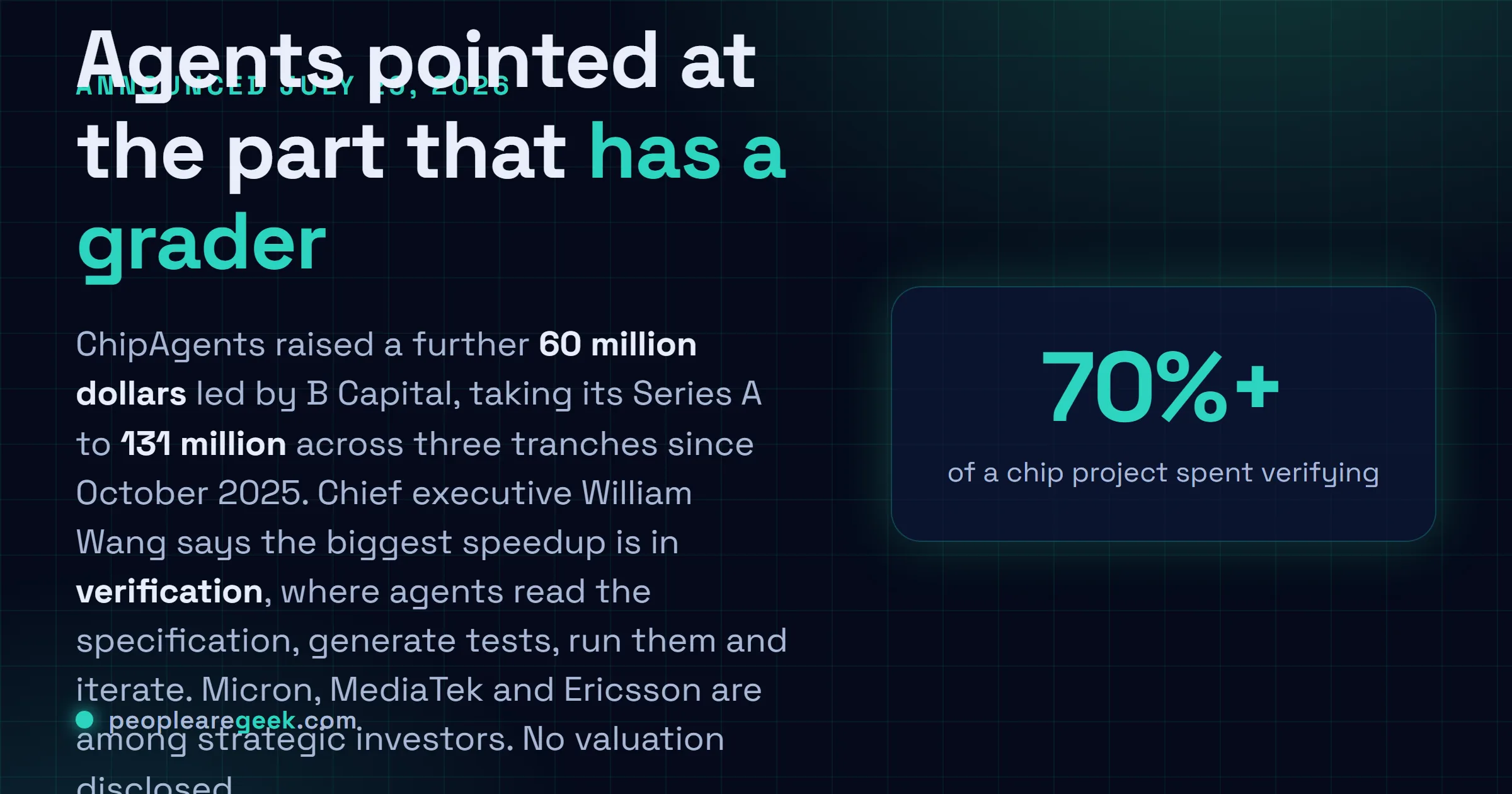
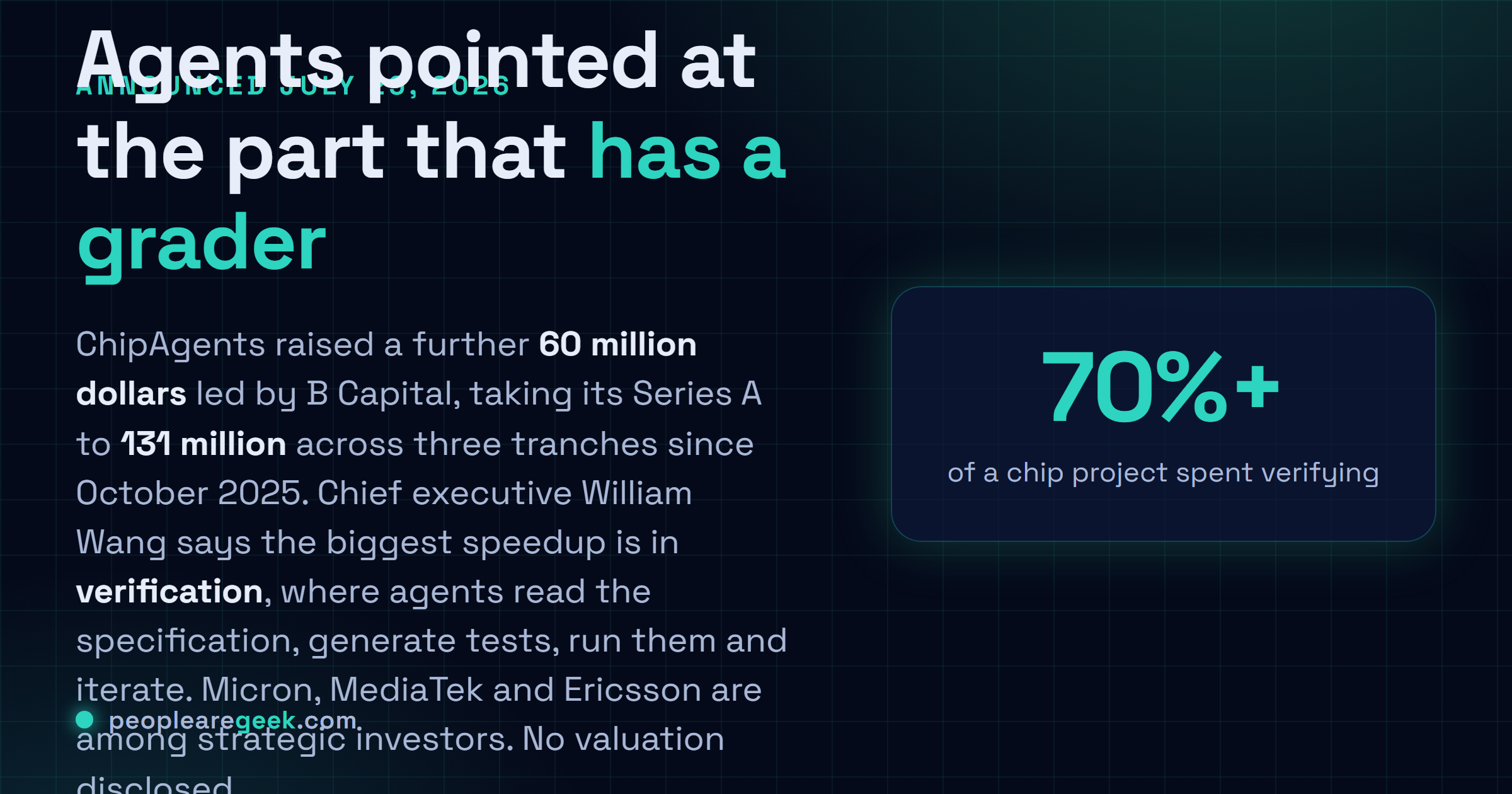
ChipAgents announced another 60 million dollars on July 29, 2026, led by B Capital, which takes its Series A to 131 million across three tranches in under a year. The company builds agents for semiconductor design, and chief executive William Wang is explicit that the biggest measured speedup is not in writing hardware description code but in verifying it. That choice is the interesting part. Verification is the phase that eats the majority of a chip project, and it is also the phase where a machine can tell you whether the output was any good. Agents do their best work where a grader exists, and this is one of the few commercial deployments picking the domain for that reason.
The short answer
ChipAgents announced a further 60 million dollars on July 29, 2026, led by B Capital, bringing its Series A to 131 million dollars across tranches in October 2025, February 2026 and July 2026. The company builds AI agents for semiconductor design, and chief executive William Wang says the largest speedup comes from verification: agents read the specification, generate tests, run them and iterate. It describes itself as an Nvidia partner and is expanding that collaboration to build a chip design specialised model. Strategic investors include Micron, MediaTek and Ericsson. No valuation was disclosed.
There is a version of the AI funding story that is not interesting, where a company raises money because the word agent is in its deck. This is not quite that one, and the reason is a single sentence from the chief executive: the biggest speedup is in verification, not in design.
That is a more useful statement than it looks.
The round
ChipAgents announced 60 million dollars on July 29, 2026, led by B Capital. It is the third tranche of the same Series A, following 21 million in October 2025 and 50 million in February 2026, for a running total of 131 million dollars in under a year. Reuters put the company at around 64 employees. No valuation was given.
Extending a Series A three times rather than moving to a B is a signal in itself. It usually means growth outpaced the normal round cadence and the company preferred not to reset terms. It is also, occasionally, a way of avoiding a headline number. Without a disclosed valuation, we would not read too much into either interpretation.
The strategic investor list is the part worth noting: Micron, MediaTek and Ericsson sit alongside venture investors including Bessemer Venture Partners. ChipAgents also calls itself an Nvidia partner and said it is expanding that collaboration to cover a chip design specialised model of its own. Wang declined to say whether Nvidia has invested.
Why verification is the right beachhead

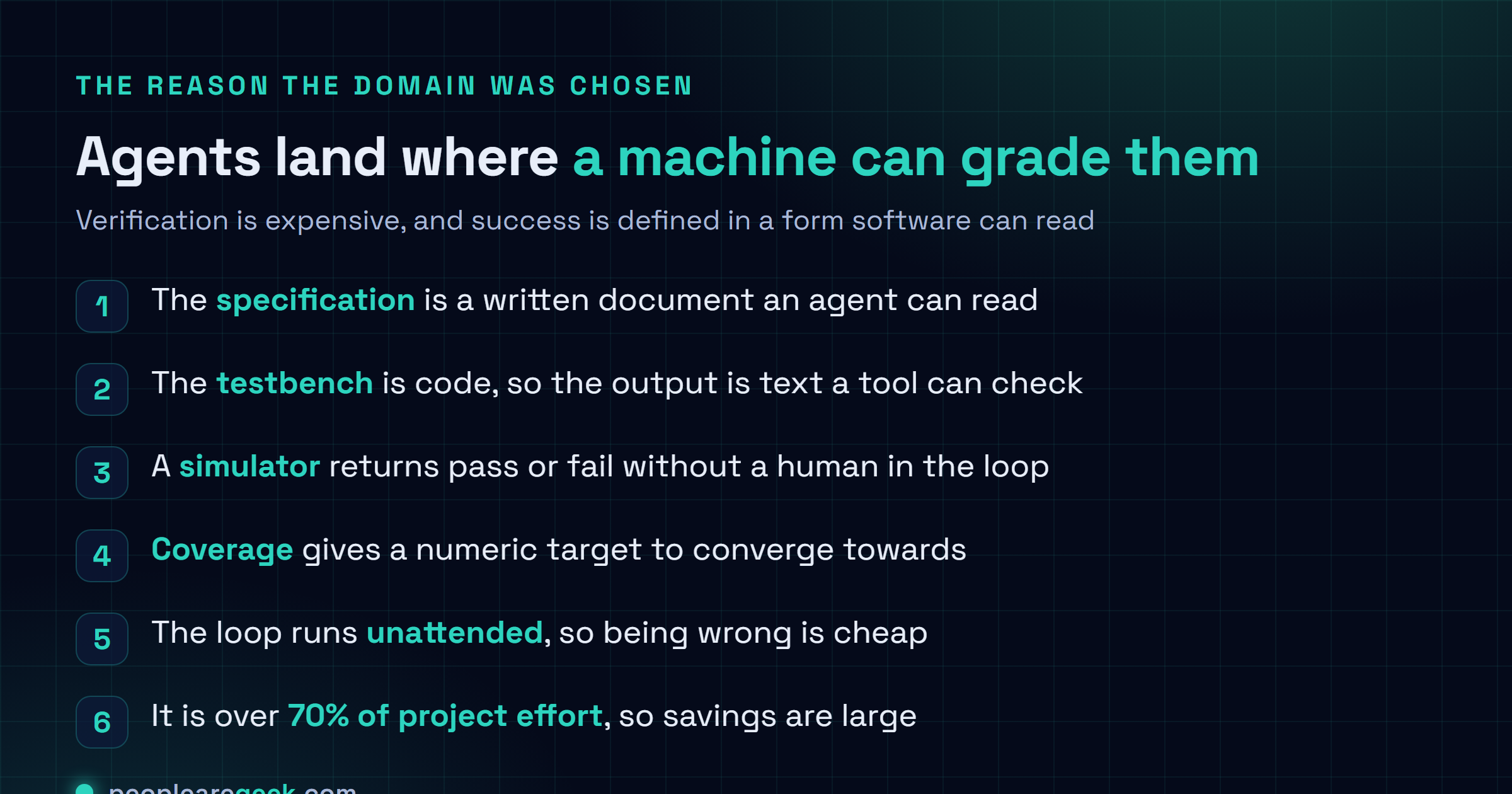
Verification is where chip projects spend their time. Reporting on this round puts it above 70 percent of project effort, which matches the number the industry has quoted for years. Any percentage saved there is a large absolute number, so the commercial logic is obvious.
The technical logic is better. Verification is one of the few software adjacent domains with an unambiguous, machine readable definition of success. Coverage either closes or it does not. An assertion either holds or it fires. A regression either passes or it fails. That means an agent's output can be graded automatically, at scale, without a human in the loop for every attempt.
This is the single strongest predictor of whether agents work in a given domain, and it explains most of the pattern in where they have succeeded so far. Compilers, test suites, type checkers, simulators: wherever there is a cheap oracle, an agent can afford to be wrong repeatedly and still converge. Wherever the only judge is a person reading prose, it cannot, and the failure mode is confident nonsense that survives review.
Picking verification is therefore a statement about method, not just about market size.
The part to stay sceptical about
Two caveats.
The first is that everything known about the product's effectiveness comes from the company. There are no published, reproducible benchmarks. Claims that agents understand specifications faster than humans and produce formal checks nearly instantly are the kind of thing a vendor says. Treat production deployment claims as directional.
The second is more interesting, and it is a limit on the approach rather than on the vendor. Verification exists to find behaviours nobody wrote down. A test generated from the specification checks that the design does what the specification says. The bugs that reach silicon are usually the ones where the specification was silent, ambiguous, or wrong, and where two blocks each behaved correctly against their own reading of it. An agent that reads the spec and generates tests from it is automating the systematic half of verification, which is the half that is expensive but not the half that is hard.
That is still worth a great deal. Freeing engineers from the systematic half to spend their time on the parts requiring judgement is exactly the trade that makes tooling valuable. It is just not the same as automating verification.
What we would take from this
If you build hardware, the practical question for any vendor in this space is not whether the demo is impressive. It is what happens when the RTL changes under a generated testbench, how the agent behaves when the specification is ambiguous, and whether your engineers can review the output rather than being asked to trust it.
If you build software, the transferable lesson is the one about oracles. The teams getting real value from agents right now are almost all working in domains where something other than a human can say whether the result was correct. Before pointing an agent at a problem, it is worth asking what will grade it. If the answer is nobody, that is the thing to build first.
Sources and further reading
- Reuters: Nvidia partner ChipAgents raises $60 million to accelerate chip design with AI agents
- The Next Web: Nvidia partner ChipAgents raises $60M for agentic chip design
- ChipAgents raises an oversubscribed $21M Series A, the October 2025 announcement
- Bessemer Venture Partners on ChipAgents founder William Wang
Frequently asked questions
How much has ChipAgents actually raised?
The July 29, 2026 announcement is 60 million dollars, led by B Capital, and it brings the company's Series A total to 131 million dollars. That total is the sum of three tranches under the same round label: 21 million announced in October 2025, 50 million in February 2026, and this 60 million. Extending a Series A rather than declaring a Series B is a choice about signalling and about not resetting terms, and it has become common among companies whose revenue is growing faster than the usual round cadence. Reuters reported the company at around 64 employees. No valuation was disclosed.
What does the product actually do?
It runs agents across the chip design and verification workflow. In verification specifically, the agents read the specification, generate tests from it, run those tests, look at the results and iterate. That loop is the part that matters. A design specification is a document, a testbench is code, and the pass or fail signal comes from a simulator rather than from a human deciding whether the output looked plausible. The company says its software is in production at multiple chipmakers, which is a company claim rather than an independently verified one. It has not published benchmark results that outside parties can reproduce.
Why is verification the part being automated first?
Because it is expensive and because it is checkable. Verification routinely consumes more than 70 percent of the effort on a chip project, so any real percentage saved is a large absolute number. More importantly, it is one of the rare software adjacent domains with a machine readable definition of success: coverage numbers go up or they do not, assertions hold or they fire, a regression suite passes or it does not. Agents are unreliable in proportion to how hard it is to grade their output. Point them at a domain with a simulator attached and the failure mode becomes wasted compute rather than a subtly wrong answer that ships.
What is the relationship with Nvidia?
ChipAgents describes itself as an Nvidia partner and said it is expanding that strategic collaboration to include developing its own AI model specialised for chip design. Wang declined to say whether Nvidia is an investor. Strategic backers named among its investors include Micron, MediaTek and Ericsson, alongside venture investors such as Bessemer Venture Partners. That mix, semiconductor manufacturers and a network equipment vendor, is a reasonable signal that the customers and the investors overlap, which cuts both ways: strong distribution, and revenue that is harder to read as independent market validation.
Should a hardware team take this seriously yet?
Take the category seriously, evaluate the vendor sceptically. The category is real, because verification has the properties that make agent work land, and every major EDA vendor is building in the same direction. On any specific product, ask for the things that are hard to fake: coverage closure on a design of your size, how the agent behaves when the specification is ambiguous, what happens to the generated testbench when the RTL changes underneath it, and whether the output is reviewable by your engineers rather than a black box you have to trust. Verification exists to catch the bug you did not think of, so a tool that only generates tests for behaviours already described in the specification is helping with the cheap half of the problem.