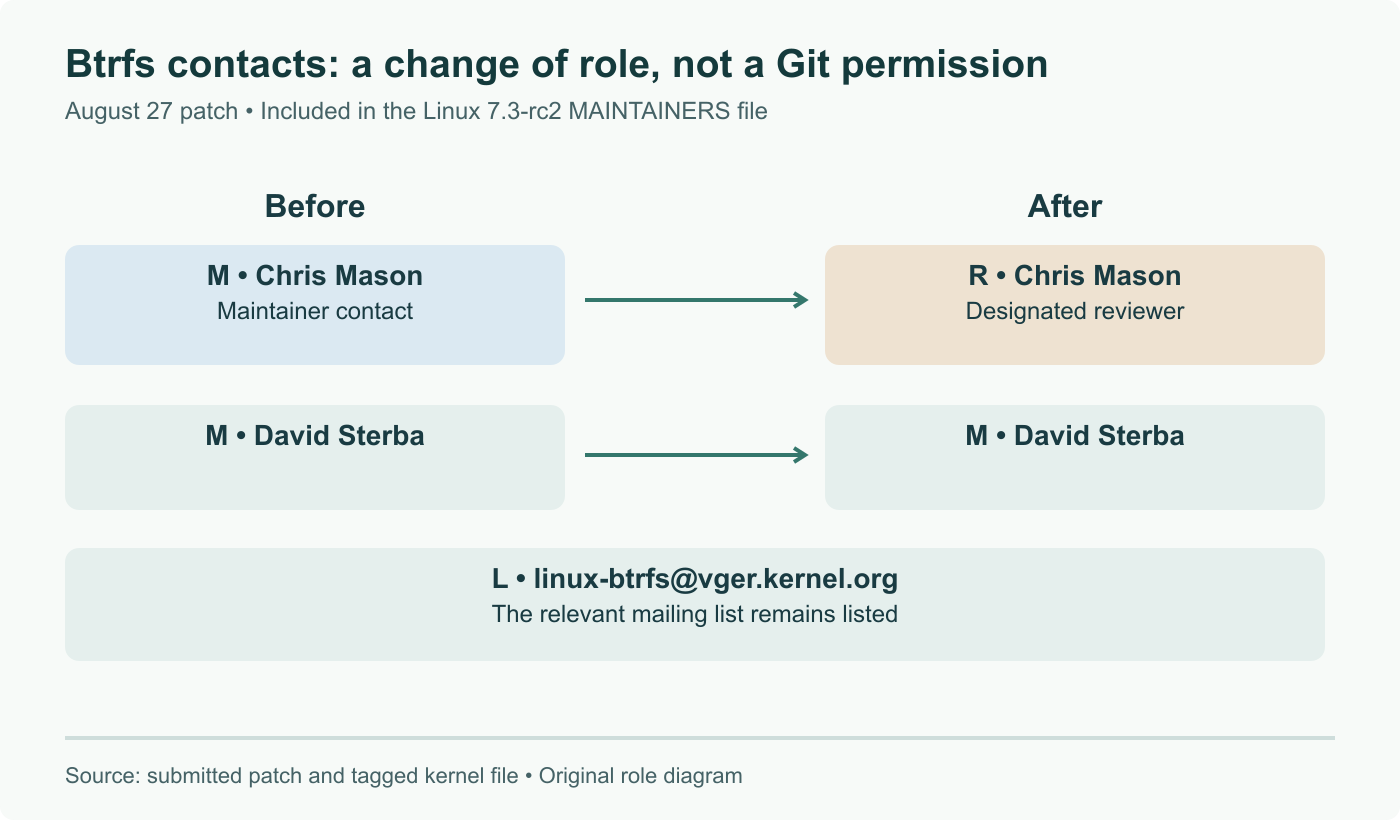
Chris Mason, who started Btrfs at Oracle in 2007, posted a one line MAINTAINERS patch on Thursday August 27, 2026 that drops him from co-maintainer to designated reviewer, and said his last day at Meta was Friday August 28. If you run Btrfs in production this changes nothing about the file system: David Sterba of SUSE has been doing the real maintainership work for years and stays listed as maintainer. What actually changed is an email address and an accurate MAINTAINERS entry. Mason says his kernel contributions continue, and that Meta's commitment to the kernel and to Btrfs is unchanged.
The short answer
Chris Mason posted a one line MAINTAINERS patch to the linux-btrfs list on Thursday August 27, 2026, moving himself from co-maintainer to designated reviewer and switching his address from fb.com to kernel.org. He left Meta on Friday August 28. David Sterba of SUSE, who has run Btrfs maintainership in practice for years, remains the listed maintainer. Mason says his kernel work continues and that Meta's commitment to the kernel and to Btrfs is unchanged. For anyone running the file system, this is a bookkeeping change, not a direction change.
The person who wrote the first line of Btrfs stepped off its maintainer list this week, and the file system did not notice. That is the healthy version of this story.
What the patch actually does
The change is two lines in a file. In the BTRFS FILE SYSTEM block of the kernel MAINTAINERS file, the entry reading M for Chris Mason at an fb.com address is removed, and an R entry for Chris Mason at mason@kernel.org is added. David Sterba's M line at suse.com is untouched, as are the mailing list, the status field and the documentation URL.
That single letter carries the whole story. M means maintainer: the person who applies patches, curates the tree and sends the pull request to Linus, and who is expected to answer when something in the subsystem breaks. R means designated reviewer: get_maintainer.pl will still copy them on every patch touching the subsystem, their review still counts, but nothing merges through them.
Mason's own commit message is blunt about the reason: Sterba has been doing the maintainership work for years, and having to update the email address anyway made it a good moment to make the file more accurate. That is the whole justification, and it is a fair one.
The email is the trigger, not the story
Mason posted the patch series on Thursday August 27 at 19:31 UTC, with a short cover note saying his last day at Meta was Friday August 28 and that his meta.com and fb.com addresses would stop working shortly. Anyone who has left a company with an address baked into an upstream file knows this chore.
He added two things worth reading carefully. First, that Meta's commitment to the kernel and to Btrfs is not changing. Second, that his own kernel contributions continue. He did not say where he is going.
Both statements are credible on the evidence. Meta runs Btrfs across a very large production fleet, which is precisely why it staffed a kernel team around it, and that fleet does not care who resigned. The company's other kernel engineers keep showing up in every merge window, including the direct I/O and fsync rework that landed in Linux 7.3.
What this means if you run Btrfs
Nothing operationally, and it is worth being precise about why rather than just reassuring.
Maintainership risk in a kernel subsystem is real, but it is measured by who merges patches, who cuts stable backports and who answers regression reports. On Btrfs those have been Sterba and the SUSE storage team for years, with Meta engineers as a major contributing group. None of that changed this week. What changed is that the MAINTAINERS file now describes that arrangement accurately instead of describing the arrangement of roughly a decade ago.
The genuinely useful lesson here is about stale MAINTAINERS entries in general. The kernel is full of them, and they matter because get_maintainer.pl is how a first time contributor decides who to email. An entry that points at a dead corporate address quietly costs review cycles for everyone downstream of it. Mason fixed his. Most people never do.
A long run, still running
Mason started Btrfs in 2007 while at Oracle, at a point when Linux had no copy on write file system with snapshots and checksums in the mainline tree. It took years to become trustworthy, and its reputation from that period still trails it around, occasionally unfairly. Today it is the default on several distributions, it underpins large fleets at Meta and elsewhere, and it keeps absorbing serious performance work release after release, from fixing regressions in the fixup worker to the iomap conversion.
Mason has also spent recent years working on AI assisted code review for the kernel, a topic the wider community has been arguing about at length while Debian settled its own generative AI policy this week. Where he lands next is unstated. That he stays a reviewer on the file system he started, under a kernel.org address rather than a corporate one, is a reasonable outcome for everybody.
Sources and further reading
- PATCH 0/1 Update my MAINTAINERS entry, Chris Mason, linux-btrfs, August 27, 2026
- PATCH MAINTAINERS: update Chris Mason's email address, linux-btrfs
- Chris Mason Steps Down As Btrfs Co-Maintainer, Departing Meta, Phoronix, August 28, 2026
- Btrfs documentation, btrfs.readthedocs.io
Frequently asked questions
Should I be worried about running Btrfs in production because of this?
No, and the reason is that this change formalises a situation that has existed for years rather than creating a new one. David Sterba at SUSE has been the effective principal maintainer of Btrfs for a long time, handling the pull requests, the stable backports and the day to day review, and he remains listed as maintainer. Chris Mason moves to the designated reviewer line, which in kernel terms means he still gets copied on patches and still reviews them. The commit rate, the stable tree cadence and the SUSE and Meta investment in the file system are all where they were last week.
What is the actual difference between an M line and an R line in MAINTAINERS?
In the kernel MAINTAINERS file, M marks the maintainer, the person who takes patches, merges them and sends the pull request upstream, and who is expected to answer for the subsystem. R marks a designated reviewer, someone who is automatically copied by get_maintainer.pl and whose review carries weight but who is not on the hook for merging anything. The practical effect for a contributor is that patches sent to linux-btrfs still reach Mason, but the person you wait on for a merge is Sterba. It is a smaller change than the headline suggests.
Why did the change happen now rather than at some tidier moment?
Because of email, prosaically enough. Mason's patch changes the address on his entry from an fb.com one to mason@kernel.org, since his Meta and Facebook mail stops working now that he has left the company. Having to touch the line at all is what prompted him to make it reflect reality, and his own commit message says as much: Sterba has been doing the maintainership work for years and the file should say so. Kernel MAINTAINERS entries drift out of date constantly, and the moments they get corrected are usually mundane ones like this.
Does Meta stop investing in Btrfs now?
Mason addressed that directly in his mailing list post and said Meta's commitment to the kernel and to Btrfs is not changing. That is worth taking at face value for a practical reason: Meta runs Btrfs at very large scale on its own fleet, which is why the company employed a kernel team working on it in the first place. Companies do not walk away from a file system their production estate depends on because one engineer left. Meta also has a substantial kernel team beyond Mason, and their upstream contributions are visible in every release.
Where is Chris Mason going next?
He did not say. The mailing list post covers the email change, the maintainership line and his thanks to Sterba and the Btrfs developers, and stops there. What he did state is that his own kernel contributions will continue, which is the part that matters for anyone tracking the subsystem. Alongside Btrfs he has spent recent years working on AI assisted code review for the Linux kernel and related work, so his next role may well touch that rather than storage. Until he announces something, anything further is guesswork.