Opus 5 is the starting point for everyday work; Fable 5.1 is worth evaluating when difficult tasks still fail. The price comparison now depends on caching: Fable costs more for new input and output, but less for cache reads.
What changes in the comparison
This page originally compared Fable 5 with Opus 4.8. It now covers Fable 5.1 and Opus 5, with information checked on September 8, 2026. The original publication date remains visible so a revision does not appear to be a new release.
Anthropic's Fable documentation recommends starting most workloads on Opus 5, then evaluating Fable 5.1 for harder reasoning and longer agent workflows. Both offer a 1M-token context window and up to 128K output tokens. Paying more does not buy a larger context window.
| API model | Identifier | Where to start |
|---|---|---|
| Opus 5 | claude-opus-5 | Establish a quality and cost baseline |
| Fable 5.1 | claude-fable-5-1 | Retry the difficult cases and measure the gain |
The Opus 5 launch announcement reports improvements over Opus 4.8. Those are vendor evaluations, not tests performed by PeopleAreGeek. The previous article's Fable 5 versus Opus 4.8 scores cannot establish which current model wins on your repository.
The cache changes the bill
Standard Claude API prices in US dollars per million tokens, excluding taxes, platform markups and optional services. Source: Anthropic pricing.
| Token category | Fable 5.1 | Opus 5 |
|---|---|---|
| Uncached input | $10 | $5 |
| Cache write, 5 minutes | $12.50 | $6.25 |
| Cache write, 1 hour | $20 | $10 |
| Cache read | $0.25 | $0.50 |
| Output | $50 | $25 |
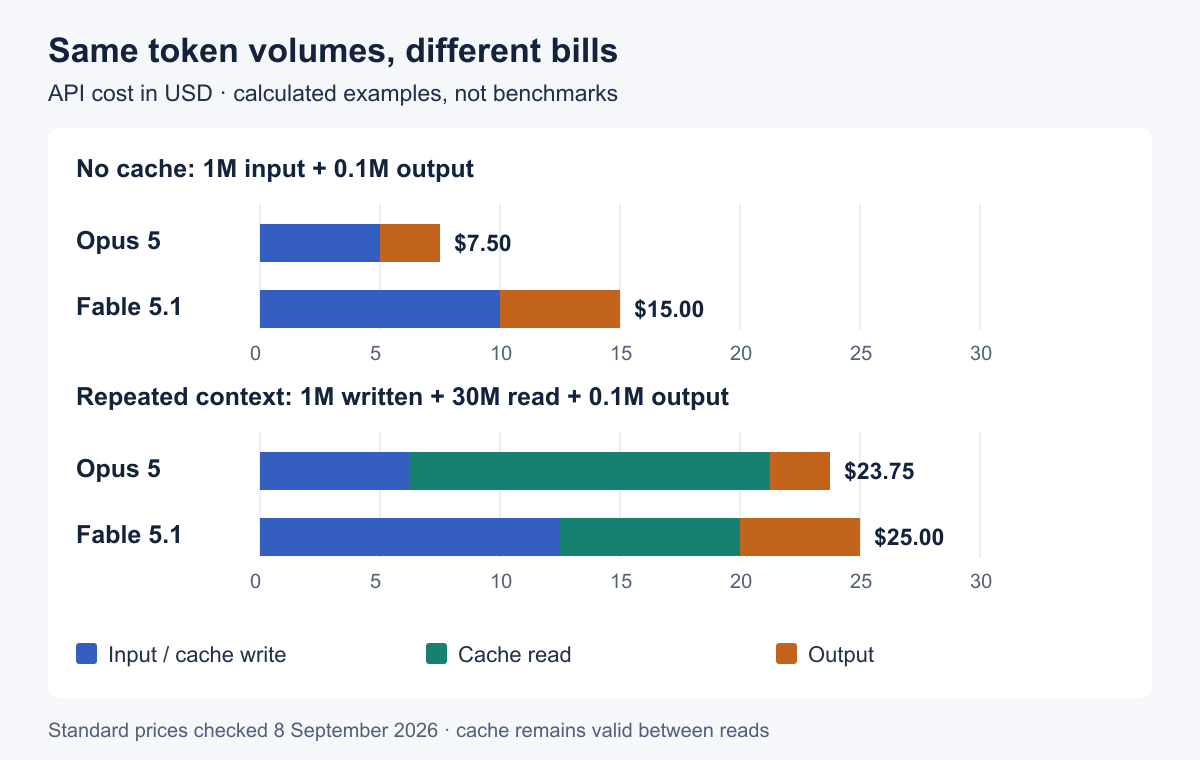
Calling Fable “twice the price” is accurate for new input and output, but not for every token category. Here are two deliberately simple examples using identical volumes for both models. They isolate billing; they do not predict how many tokens each model will need.
- No cache: 1M input tokens and 0.1M output tokens cost $15 with Fable or $7.50 with Opus.
- Repeated context: 1M tokens written once into a five-minute cache, 30M cache-read tokens and 0.1M output tokens cost $25 with Fable or $23.75 with Opus. Each read must happen while the cache is valid; a new write changes the calculation.
For that second example, the arithmetic is 12.50 + 30 × 0.25 + 0.1 × 50 versus 6.25 + 30 × 0.50 + 0.1 × 25. Nothing here assumes Fable generates fewer tokens, avoids a failed run or saves a developer an hour. Those would require measurements.
This distinction matters for a coding agent that repeatedly sends a stable repository context. It matters less for a one-off short request. Include failed attempts and cache writes in your accounting, not just the successful final response. Our prompt-caching explanation separates these categories in more detail.
Check the integration before changing the model
The Fable 5.1 migration guide identifies breaking changes beyond the model name. Forced tool choice (any or a named tool) is rejected. Fable's adaptive thinking stays enabled; disabling it is not supported. Preserved thinking blocks also have model and conversation constraints, so test both a fresh session and an existing conversation.
Do not carry over the old article's claim that every sensitive request transparently becomes an Opus answer. The API's refusal and fallback documentation describes explicit refusal handling and optional fallback configuration. Log the model that actually answered when comparing results and costs.
A comparison you can reproduce on your own work
Pick ten representative tasks before running either model: small fixes, a larger refactor, an unfamiliar code path, a documentation change and a task requiring several tools. Save the same initial files and instructions for both runs. Define what counts as success before seeing the output.
Record the model ID, effort setting, elapsed time, token categories, tool charges, passing checks and manual corrections. Repeat the difficult cases: one lucky run is weak evidence. Keep the tools and stopping conditions comparable, then perform a second round with settings tuned separately for each model.
A useful decision metric is total cost per accepted result, with review time tracked separately. If Opus passes your acceptance checks reliably, keep it for that task. If Fable rescues enough otherwise failed tasks to justify its measured extra cost, use it for those cases. A larger benchmark score alone does not settle that trade-off.
Rebuilt for Fable 5.1 and Opus 5 from current primary documentation. Historical launch-day impressions and obsolete benchmark comparisons removed. Cost examples are calculations, not measured model performance.