NetworkNews

Cloudflare Sees Machine Traffic Hitting 1000x Human Levels

On this page
  1. What was said
  2. Why the numbers move so violently
  3. What changes if you run an origin
  4. How much to believe
  5. Sources and further reading

Cloudflare CFO Thomas Seifert told analysts on the company's second quarter earnings call that if current trends hold, non-human traffic will be as much as 1,000 times human traffic within five years. His phrase for it was that humans will be a rounding error on the internet, not because human traffic falls but because the other kind grows that fast. The company had expected machines to overtake humans in 2027 and measured the crossover in May 2026 instead. Seifert added the caveat that he has called this wrong at every point so far. We looked at what a machine majority actually changes for anyone running an origin.

The short answer

On Cloudflare's second quarter 2026 earnings call, chief financial officer Thomas Seifert said that if current trends continue, non-human traffic will be as much as 1,000 times human traffic within five years, and that humans will become a rounding error on the internet, not because human traffic drops but because machine traffic grows that fast. The company had forecast the crossover for 2027 and measured it in May 2026 instead. Seifert noted he has called the trend wrong at every point so far. Cloudflare reported revenue of 696 million dollars for the quarter, up 36 percent year over year, with a net loss of 205.7 million dollars.

1000xnon-human to human traffic ratio forecast within five years
May 2026month machines overtook humans, forecast had been 2027
$696MCloudflare second quarter revenue, up 36 percent year over year
Answer card titled humans as a rounding error, explaining that Cloudflare chief financial officer Thomas Seifert told analysts on the second quarter 2026 earnings call that non-human traffic could reach one thousand times human traffic within five years, that he added he has called it wrong at every point so far, and highlighting May 2026 as the month machines overtook humans.
The forecast and its caveats in one card. Source: the Cloudflare second quarter 2026 earnings call, reported August 7, 2026. PNG

Forecasts made on earnings calls deserve a particular kind of reading, and this one comes with its own warning label attached by the person who delivered it. What makes it worth a closer look anyway is that the underlying crossover is not a projection at all. It already happened, and it happened more than a year ahead of the company's own estimate.

What was said

Thomas Seifert, Cloudflare's chief financial officer, told analysts that if current trends continue, non-human traffic will be as much as 1,000 times as much as human traffic within five years. His summary was that humans will be a rounding error on the internet, not because human traffic goes down, but because that is simply how fast non-human traffic is growing.

He then added something most executives leave out: the observation that he has called this wrong at every point along the way. That is worth keeping in view. It is a trend line extended across five years, delivered on a call whose purpose is to explain why demand for the company's products should grow.

The part that is not a forecast is the crossover. Cloudflare had expected machine generated traffic to exceed human generated traffic in 2027, with chief executive Matthew Prince having pointed at the end of that year. The company measured it in May 2026 instead.

The financials framing the remarks were revenue of 696 million dollars for the quarter, up 36 percent year over year, a net loss of 205.7 million dollars, and planned capital expenditure of 14 to 15 percent of a full year revenue forecast of 2.865 to 2.87 billion dollars, which works out around 430 million.

Why the numbers move so violently

The mechanism is a multiplier, not new demand.

A person comparing cameras opens perhaps five retailer pages. An agent asked the same question can fetch several thousand, and the person never sees most of them. The human intention is identical. The traffic it generates differs by three orders of magnitude, and nothing about that ratio is fixed by physics or by habit.

That is also why the growth rate resists prediction. It depends on how agent designers trade breadth of retrieval against cost and latency, and those choices can shift by an order of magnitude between two product releases. A model that fetches more aggressively because retrieval got cheaper moves the whole curve, without a single additional user arriving.

What changes if you run an origin

Checklist card titled what stops holding first, listing that capacity models built on monthly active users drift low, that cache hit ratio erodes because machine traffic is broad and shallow, that cost per request is multiplied by every fetch one prompt triggers, that engagement metrics stop describing your audience, and that the one thousand times figure should be read as an order of magnitude rather than a planning number.
The planning assumptions that stop holding first, before any architecture changes. PNG

Most of what shifts is assumptions rather than architecture.

Request volume decouples from user count. If your capacity model starts from monthly active users and multiplies out, it will drift, and it will drift in the direction of underestimating.

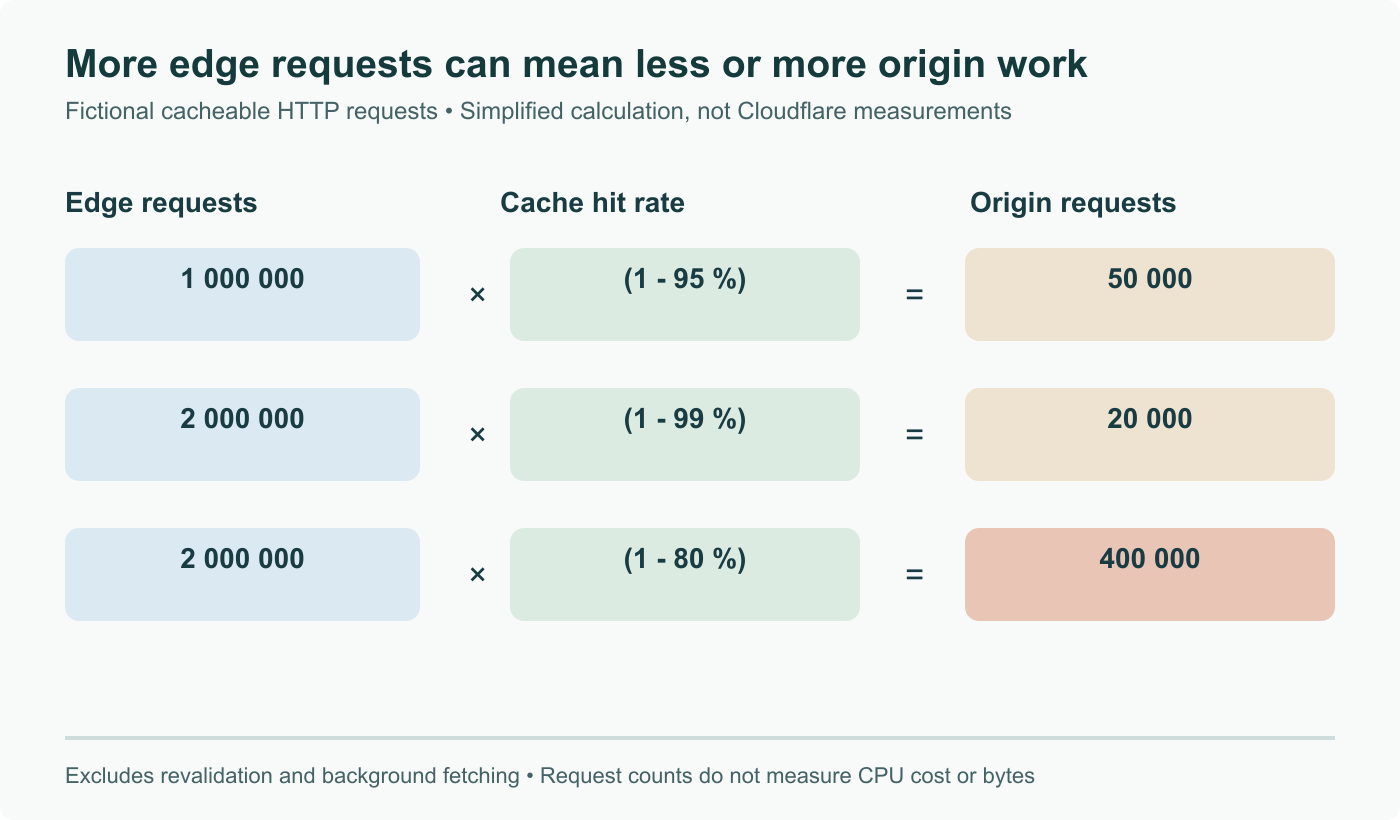
Cache hit ratio becomes the number that matters more than request count. Machine traffic tends to be broad and shallow, touching many distinct URLs once rather than a few URLs repeatedly. That is exactly the access pattern a cache handles worst, so a rising share of it will quietly erode a hit rate that used to be stable.

Cost per request stops being a rounding error of its own. When one human intention can generate thousands of fetches, anything you do per request that is expensive, a database round trip, a template render, an outbound call, gets multiplied by the same factor.

Analytics degrade in a way that is easy to miss. Engagement metrics computed over a request stream that is mostly not human describe something, but not your audience. If a dashboard has been quietly drifting for a year, this is a plausible explanation.

And API shape becomes a cost decision. An endpoint that forces callers into many small round trips is unremarkable when the caller is a person clicking through pages, and expensive in aggregate when the caller is software with no patience and no attention budget.

How much to believe

The 1,000 times figure should be read as an argument about orders of magnitude, not as a number to plan against. Its author flagged his own record on it, and it serves a commercial argument on the call where it was made.

The measured crossover is the more solid input, and its most interesting property is that it arrived early. A forecast that misses by more than a year in the direction of underestimating is a signal about the shape of the curve, and it is a better reason to revisit your assumptions than any five year projection.

The practical version fits in a sentence. Assume that within a few years most of what reaches your infrastructure will not be a person, then check whether your capacity model, your cache strategy and your cost accounting were built on the opposite assumption. For most teams, they were.

Sources and further reading

Frequently asked questions

What exactly did Cloudflare say, and in what context?

Thomas Seifert, Cloudflare's chief financial officer, made the remarks on the company's second quarter 2026 earnings call, and they were reported the following day. The specific wording was that if current trends continue, in five years non-human traffic will be as much as one thousand times as much as human traffic, and that humans will be a rounding error on the internet, not because human traffic goes down, but that is simply how fast non-human traffic is growing. He attached an unusually candid caveat, noting that he has called this wrong at every point along the way, which is a useful reminder that this is a projection from a trend line rather than a measurement. Context matters too. This was an investor call, where the argument being made is that traffic growth of any kind creates demand for the company's services, so the forecast and the pitch point in the same direction.

Has machine traffic really already passed human traffic?

On Cloudflare's network, yes, and that part is a measurement rather than a forecast. The company had previously expected machine generated traffic to exceed human generated traffic in 2027, with chief executive Matthew Prince having pointed at the end of that year, and the crossover was instead observed in May 2026. The important qualifier is whose network we are talking about. Cloudflare sits in front of a very large slice of the public web, which makes its view broad, but it is still a sample shaped by the kinds of sites that use it. A private API estate, an internal service mesh or a corporate network would produce a completely different ratio. Treat the crossover as a solid signal about the public web as seen from one very large vantage point, and not as a universal fact about all internet traffic everywhere.

What is actually driving the growth?

Agentic software: programs that browse and retrieve pages on behalf of an assistant rather than a person. The reason the numbers move so violently is that the ratio between a human action and the machine work it triggers has no natural ceiling. A person comparing cameras might open five retailer pages. An agent asked the same question can fetch several thousand, and the person will never see most of them. That is a multiplier applied to demand that already existed, which is why the growth does not require more people or more time online. It is also why the growth rate is so hard to predict, since it depends on how agent designers choose to trade breadth of retrieval against cost and latency, and those design choices can change by an order of magnitude between one product release and the next.

What does this change for someone running a website or an API?

Mostly it changes your assumptions rather than your architecture. Request volume decouples from user count, so capacity planning driven by monthly active users starts drifting from reality. Cache hit ratio becomes a more important number than raw request count, because machine traffic tends to be broad and shallow, hitting many distinct URLs once rather than a few URLs repeatedly, which is the pattern that hurts a cache. Cost per request matters more when a single human intention can generate thousands of them. Your analytics get noisier, since engagement metrics computed over a request stream that is mostly not human describe something other than your audience. And the shape of your API starts to matter commercially: endpoints that force many small round trips are cheap to serve one at a time and expensive in aggregate once callers are software.

Should the 1000x figure be taken at face value?

No, and Seifert practically says so himself. It is an extrapolation of a current trend across five years, offered by an executive whose own track record on this specific question he described as consistently wrong, on a call whose purpose is to explain why demand for his company's products should grow. None of that makes it dishonest, and the direction it points is supported by an actual measured crossover that arrived more than a year early. The useful way to hold it is as an argument about orders of magnitude rather than a number. Whether the ratio lands at fifty times or a thousand times, the planning consequence is the same: assume that within a few years the majority of what reaches your infrastructure will not be a person, and design your capacity model, your caching and your cost accounting on that basis rather than on user counts.