Cursor began rolling out Origin, its own code hosting platform, to users on paid plans on Monday, August seventeenth, 2026. It does the things you use GitHub for, which is repositories, pull requests, code browsing and review, with Cursor agents wired in and GitHub sync so you do not have to move anything. Roughly three and a half hours after the rollout started, GitHub went into a six hour forty two minute global degradation, its seventh incident in fifteen days. The timing was luck. The question underneath it is not, and it is worth thinking about before you sync a repository anywhere.
The short answer
Cursor started rolling Origin out to paid plans on Monday, August seventeenth, 2026. It ships with repositories, pull requests, code browsing, two way GitHub sync and Cursor agents, and existing GitHub Actions workflows run unchanged. Vercel, Depot and Buildkite integrations are available now. Roughly three and a half hours into the rollout GitHub entered a six hour forty two minute global degradation, its seventh incident in fifteen days. The timing was coincidence, but it is the reason everyone noticed.
Building a code host is a strange thing to do in 2026. The category has been settled for a decade, the incumbent has around a hundred and eighty million users, and nobody wakes up wanting to migrate repositories. Cursor did it anyway, and the argument it makes is more interesting than the launch.
What shipped
Origin began rolling out on Monday, August seventeenth, 2026, in early beta, to users on all paid Cursor plans. Enterprise organisations are included unless their administrators opt out. Cursor had previewed Origin back in June and pointed at a wider release later in the year, so this is the beta arriving ahead of that schedule.
The feature set is the expected core of a code host. Repositories, pull requests, code browsing and review, and access to Cursor agents across a whole project rather than a single open file. It lives in a new Codebase tab in the editor, and hosted repositories get URLs under cursor.com/codebase/name.
Two compatibility decisions matter more than any feature in that list.
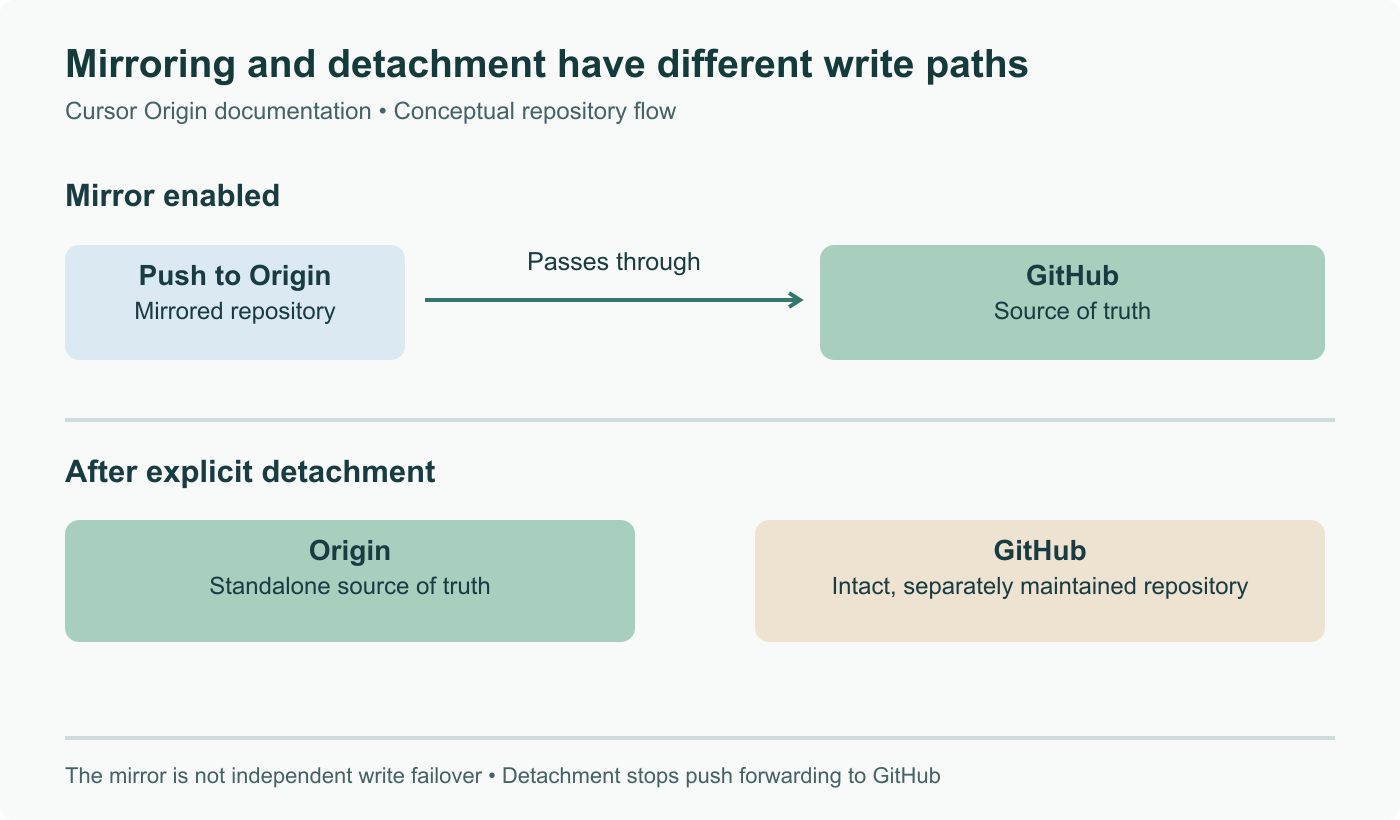
The first is GitHub sync. You connect a GitHub account and mirror repositories into Origin, with GitHub staying the source of truth, and pull request conversations synchronising both ways. Cursor's phrasing is that your GitHub repositories can sit alongside the ones it hosts. That makes trying Origin close to free, because you are adding a mirror rather than performing a migration, and you can stop by disconnecting.
The second is that existing GitHub Actions workflows run unchanged, with Vercel, Depot and Buildkite integrations available from day one. This is the decision that separates a serious attempt from a demo. CI is where code host migrations normally die, because pipelines accumulate years of quiet dependencies on the platform they grew up on, and rewriting them is a project nobody has budget for. Accepting Actions as they are means the trial does not begin with that work.
The argument, which is about agents
Cursor describes Origin as Git hosting at agent scale, and that phrase is doing real work. It is a claim about a change in the traffic, not a list of features.
Git and the workflows layered on top of it were designed around humans. A person opens a branch, pushes a handful of commits over a day or two, opens one pull request, and waits for another person to read it. Review capacity is the scarce resource, and every convention in the modern pull request workflow assumes as much.
Coding agents break those assumptions in ways that are easy to observe if you already run them. Branches multiply, because spinning one up costs nothing. Pull requests get smaller and far more numerous. Merges arrive in bursts rather than spread across a working day. The queue that used to be limited by how fast people could write code is now limited by how fast people can read it, which is a different bottleneck with different fixes.
Whether a host designed for that pattern behaves meaningfully better than one adapted to it is exactly the question Origin exists to answer, and a beta with sparse details is not the answer. Cursor has said agent native features are coming without saying what they are. Treat the framing as a hypothesis worth watching rather than a shipped advantage.
The reliability question, handled honestly
The launch collided with a GitHub outage, and the collision is worth separating from the substance.
Cursor started the rollout on Monday morning. About three and a half hours later GitHub entered a degradation that ran six hours and forty two minutes, with roughly a twenty percent error rate, its seventh incident in fifteen days. A Cursor employee got the day's best line out of it, noting they would have shipped earlier but GitHub was down. It was luck, not planning.
The temptation is to read that as a reliability argument for switching, and it is not one. A platform in early beta has no availability track record at all, which is a weaker position than a platform having a bad fortnight. Any honest comparison needs months of data, published status history and a real incident response process on both sides. Single dependency risk is a genuine engineering concern, but the answer to it is not swapping one single dependency for a newer one.
There is a cheaper answer available, and it is one of the few advantages Git still gives you for free. A Git repository is distributed by design, so mirroring to a second host is a configuration change, not a migration. Push to two remotes, keep your CI definition portable where you reasonably can, and the outage question becomes an inconvenience rather than a stoppage. That holds whether the second remote is Origin, a self hosted server or another provider entirely.
What we would actually do
Sync a low stakes repository and use it for a week, because the trial cost really is low and reading your own diffs in a different review interface tells you more than any launch post.
Keep GitHub as the source of truth while you do, which is the default and the right default. Before enabling it anywhere sensitive, check what the two way sync writes back into your GitHub pull request conversations, who in your organisation can turn it on, and whether your administrators have already opted out. Anything that calls the GitHub API directly, or depends on GitHub specific permissions or repository settings, needs checking separately, since running Actions unchanged does not cover those.
Then wait. Code hosting is infrastructure, and infrastructure earns trust through boring months rather than good launch days.
Sources and further reading
- Cursor capitalizes on GitHub frustration, launches rival hosting platform, TechCrunch, August 18, 2026
- Cursor launches Origin code hosting platform as GitHub outage exposes opening in AI coding race, VentureBeat, August 2026
- Cursor begins Origin code hosting rollout for paid plans, TestingCatalog, August 17, 2026
- Cursor launches Origin, a code hosting platform built for AI coding agents with GitHub sync, Tech Startups, August 17, 2026
Frequently asked questions
What is Cursor Origin and who can use it?
Origin is a code hosting platform built by Cursor, rolling out in early beta from Monday, August seventeenth, 2026 to users on all paid Cursor plans, except inside enterprise organisations whose administrators opt out. It covers the core of what a code host does, which is repositories, pull requests, code browsing and review, plus direct access to Cursor agents across a project. It lives in a Codebase tab inside the editor, and repositories get URLs in the form cursor.com/codebase/name. Cursor first previewed it in June 2026 and had signalled a general release later in the year, so this beta arrives ahead of that.
Do I have to leave GitHub to try it?
No, and that is the deliberate design. You can sync existing GitHub repositories into Origin with GitHub remaining the source of truth, and pull request conversations sync in both directions. Cursor's own framing is that your GitHub repositories can sit alongside the ones it hosts. In practice that means the trial cost is low, because a synced repository is a mirror rather than a migration. It also means the usual questions apply before you enable it on anything sensitive: what the sync writes back, who in your organisation can turn it on, and whether your administrators have opted out.
Does my CI still work?
Existing GitHub Actions workflows run unchanged, which is the single most important compatibility claim in the launch. Vercel, Depot and Buildkite integrations shipped on day one, with more promised. CI is normally the reason a code host migration stalls, because pipelines accumulate years of implicit dependencies on the platform they were written for. Keeping Actions working removes that blocker for a trial. It does not remove it for a full migration, since anything touching the GitHub API, GitHub specific permissions or repository settings still needs checking.
What does agent scale actually mean here?
It is Cursor's framing for a workload change rather than a feature list. When coding agents commit, branch, open pull requests and merge at machine speed, the volume and shape of Git traffic stop looking like human traffic. You get far more branches, far more small pull requests, and review queues that no longer match a human review cadence. Cursor argues a host designed for that pattern behaves differently from one designed for humans clicking merge. The claim is reasonable in principle. The specifics are still thin, and a beta is not enough evidence either way.
Was the GitHub outage related to the launch?
No. The rollout started on Monday morning and GitHub's degradation began roughly three and a half hours later, so the sequence is coincidence rather than cause. The context is what makes it notable. That incident ran six hours and forty two minutes and was GitHub's seventh in fifteen days, which is why availability came up at all. One bad fortnight is not a trend, and a platform in early beta has no availability record to compare against. Judge a new host on months of uptime, not on the week it launched.