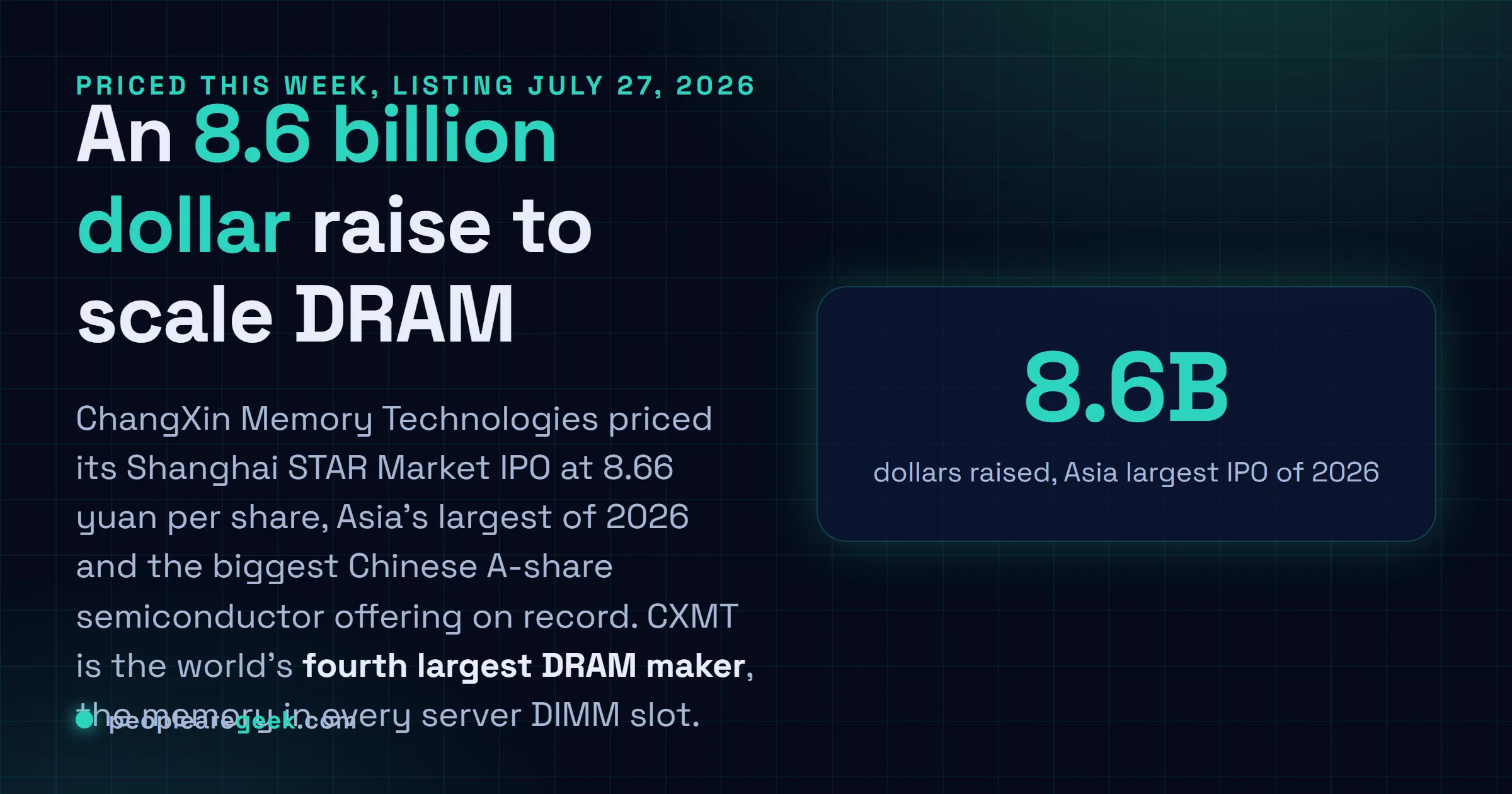
ChangXin Memory Technologies, better known as CXMT, set the price for its Shanghai listing this week, and the numbers are big enough to matter well beyond the stock market. The company is raising at least 57.9 billion yuan, about 8.6 billion dollars, on Shanghai's STAR Market at 8.66 yuan per share, with trading set to begin on July 27, 2026. That makes it Asia's largest IPO of the year so far and the biggest Chinese A-share semiconductor offering on record, past even SMIC's 2020 sale. CXMT is the world's fourth largest maker of DRAM, the memory that fills the DIMM slots in every server, so this raise is really about scaling up production of a component that sits under a huge share of computing.
The short answer
ChangXin Memory Technologies, or CXMT, priced its Shanghai STAR Market IPO at 8.66 yuan per share, raising at least 57.9 billion yuan, about 8.6 billion dollars, with trading to begin July 27, 2026. It is Asia's largest IPO of the year and the biggest Chinese A-share semiconductor offering on record. CXMT is the world's fourth largest DRAM maker, the memory that fills server DIMM slots, so this raise is about scaling up a component that sits under a huge share of computing.
Most of us only think about DRAM when a server order stalls or a memory quote jumps for no obvious reason. This week put a very large number on the thing behind those moments. ChangXin Memory Technologies, the company usually called CXMT, priced one of the biggest chip IPOs on record, and it is doing it to make more of the memory that sits in every DIMM slot you have ever populated. We read it less as a finance story and more as a supply signal for hardware buyers.
The raise, in numbers
CXMT priced its listing on Shanghai's STAR Market at 8.66 yuan per share, raising at least 57.9 billion yuan, roughly 8.6 billion dollars, with trading set to begin on July 27, 2026. That is Asia's largest IPO of the year so far and the biggest Chinese A-share semiconductor offering ever, surpassing chipmaker SMIC's 2020 sale. Notably, the company doubled its original target of about 29.5 billion yuan, which tells you demand for the offering was strong.
The scale is the point. This is not a small raise to fund a product line. It is the kind of capital a memory maker deploys to expand fabrication capacity, and capacity is exactly the lever that moves a commodity market like DRAM.
Why DRAM is the story, not the stock
CXMT is the world's fourth largest maker of DRAM, dynamic random-access memory, with roughly a 7.7 percent share of the market in 2025. DRAM is the working memory that goes into server, desktop, and laptop DIMMs, and it increasingly rides alongside AI accelerators as high-bandwidth memory. It is also a commodity in the technical sense: standardized, interchangeable, and priced on a global cycle. That is why a single large producer adding capacity can ripple across the entire market rather than staying local.

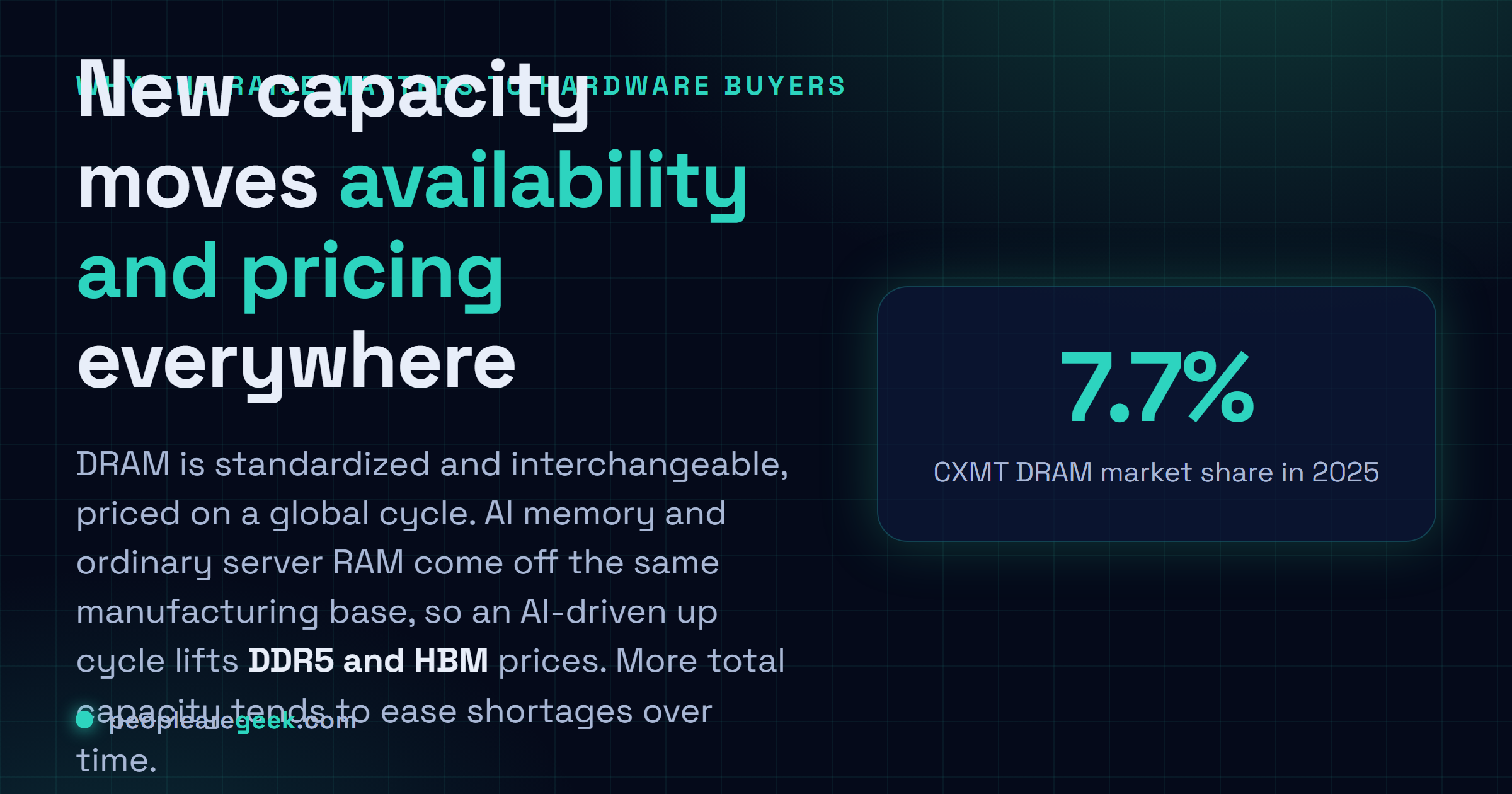
Here is the part that lands on your budget. Memory pricing is cyclical, and it has been in an up cycle driven by AI demand. Accelerators pair with large pools of high-bandwidth memory, and modern systems carry ever more standard DRAM, so DDR5 and HBM prices have been climbing and lead times have stretched. The awkward truth is that AI memory and ordinary server RAM come off the same manufacturing base, so when AI demand runs hot, it competes for the same capacity that makes the sticks going into your racks.
What it means for the people buying hardware
A large producer raising billions to expand output is a supply-side signal, and a useful one. More capacity over the coming years tends to ease shortages and soften prices. The honest caveat is timing: this plays out over quarters and years, not weeks, because fabs are slow to build and leading-edge memory nodes take a long time to qualify for demanding server and AI workloads.
The other effect is structural. The DRAM market has long been concentrated among a small handful of producers, so a fourth major supplier scaling up adds both capacity and competition to a tight market. For anyone who buys memory, more suppliers and more total capacity is generally good news, because it widens sourcing options and puts downward pressure on prices over time. If you plan hardware refreshes or size memory for servers, CXMT's raise is worth filing away: it is one of the clearer signs that the industry is investing to catch supply up with an AI-driven demand spike.
Sources and further reading
- Eastern Herald: China's CXMT raises 8.6 billion dollars in record Shanghai IPO to challenge Samsung and Micron
- MarketScreener via Reuters: China's ChangXin Memory Technologies sets July 27 listing date
- Modern Diplomacy: What is CXMT and why is it China's leading DRAM chipmaker
Frequently asked questions
What is CXMT raising and when does it list?
ChangXin Memory Technologies priced its initial public offering on Shanghai's STAR Market at 8.66 yuan per share, raising at least 57.9 billion yuan, roughly 8.6 billion dollars. Trading is set to begin on July 27, 2026. The company doubled its original fundraising target of about 29.5 billion yuan, a sign of strong investor demand. The raise is Asia's largest IPO of 2026 so far and the biggest Chinese A-share semiconductor offering ever recorded, surpassing SMIC's 2020 listing.
What does CXMT actually make?
CXMT makes DRAM, or dynamic random-access memory, the working memory that goes into the DIMM modules in servers, desktops, and laptops, and increasingly into memory alongside AI accelerators. It is the world's fourth largest DRAM maker, with roughly a 7.7 percent share of the market in 2025. DRAM is a commodity in the sense that it is standardized and interchangeable, which means added capacity from a large new supplier can move availability and pricing across the whole market, not just in one region.
Why should sysadmins and hardware buyers care?
Because DRAM pricing is cyclical and it directly sets the cost of the servers and workstations you buy. Memory has been in an up cycle driven by AI demand, which pushes DDR5 and high-bandwidth memory prices higher and can stretch lead times. A large producer raising billions to expand output is a supply-side signal worth tracking: more capacity over the coming years tends to ease shortages and soften prices, though the effect plays out over quarters, not weeks, because fabs take a long time to build and qualify.
Is this about AI memory or ordinary server RAM?
Both, and they are linked. The immediate boom is AI, where accelerators pair with large pools of high-bandwidth memory and systems carry ever more standard DRAM. But the same fabs and process lines that serve AI also make the DDR5 that goes into ordinary servers and PCs. When memory demand from AI runs hot, it competes for the same manufacturing capacity, which is part of why broad DRAM prices rise during an AI cycle. More total capacity helps relieve that pressure across the board.
Does a Chinese DRAM maker change the global supply picture?
Gradually, yes. The DRAM market has long been concentrated among a small number of large producers, so a fourth major supplier scaling up adds capacity and competition to a tight market. It does not shift the balance overnight, because leading-edge memory nodes take years to ramp and qualify for demanding server and AI workloads. But over time, more suppliers and more capacity is generally good news for anyone buying memory, since it widens sourcing options and puts downward pressure on prices.