SysadminNews

HP, Asus and Acer Start Shipping Chinese DRAM in Laptops

On this page
  1. What was actually reported
  2. Why they did it anyway
  3. Find out what you already have
  4. What we would and would not worry about
  5. Sources and further reading

Three of the biggest names in PCs have quietly started fitting memory from a Chinese supplier, and the reason is arithmetic rather than politics. Semafor reported on August 5 that HP, Asus and Acer are now shipping notebooks containing DRAM from ChangXin Memory Technologies, in limited volumes and only in models sold outside the United States. DRAM contract prices have tripled in eighteen months, AI data centre buildouts are forecast to absorb around seventy percent of memory production this year, and the PC market is heading for a double digit decline. If you buy or specify laptops, the label on the memory die is now something worth checking.

The short answer

Semafor reported on August 5 that HP, Asus and Acer have begun fitting DRAM from China's CXMT in notebooks, in limited volumes and only in models sold outside the United States, after validation completed in mid 2026. CXMT is the only Chinese manufacturer mass producing JEDEC certified DDR4, DDR5 and LPDDR5X. The driver is a memory shortage severe enough that PC makers are also reusing older components, with the market expected to shrink more than eleven percent this year.

3 makersHP, Asus and Acer now shipping CXMT memory in notebooks
3xthe rise in DRAM prices over the last eighteen months
~70%of 2026 memory chip output forecast to go to AI data centres
Answer card: HP, Asus and Acer began fitting DRAM from China's CXMT in notebooks in limited volumes during 2026, after validation completed mid year, restricted to models sold outside the United States, against a backdrop of DRAM prices tripling in eighteen months and AI data centres absorbing about seventy percent of memory production.
The substitution in one card. Sources: Semafor, Gizmodo, Benzinga and The Asia Business Daily, August 5 2026. PNG

We wrote a few days ago about the memory shortage reaching the MacBook Air, and the useful thing about that story was that it showed what happens when a very large buyer cannot get parts. This one shows what happens next: the buyer finds a different supplier.

What was actually reported

HP, Asus and Acer have started using DRAM from ChangXin Memory Technologies in laptops. Validation of the parts finished in mid 2026, and shipments since then have been small on purpose. The machines involved are sold outside the United States.

CXMT is not a new entrant scraping by on tolerance. It is the only Chinese manufacturer currently mass producing DRAM with JEDEC certification, across DDR4, DDR5 and LPDDR5X, which places its parts inside the same published standard everyone else builds to. It listed on the Shanghai STAR Market on July 27, and guided first half 2026 net profit to between 52 and 58 billion yuan, an increase of as much as 2,530 percent year on year, which tells you everything about the pricing environment it walked into.

The restraint on the buyers' side has two causes, and only one is geopolitical. The United States has designated CXMT as linked to the Chinese military, which is why nothing goes into US models. The other cause is more mundane: HP, Asus and Acer still buy the vast majority of their memory from Samsung and SK Hynix, and being seen to defect during an allocation crunch is a poor negotiating position.

Why they did it anyway

DRAM contract prices have roughly tripled in eighteen months. Forecasts put AI data centre buildouts at around seventy percent of all memory chip production for 2026. The PC industry is expected to contract by more than eleven percent this year, and component cost is the main reason.

That is the shape of a shortage that does not resolve by waiting. Wafer capacity committed to high bandwidth memory for accelerators is not making DDR5 for a laptop, new fabs take years to qualify, and the annual increase in supply is currently being absorbed almost entirely by one category of customer. Reports also describe manufacturers reusing older components in new machines, which is the kind of thing companies do when the alternative is not shipping.

Under those conditions, qualifying a second source is not a political statement. It is what a procurement organisation is for.

Terminal card showing how to identify installed memory on Linux and Windows: sudo dmidecode -t memory reporting manufacturer, part number, speed and form factor per slot, lshw -short -C memory for a summary, and the Windows PowerShell equivalent Get-CimInstance Win32_PhysicalMemory.
Two commands that answer the question for a single machine. Worth running across a fleet before it becomes urgent. PNG

Find out what you already have

The practical response to this news is not to change your buying policy. It is to be able to answer the question.

On Linux, sudo dmidecode -t memory walks the SMBIOS tables and prints manufacturer, part number, rated speed, size and form factor for every populated slot, soldered memory included. lshw -short -C memory gives you the same picture faster and less precisely. On Windows, Get-CimInstance Win32_PhysicalMemory returns the same fields, and the older wmic memorychip get Manufacturer,PartNumber,Speed,Capacity still functions on current builds.

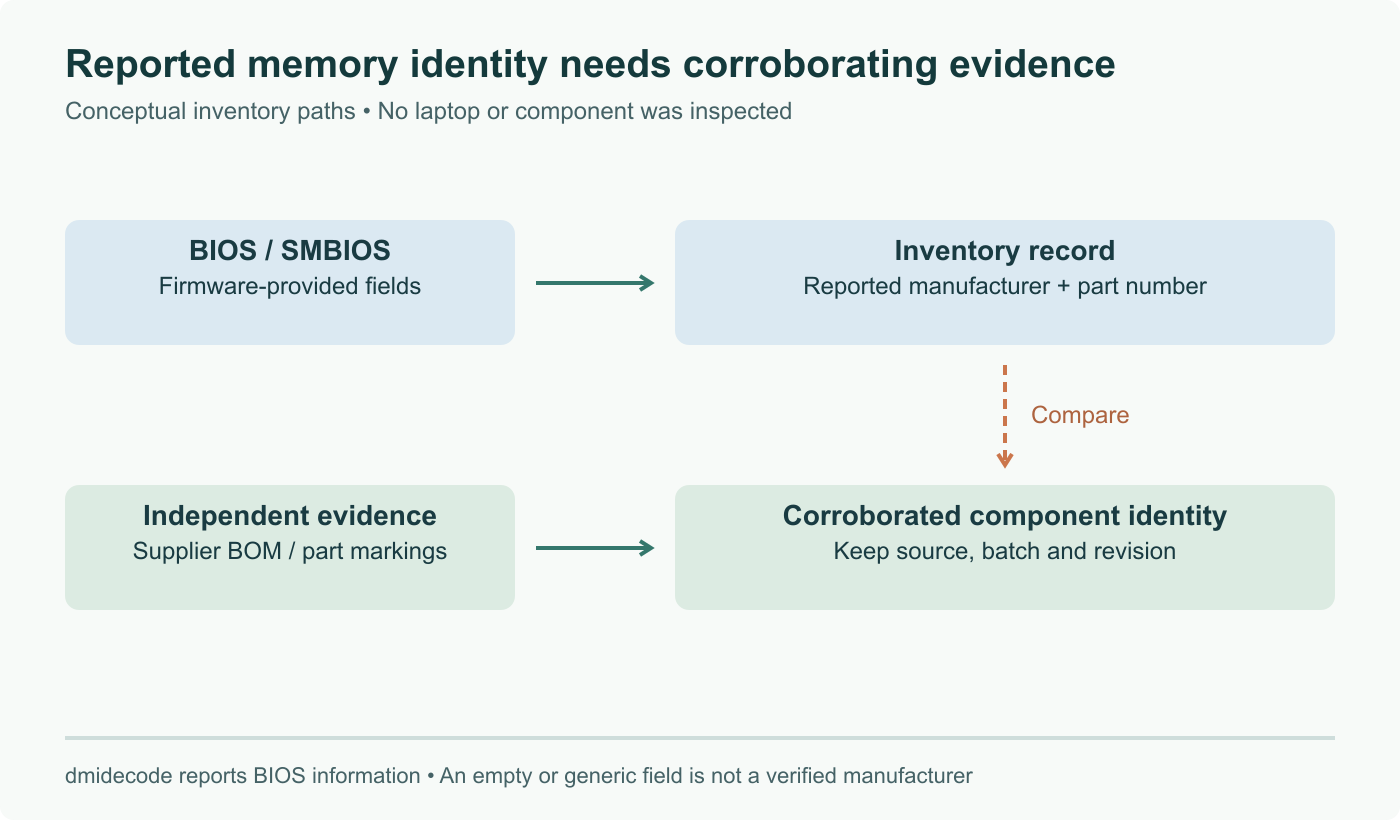
One caveat that catches people out. The manufacturer string comes from the SPD data written to the module, and on machines with soldered memory it sometimes names the assembler rather than the company that made the dies. Treat the part number as the identifier and the manufacturer field as a hint.

If you manage a fleet of any size, collect these two fields into your inventory system now. It costs one afternoon today and answers a question that becomes expensive to answer retroactively.

What we would and would not worry about

We would not worry about performance or conformance. A JEDEC certified DDR5 part meets the DDR5 specification, and the whole purpose of that certification regime is to make the vendor name irrelevant to whether the module works. There is no evidence of a technical problem here, and there is a clear commercial reason for the substitution.

The genuine unknown is long term field reliability, and it is unknown in the literal sense: that data only exists after several years of returns at volume, and CXMT has not been in Western consumer channels long enough to have produced it. That is exactly why the volumes are small. It is a sensible way to build the data set.

What we would actually worry about is documentation. In two years someone will ask which machines in your estate contain which components, either because of a warranty pattern, a customer questionnaire or a procurement rule that did not exist when you bought them. The cost of answering that question is close to zero today and unpleasant later.

For a standard three year office refresh, accept the qualified part and move on. For long service life equipment, regulated environments, or anything where a memory fault is expensive to diagnose, put the memory vendor on the quotation as a line item and keep the paperwork.

Sources and further reading

Frequently asked questions

Is CXMT memory worse than Samsung or SK Hynix memory?

On paper, no, and that is the point of the certification. CXMT is the only Chinese manufacturer currently mass producing DRAM that carries JEDEC certification, covering DDR4, DDR5 and LPDDR5X. JEDEC certification means the part meets the published standard for timings, voltages and signalling, which is the same standard the incumbent suppliers build to. A validated DDR5 module is a validated DDR5 module. What certification does not tell you is anything about long term reliability at scale, because that data only exists after several years of field returns, and CXMT has not been shipping into Western consumer channels long enough to have it. That is a genuine unknown rather than a known defect, and it is the reason the PC makers are proceeding in limited volumes rather than switching wholesale.

How do I find out what memory is actually in a machine?

On Linux, `sudo dmidecode -t memory` reports the manufacturer, part number, rated speed and form factor for each populated slot, and it works on soldered memory too. `lshw -short -C memory` gives a quicker summary. On Windows, `wmic memorychip get Manufacturer,PartNumber,Speed,Capacity` still works on current builds, and `Get-CimInstance Win32_PhysicalMemory` is the modern equivalent. Be aware of one wrinkle: the manufacturer field comes from the SPD data on the module, and on laptops with soldered memory the reported vendor is sometimes the module assembler rather than the die maker. The part number is the more reliable identifier. If you are running a fleet, this is worth collecting into your inventory now rather than after a warranty question comes up.

Why only models sold outside the United States?

Because the United States government has designated CXMT as linked to the Chinese military, and that designation carries procurement consequences for anything sold into federal channels and reputational consequences well beyond them. Restricting these parts to non US models is a straightforward way for the manufacturers to avoid the problem entirely in the market where it bites hardest. There is a second, quieter reason for keeping volumes low everywhere: HP, Asus and Acer all buy the overwhelming majority of their memory from Samsung and SK Hynix, and a visible defection during a shortage is not a good way to be treated well on allocation next quarter. The result is a deliberately small, deliberately quiet substitution rather than a supplier change.

What does this tell me about memory prices for the rest of the year?

That the shortage is severe enough to change purchasing behaviour at companies with the most leverage, which is not a signal of imminent relief. DRAM contract prices have roughly tripled over eighteen months. Forecasts put AI data centre demand at around seventy percent of total memory chip output for 2026, and the PC industry is expected to shrink by more than eleven percent this year largely because of component cost. When manufacturers of this size start qualifying a second source they previously would not have touched, and when reports describe older components being reused in new machines, the constraint is real rather than a pricing tactic. Budget on the assumption that memory costs more next quarter than this one, and buy earlier in the project than feels comfortable.

Should this change what we buy?

It should change what you record, not necessarily what you buy. For a standard office fleet under a three year refresh, a JEDEC certified DDR5 part from any qualified vendor is a reasonable thing to accept, and refusing it in this market mostly means paying more and waiting longer. For anything with a longer service life, a compliance requirement about component origin, or a workload where a memory fault is expensive, ask your supplier to state the memory vendor on the quotation and keep that on file. The practical risk here is not that a machine fails, it is that in two years you cannot answer a simple question about what is inside your estate. Collect the inventory data now while it is cheap to collect.