Dasharo v0.9.0 landed on July thirtieth and it is the first open source firmware release for a modern AMD Ryzen desktop motherboard, targeting one specific board: the MSI PRO B850-P WIFI. 3mdeb built it on coreboot 25.12 and AMD openSIL, with an EDK II payload on top so the boot interface still looks like the UEFI you know. It boots Ubuntu 26.04 LTS and Windows 11 25H2, keeps Secure Boot and fTPM working, and cuts the closed source portion of the firmware image by 79.1% against the stock MSI BIOS. The catch is narrow processor coverage and a short list of things that still do not work.
The short answer
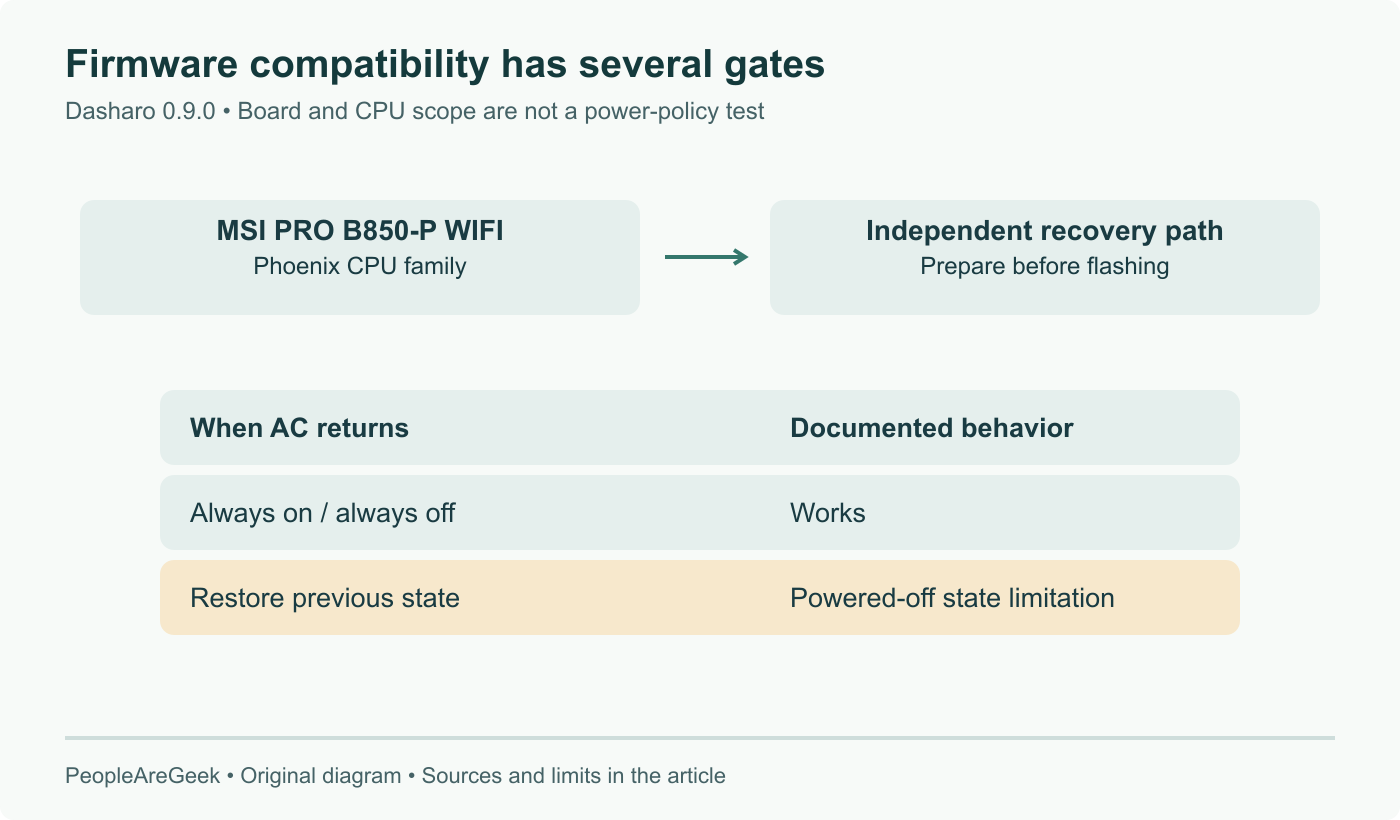
3mdeb published Dasharo v0.9.0 for the MSI PRO B850-P WIFI on July thirtieth, the first open source firmware release aimed at a modern AMD Ryzen desktop motherboard. It combines coreboot 25.12, AMD's openSIL silicon initialization library and an EDK II payload, and has been tested booting Ubuntu 26.04 LTS and Windows 11 25H2 with Secure Boot and fTPM working. Processor coverage is limited to Phoenix generation Zen 4 parts, validated on a Ryzen 5 8600G. Four limitations remain open, including capsule updates that do not survive a reset and S5 power state restore that does not work at all.
Open firmware on AMD desktops has been a five year conversation with nothing you could actually boot at the end of it. The blocker was never coreboot. It was AGESA, the closed blob that does memory training and fabric setup on every AMD platform, and which no amount of community effort could route around. openSIL was AMD's answer to that, and until this week it had only ever been demonstrated on server silicon.
What actually shipped
Dasharo v0.9.0 targets exactly one board, the MSI PRO B850-P WIFI, and one processor family, Phoenix generation Zen 4 on socket AM5. 3mdeb validated it on a Ryzen 5 8600G, with the Ryzen 7 8700G as the highest end part the branch currently handles.
The stack is coreboot 25.12 for the platform init, openSIL in place of AGESA for the silicon bring up, and an EDK II payload providing the UEFI interface. That last piece matters more than it sounds: it means the firmware presents a normal UEFI environment, so bootloaders, installers and operating systems do not need to know anything unusual is underneath. Ubuntu 26.04 LTS and Windows 11 25H2 both install and boot.
The feature list is closer to complete than a 0.9 release usually implies. UEFI Secure Boot works. AMD fTPM with measured boot works. SMM write protection for the BIOS region is handled through AMD ROM Armor 3. There is setup menu password protection, TCG OPAL and SATA disk password support, serial console redirection, fast boot through memory context save and restore, EZ Debug LED support, and ACPI thermal zone reporting.
The number to hold onto, and the number underneath it
79.1% less closed source code than MSI's version E7E56AMSI.2A92 is the headline figure, and it is worth understanding what the remaining fraction is.
What is left is the AMD PSP initialization blobs. The Platform Security Processor is the first thing that runs on a modern AMD CPU, before the x86 cores are released from reset, and AMD does not publish that code. Nobody's coreboot port eliminates it, on AMD or on Intel. So 79.1% is not a waypoint on the road to a fully open image. It is roughly where the road ends with current silicon.
What you get for it is real anyway. Everything above the PSP, which is to say every decision about how the board initializes, what it exposes in setup, how it handles updates and what it does with your disk passwords, is code in a public tree that you can read, audit and rebuild.
Read the limitations before you plan around it
Four things are documented as not working, and one of them decides whether this is a desktop project or an infrastructure project.
UEFI capsule updates apply immediately but do not survive a reset, so Capsule on Disk is not usable as a full workflow. Restoring power state from S5 does not work. Ubuntu 26.04 with serial console redirection enabled can hang during boot. And the WiFi adapter occasionally goes missing from the PCI device list.
The S5 one is the disqualifier for unattended use. If a machine cannot be told to come back up on its own after power is restored, it does not belong anywhere you are not physically standing. Combined with the serial console hang, which removes the tool you would use to debug a headless box, the honest read is that v0.9.0 is a workstation and workbench release. That is a reasonable place for a 0.9 to be.
Why this is a bigger deal than one board
The porting effort was announced in February, reached Windows 11 boot by midsummer and shipped in July. That is a fast arc for firmware work, and it happened because openSIL made it possible to do the platform specific part in the open rather than reverse engineering around a blob.
The follow on question is which board is next, and how much of this port transfers. Some of it is board specific by definition, the GPIO map, the fan headers, the EZ Debug LEDs. The openSIL integration and the Phoenix bring up path are not. That is the reusable part, and it is now proven on consumer hardware rather than only on EPYC.
One practical note that says something about demand: the MSI PRO B850-P WIFI launched around 179 dollars and now sells for roughly 300 dollars at major retailers. When a two year old mid range motherboard appreciates because someone published firmware for it, the market is telling you something about how scarce this option is.
Sources and further reading
- 3mdeb: MSI PRO B850-P WIFI Dasharo v0.9.0 release
- Phoronix: the first open source firmware released for modern AMD Ryzen AM5 platform
- Igor's Lab: AMD's openSIL lands on an AM5 consumer board
- The coreboot project
Frequently asked questions
Which processors does Dasharo v0.9.0 actually support?
AMD Phoenix Zen 4 chips on socket AM5, which in practice means the Ryzen 8000 series desktop APUs. 3mdeb validated the release on a Ryzen 5 8600G and says the Ryzen 7 8700G is the highest end part the current branch handles. That is a narrow window, and it is worth being blunt about it: if you have a Ryzen 7000 or 9000 series desktop chip in that board, this firmware is not for you yet. The openSIL code paths that exist today cover Phoenix, and the rest of the AM5 lineup depends on silicon initialization code that has not been published in the same form.
What is openSIL and why does it matter here?
openSIL is AMD's open source silicon initialization library, the replacement for the closed AGESA blob that has traditionally handled memory training, fabric setup and the rest of the early boot work on AMD platforms. AGESA is where the majority of the opacity in an AMD firmware image lives, so replacing it is what makes a meaningfully open firmware possible at all. Before this release openSIL on coreboot had been demonstrated on server hardware, including 3mdeb's earlier Gigabyte EPYC port. Getting it onto a consumer AM5 board is the step that moves it from a lab result to something you could put in a desktop.
How much of the firmware is still proprietary?
3mdeb measures a 79.1% reduction in closed source firmware code against MSI's own version E7E56AMSI.2A92. What remains is essentially the AMD PSP initialization blobs, the Platform Security Processor code that AMD does not publish and that the CPU requires to come out of reset. No coreboot port on modern AMD or Intel silicon eliminates that layer, so 79.1% is close to the practical ceiling rather than a halfway point. The value is that everything above the PSP, the part that decides how your board boots and what it exposes, is now code you can read and build.
What does not work yet?
Four known limitations are listed. UEFI capsule updates only apply immediately and do not survive a reset, so Capsule on Disk is not usable end to end. Restoring power state from S5 does not work, which matters if you rely on the board coming back up after a power cut. Ubuntu 26.04 with serial console redirection enabled can hang during boot. And the WiFi adapter occasionally disappears from the PCI device list. None of these are fatal on a desktop you sit in front of, but the S5 behaviour alone would disqualify it from anything you run headless in a rack.
Can I flash this on a board I already own?
3mdeb distributes it as part of the Dasharo Pro Package, sold in their shop as a combined MSI PRO B850-P hardware and firmware bundle. The source is coreboot, so the code path is open, but the supported route the vendor documents is the bundle rather than a self service flash of a board you bought elsewhere. Worth noting on the hardware side: the board launched around 179 dollars and has since climbed to roughly 300 dollars at major retailers, which the coverage attributes to exactly this kind of interest.