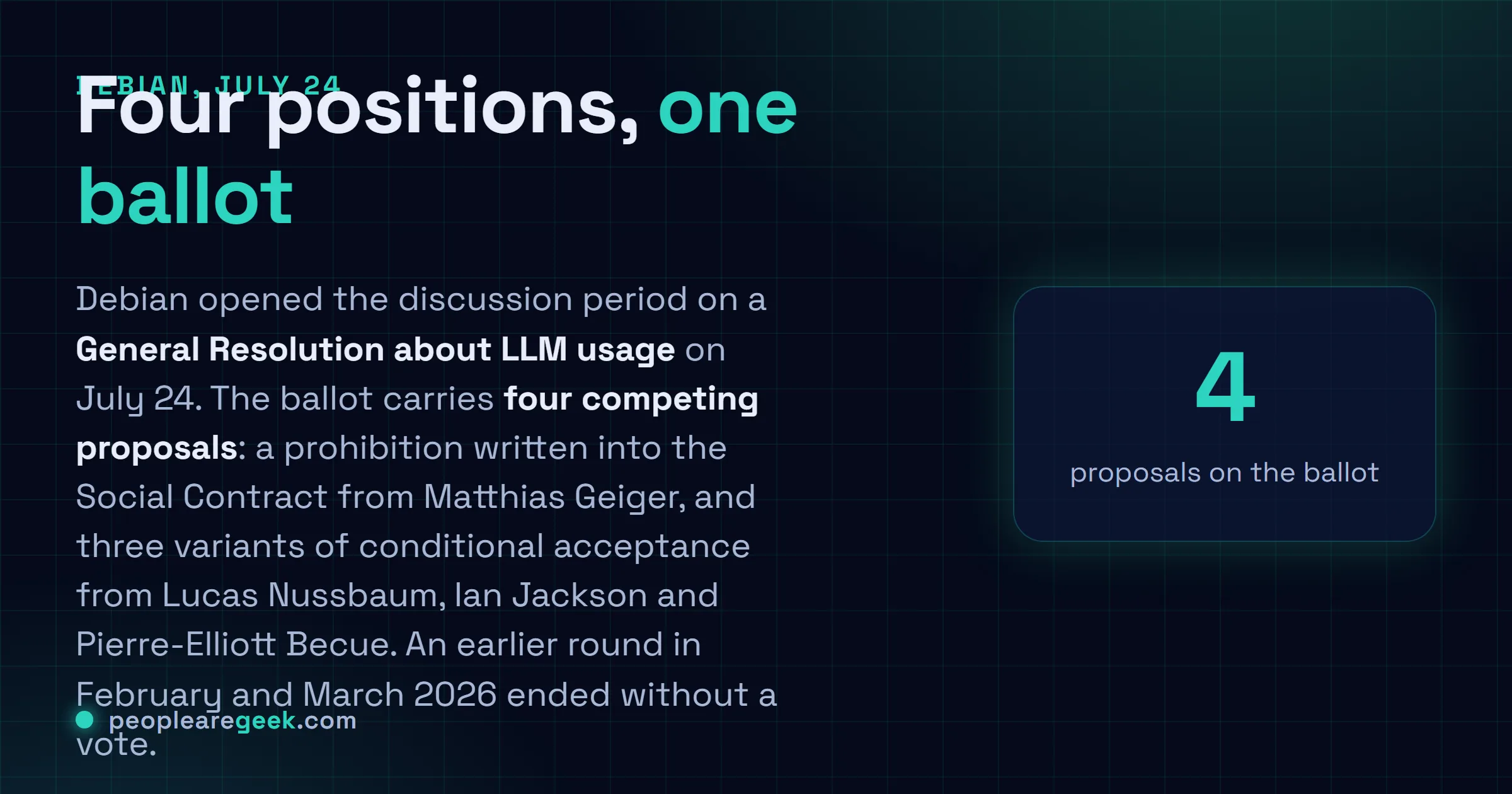
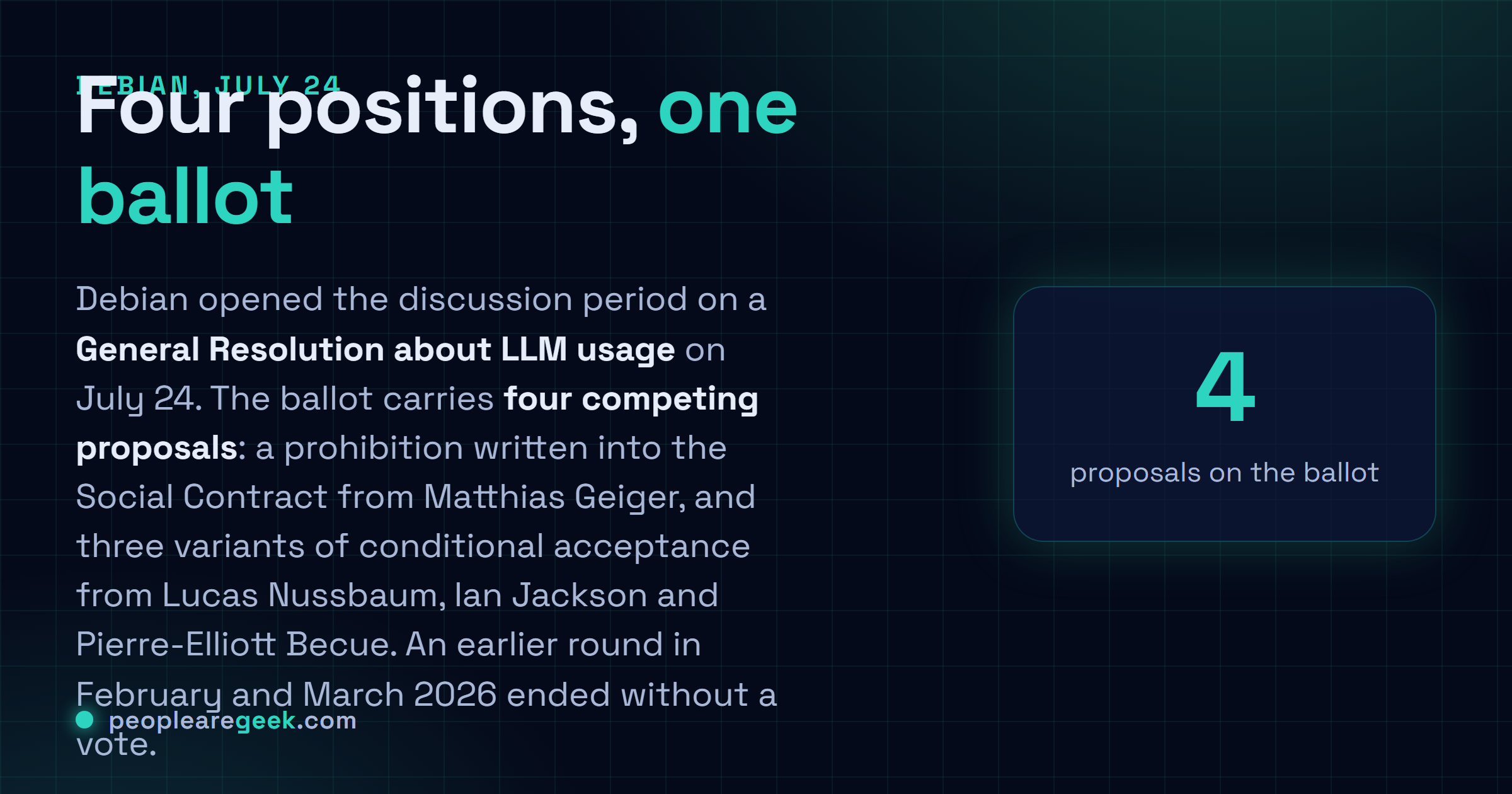
Debian opened the discussion period on a General Resolution about large language model usage in the project on Friday, July twenty fourth, with four competing options on the ballot. They range from an outright prohibition written into the Social Contract to conditional acceptance under a list of obligations. This is the project's second attempt at the question in 2026: a similar debate in February and March ran for weeks and ended without a vote at all. What makes it worth your attention even if you never touch a Debian package is that Debian sits upstream of Ubuntu and a long tail of derivatives, and its contribution policy tends to become everyone else's template.
The short answer
Debian opened the discussion period on a General Resolution about LLM usage on Friday, July twenty fourth. The ballot carries four options: a prohibition written into the Social Contract, proposed by Matthias Geiger, and three variants of conditional acceptance from Lucas Nussbaum, Ian Jackson and Pierre-Elliott Becue. An earlier round in February and March ended without a vote. Debian sits upstream of Ubuntu and many derivatives, so the outcome tends to travel.
Every project that accepts patches has had some version of this conversation in the last two years, usually in a pull request thread, usually resolved by whoever was maintaining that repository that week. Debian is doing it the Debian way instead: in the open, on a ballot, with four written positions and a formal discussion period.
What is on the ballot
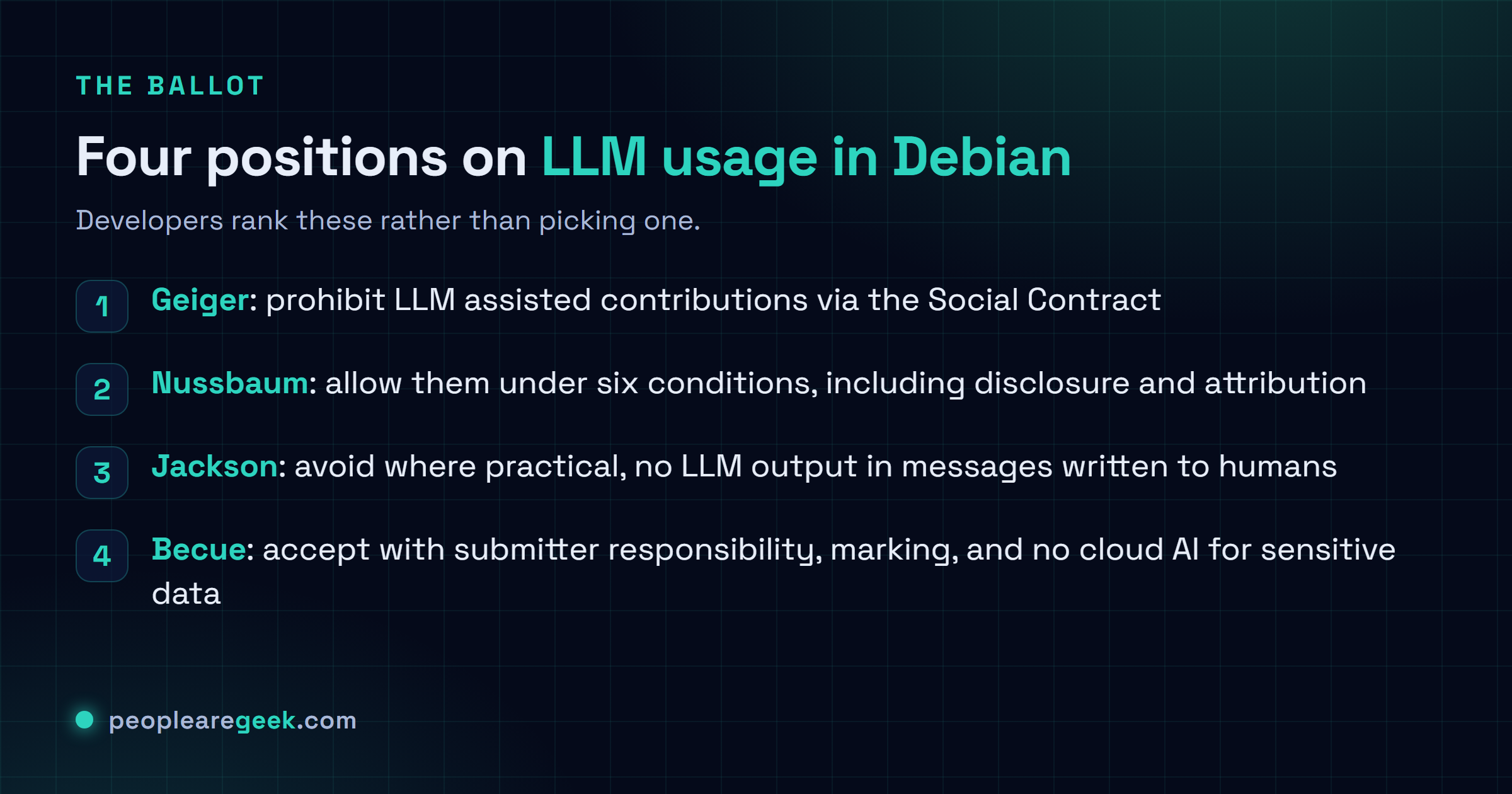
The resolution is titled LLM usage in Debian. Matthias Geiger proposed it on July twenty second and the discussion period opened on July twenty fourth. Rather than a single motion with a yes and a no, developers will rank four substantive proposals.
The strictest, from Geiger, would amend the Debian Social Contract to prohibit direct contributions written with the use or assistance of large language models. The scope is broad: source packages, packaging work, software Debian develops itself, official web resources, documentation, translations and project communications. The argument runs on copyright clarity, accuracy, the effect on the contributor community and the ethics of how training corpora were assembled. Placing it in the Social Contract matters, because that is a foundation document and is deliberately harder to revisit than ordinary policy.
Lucas Nussbaum's proposal takes the opposite starting point. It allows contributions partially or fully generated by an LLM as long as six conditions hold, covering legal compatibility of the tooling used, licensing and attribution, contributor accountability, disclosure when AI usage is significant, prior discussion before bulk changes, and confidentiality.
Ian Jackson's proposal sits between the two. It asks contributors to avoid LLMs where practical and draws a firm line at human facing communication: messages written to people must be drafted solely by humans. Any use of an LLM for Debian work must be disclosed, project specific bans are to be respected, and violations are treated as Code of Conduct matters. It also protects contributors writing in their own language without LLM assistance.
Pierre-Elliott Becue's proposal is the pragmatic one. It opens by acknowledging that these practices are already in use and here to stay, then places the weight on the submitter: DFSG compliance, real evaluation and understanding of what is being submitted, marking of AI assisted work, and no cloud based AI for sensitive data.

The second attempt
This is not Debian's first run at the question this year. A comparable debate ran through February and March 2026, generated a substantial volume of mailing list traffic, and ended without a vote. The project effectively decided not to decide, continuing to handle AI assisted contributions case by case under existing policy.
That history is the most useful context for reading the current round. The earlier collapse was not a rejection of any particular position, it was a failure to converge, and nothing about the four proposals now on the table suggests the underlying disagreement has narrowed. Whether this resolution reaches an actual vote is a genuinely open question.
Why it travels beyond Debian
If you maintain a project and have been avoiding writing down a policy on AI assisted contributions, this ballot is worth reading whatever Debian ends up doing with it.
Debian sits upstream of Ubuntu and a long list of derivatives, so anything it adopts propagates downward through packaging practice. More than that, Debian's governance documents get borrowed. Projects that need language for a contributing guide reach for text that already exists and has already survived an argument, and a General Resolution has stood up to considerably more argument than most.
The four proposals are also, read purely as drafting, a good survey of the design space. Prohibit at the foundation level. Permit with obligations. Discourage with mandatory disclosure and a hard line around human communication. Accept and push responsibility onto the submitter. Most organisations working out an internal position will land somewhere on that spectrum, and it is easier to start from four positions that have been argued in public than from a blank page in a wiki.
Sources and further reading
- Debian: General Resolution, LLM usage in Debian
- Phoronix: Debian considering General Resolution over LLM usage in the project
- LWN: Debian decides not to decide on AI generated contributions
- Linuxiac: Debian developers debate ban on AI assisted contributions
Frequently asked questions
What exactly is Debian voting on?
A General Resolution titled LLM usage in Debian, proposed by Debian developer Matthias Geiger on July twenty second, with the formal discussion period opening on July twenty fourth. The ballot carries four distinct proposals rather than a simple yes or no. They differ on whether generative AI assistance is prohibited outright, permitted under conditions, discouraged but tolerated with mandatory disclosure, or accepted with responsibility placed on the submitter. Debian votes on ballots like this using a Condorcet method, so developers rank the options rather than choosing one.
What does the strictest option say?
The proposal from Matthias Geiger would prohibit LLM assisted contributions through an addition to the Debian Social Contract, covering source packages, packaging work, software developed by Debian, official web resources, documentation, translations and project communications. The stated reasoning cites copyright clarity, accuracy problems, effects on the contributor community and ethical concerns about how training data was gathered. Putting it in the Social Contract rather than in policy is significant, because the Social Contract is a foundation document and is harder to amend later than an ordinary policy decision.
What do the more permissive options require?
Lucas Nussbaum's proposal allows contributions partially or fully generated by an LLM provided six conditions are met, covering legal compatibility of the tooling, licensing and attribution, contributor accountability, disclosure of significant AI usage, prior discussion of bulk changes and confidentiality. Ian Jackson's option asks contributors to avoid LLMs where practical, rejects LLM output in messages written to humans, requires disclosure of any use and treats violations as Code of Conduct matters. Pierre-Elliott Becue's option accepts AI assistance for Debian specific work with DFSG compliance, genuine understanding by the submitter, marking of AI assisted work and avoidance of cloud AI for sensitive data.
Did Debian not already discuss this in 2026?
Yes, and that attempt ended without a decision. A debate ran through February and March 2026 across the project mailing lists, and rather than voting, the community let the resolution lapse and continued handling AI assisted contributions case by case under existing policy. The July resolution is a renewed effort at settling the question formally. Whether it reaches a vote this time is genuinely open, since the earlier round showed the project is capable of talking itself out of deciding.
Why should I care if I do not contribute to Debian?
Because Debian is upstream of Ubuntu and a long list of derivative distributions, and because its governance documents get copied. Free software projects looking for language to put in their own contributing guidelines routinely borrow from Debian rather than drafting from scratch, and a General Resolution carries far more weight as precedent than a maintainer's preference in a README. If your organisation has an internal position on AI assisted code that it has never written down, the four proposals on this ballot are a well argued starting set of options to work from.