DevNews

DeepMind Open Sources WeatherNext, Its Cyclone Model

On this page
  1. What the numbers say
  2. How it is built
  3. What is in the repository
  4. Who this is actually for
  5. Sources and further reading

Google DeepMind published its WeatherNext cyclone work in Nature on August 6, 2026, and released the code and the weights the same day. The headline claim is an extra day of lead time: three day forecasts of a tropical cyclone track that match what earlier models delivered at two days, which is roughly a hundred kilometres less position error than the ECMWF ensemble at that range. The code is Apache 2.0, the weights and accompanying materials are Creative Commons Attribution 4.0, and a mini variant runs in a free Colab notebook on a single TPU. We looked at what is actually in the repository and what it takes to run.

The short answer

Google DeepMind published WeatherNext in Nature on August 6, 2026, and open sourced the code and the model weights the same day. WeatherNext Cyclones improves three day tropical cyclone track forecasts by roughly a hundred kilometres against the ECMWF ensemble and intensity by roughly eleven knots against HWRF, which DeepMind sums up as one extra day of warning. The repository ships WeatherNext 2, WeatherNext Cyclones and mini variants of both, plus the earlier GraphCast and GenCast models. The mini checkpoints run at 1 degree resolution on a single TPU or a P100 class GPU, and the included Colab notebook runs on the free tier.

100 kmless three day track error than the ECMWF ensemble
1,000ensemble members, up from 50 in the 2025 generation
CC BY 4.0licence on the weights, with Apache 2.0 on the code
Answer card titled one extra day of cyclone warning, explaining that Google DeepMind open sourced WeatherNext Cyclones and WeatherNext 2 on August 6, 2026, with code under Apache 2.0 and weights under Creative Commons Attribution 4.0, and highlighting 100 km as the reduction in three day track position error against the ECMWF ensemble.
The release in one card. Source: the Google DeepMind announcement and Nature paper, August 6, 2026. PNG

Most model releases arrive with a benchmark table and an invitation to trust it. This one arrived with a hurricane season behind it, which is a different kind of claim and a more useful one.

What the numbers say

Two errors matter in cyclone forecasting and they fail independently. Track position error tells you where the storm will be. Intensity error tells you how hard it will hit when it gets there. A model can be good at one and mediocre at the other, and historically the specialised intensity models and the global ensembles have divided that work between them.

WeatherNext Cyclones reduces three day track position error by roughly one hundred kilometres against the ECMWF ensemble, and three day intensity error by roughly eleven knots against HWRF. DeepMind's own summary of the combined effect is the one worth quoting back: the three day forecast is about as accurate as what previous models managed at two days.

An extra twenty four hours sounds incremental until you consider what happens inside it. Evacuation orders, hospital transfers, ship routing and grid preparation all have lead times measured in days, not hours, and each of them gets a full extra cycle.

The operational evidence is what separates this from a leaderboard entry. During the 2025 Atlantic season the National Hurricane Center used the model while forecasting Hurricane Melissa, including its rapid intensification and its landfall in Jamaica. Rapid intensification is the failure case that conventional models handle worst, so it is a fair test rather than a flattering one.

How it is built

The architecture DeepMind describes is a single model that connects global wind patterns to the smaller scale behaviour of an individual storm, rather than bolting a specialised storm model onto a general forecast. Training used nearly twenty terabytes of global atmospheric data, plus the IBTrACS archive of roughly five thousand historical cyclones.

The generative part is what produces the spread. WeatherNext uses Functional Generative Networks to produce 1,000 member ensembles, where the 2025 generation produced 50. That is a twenty fold increase in how finely you can sample the distribution, and it is only affordable because a single fifteen day forecast takes under a minute on a TPU. A physics based ensemble pays for every member with a full simulation, which is precisely why operational ensembles are counted in dozens.

Checklist card contrasting the full WeatherNext checkpoints at 0.25 degree resolution needing a TPU or an H100 GPU with the mini checkpoints at 1 degree resolution running on a single TPU or a P100 class GPU inside the free Colab notebook.
The two tiers in the repository, and what each one needs to run. PNG

What is in the repository

The repository holds more than the headline model. WeatherNext 2 is the general medium range atmospheric model. WeatherNext Cyclones is the specialised one. Both have mini counterparts, and the older GraphCast and GenCast models are there as well, so the repository doubles as an archive of the whole line.

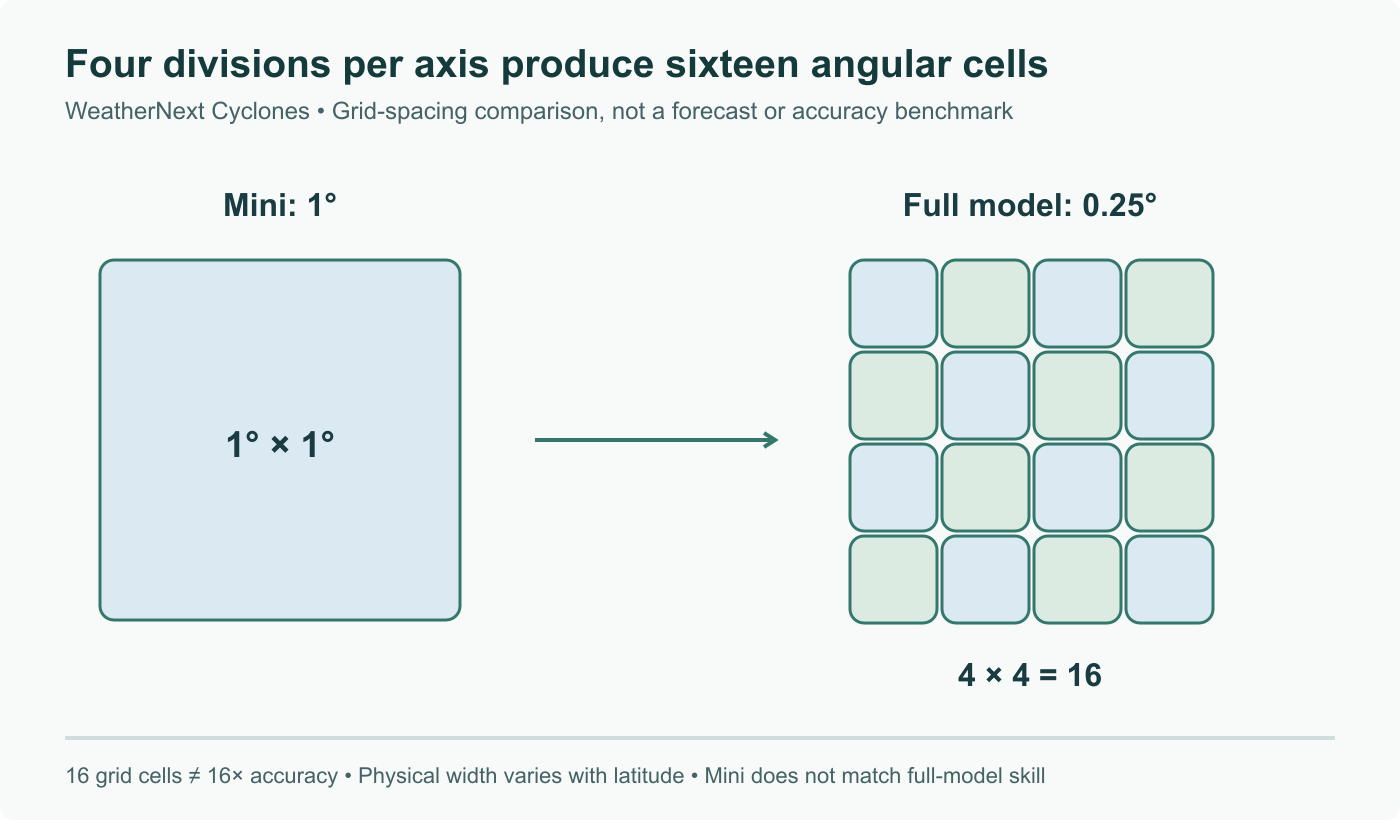
The split that matters for anyone planning to run this is resolution. The full checkpoints work at 0.25 degrees, about thirty kilometres, and DeepMind recommends a TPU, with an H100 as the GPU path. The mini checkpoints work at 1 degree and are described in the README as suitable for local testing or a single TPU or GPU, which puts them in P100 territory. Multiple checkpoint versions ship with different training data cutoffs, from 2023 through 2025, which matters if you intend to evaluate against a season the model has not seen.

The licensing is split too, and it is worth reading rather than assuming. Code is Apache License 2.0. The weights and the other accompanying materials are Creative Commons Attribution 4.0. Both permit commercial use, both require attribution, and they are not the same licence, so a compliance review should look at both files rather than one.

Who this is actually for

The interesting design decision is the mini variant, and specifically the choice to make the Colab notebook default to WeatherNext Cyclones Mini on a v5e-1 runtime that the free tier provides. That is not a demo convenience. The stated intent is to put this class of model in reach of national weather services without supercomputing budgets, and the regions named are the Caribbean, the Pacific Islands and South Asia.

Those are the places where cyclone forecasting is most consequential and forecasting infrastructure is thinnest, so an open licence and a free tier notebook are doing more work here than they would for most model releases.

If you are evaluating this for anything operational, the honest starting posture is that the mini checkpoints are a way to learn the interface and the data format, not a substitute for the full models. The README says as much. Run the notebook first, understand what the inputs look like, then decide whether the full checkpoints and the hardware they need are worth it for your case.

Sources and further reading

Frequently asked questions

What did DeepMind actually release, and under which licence?

Three things landed at once on August 6, 2026: a paper in Nature, the inference code, and the model checkpoints. The repository at github.com/google-deepmind/weathernext carries WeatherNext 2 for general medium range atmospheric forecasting, WeatherNext Cyclones for tropical cyclone track, intensity and wind structure, and the earlier GraphCast and GenCast models that Google had already published. The licensing is split in the way that has become normal for this kind of release: the code is under the Apache License 2.0, while the weights and the other accompanying materials are under Creative Commons Attribution 4.0. That combination means you can run the models commercially and build on them, provided you attribute the source. It is worth reading both licence files rather than assuming, because a repository with two licences in it is easy to misread, and the checkpoints are the part most people actually want.

How much better is it, in numbers rather than adjectives?

The two figures that matter are position and intensity. On three day forecasts, WeatherNext Cyclones cuts track position error by roughly one hundred kilometres compared with the ECMWF ensemble, and intensity error by roughly eleven knots compared with HWRF. DeepMind frames the combined effect as an extra day: the three day forecast is about as good as what the previous generation could produce at two days. For context on how slowly this field normally moves, that jump is described as around a decade of conventional progress. The model was also run operationally rather than only on historical data. During the 2025 Atlantic hurricane season the National Hurricane Center used it while forecasting Hurricane Melissa, including the rapid intensification and the Jamaica landfall, which is the part that turns a benchmark into evidence.

What hardware do I need to run it myself?

Less than you would guess, if you pick the right variant. The full models run at 0.25 degree resolution, roughly thirty kilometres, and DeepMind recommends a TPU; on GPUs the full checkpoints want an H100. The mini variants run at 1 degree resolution and are explicitly built for lower memory and compute, which brings them down to a P100 class GPU or a single TPU. The interactive Colab notebook in the repository defaults to WeatherNext Cyclones Mini on a v5e-1 runtime, and that runtime is available on the free Colab tier. So the entry cost for a first run is a browser and a Google account. The tradeoff is honest and stated in the README: the mini checkpoints forecast the same outputs but are not expected to match the larger models.

Why does the ensemble size keep coming up?

Because a cyclone forecast is a probability distribution, not a line on a map, and the number of members you can afford determines how well you can see the tails. WeatherNext generates 1,000 member ensembles, up from 50 in the 2025 generation, using an approach DeepMind calls Functional Generative Networks. Twenty times more members is what lets a forecaster reason about the unlikely but expensive outcomes, the rapid intensification that arrives faster than the mean track suggests, rather than only the central case. The cost side is what makes that practical: a single fifteen day forecast is generated in under a minute on a TPU. Traditional physics ensembles are expensive precisely because each member is a full simulation, so cheap members are the whole point of the approach.

Is this a replacement for a national weather service?

No, and DeepMind does not present it as one. The model was developed with the National Hurricane Center, the Cooperative Institute for Research in the Atmosphere and the UK Met Office, and it sits inside a forecasting process rather than replacing it. What the open release changes is who else gets access to that class of model. The stated intent behind shipping a Colab runnable mini variant is to lower the barrier for national weather services that do not have supercomputers, particularly in the Caribbean, the Pacific Islands and South Asia, which are also the regions where an extra day of cyclone warning is worth the most. The training data behind it is nearly twenty terabytes of global atmospheric data plus the IBTrACS archive of around five thousand historical storms.