DeepSeek released V4-Pro-0813 on August 13, 2026 and, in the same announcement, repriced its API from August 16 at 4 p.m. UTC. Output on V4-Pro goes from $0.87 per million tokens to $1.98 off peak and $3.96 at peak, and cache hits rise by as much as 1,100 percent. Peak is defined as 01:00 to 04:00 and 06:00 to 10:00 UTC, so 17 hours of every 24 stay at the lower rate. The company says it wants to allocate resources more reasonably. If you built a cost model on cheap cached prompts, this is the week to reopen it.
The short answer
DeepSeek released V4-Pro-0813 on August 13, 2026 and repriced its API effective August 16 at 4 p.m. UTC. V4-Pro output moves from $0.87 per million tokens to $1.98 off peak and $3.96 at peak, input on a cache miss from $0.435 to $0.66 and $1.32, and cache hits from $0.003625 to $0.022 and $0.044. Peak hours are 01:00 to 04:00 and 06:00 to 10:00 UTC. The company says the goal is to allocate resources more reasonably. Harness v0.1 shipped alongside under the MIT licence.
Most model announcements this year have been about going down: cheaper tokens, cheaper tiers, cheaper everything. This one goes the other way, and the reason it gives is worth reading carefully.
What was announced
On August 13, 2026, DeepSeek released V4-Pro-0813, an updated version of its flagship model, and published a new price list that takes effect on August 16 at 4 p.m. UTC.
The model side is straightforward improvement. Terminal Bench 2.1 moves from 72.1 to 87.9. DeepSWE moves from 12.8 to 62.7, which is less a gain than the arrival of a capability. On the Artificial Analysis Intelligence Index the model goes from 45 to 53, which puts it clearly behind Claude Opus 5 at 63 but well up the field. DeepSeek also published Harness v0.1, a modular plugin architecture for autonomous agents, as a developer preview under the MIT licence.
The price side is where the news is.
The new bill
The old structure was one flat rate. The new one is a clock.
Peak hours are 01:00 to 04:00 and 06:00 to 10:00 UTC. Off peak is everything else, priced at exactly half the peak rate, which leaves 17 of every 24 hours at the lower number. On V4-Pro, input on a cache miss goes from $0.435 per million tokens to $0.66 off peak and $1.32 at peak. Output goes from $0.87 to $1.98 and $3.96. V4-Flash follows the same pattern, with input from $0.14 to between $0.22 and $0.44, and output from $0.28 to between $0.66 and $1.32.
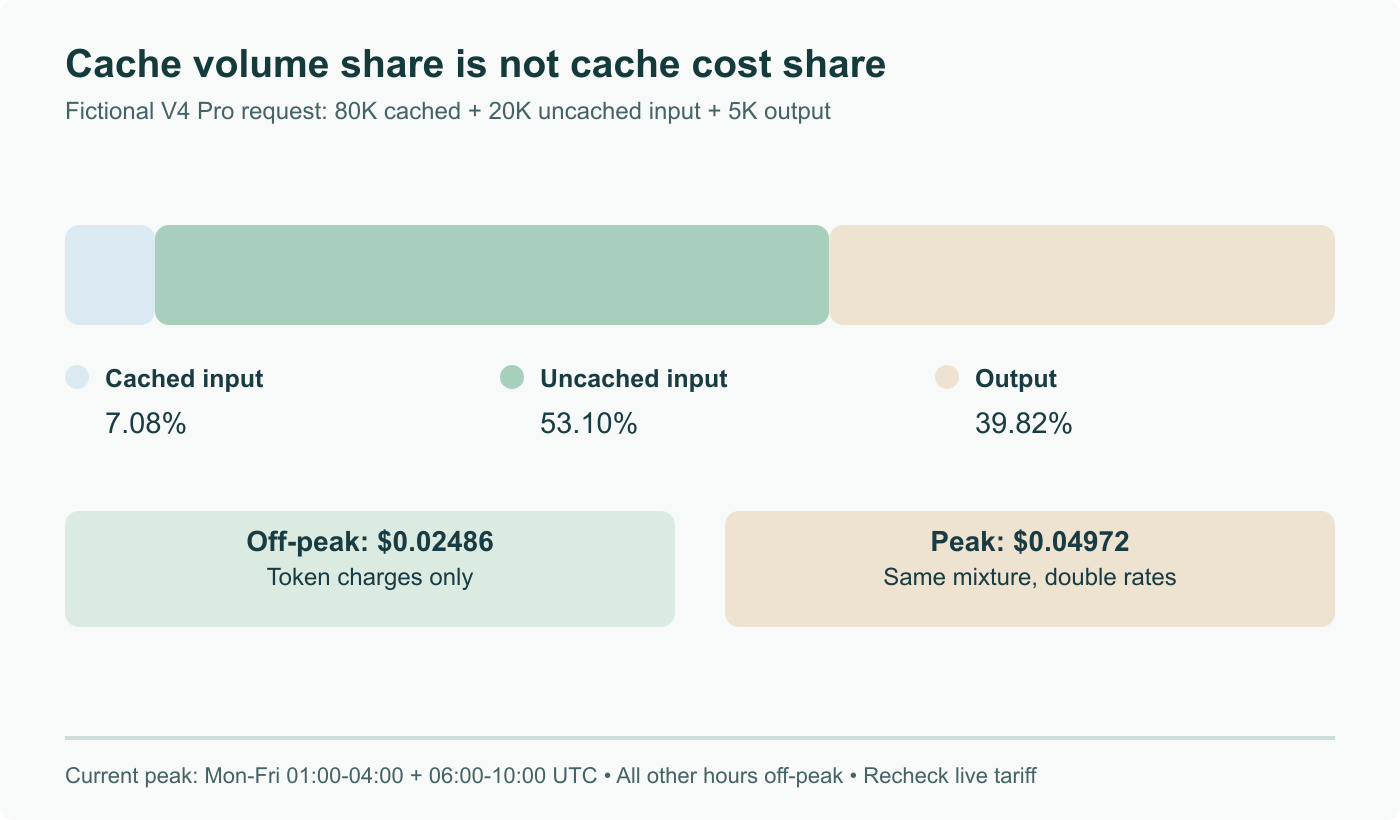
The line nobody puts in a headline is cache hits. On V4-Pro they go from $0.003625 per million tokens to $0.022 off peak and $0.044 at peak. The absolute figures are still tiny, but that is the move behind the 1,100 percent number in the coverage, and it is the one most likely to surprise a real bill. Prompt caching is what heavy users rely on: a long system prompt, a retrieved document, a conversation history, resent on every single turn and previously billed at close to zero. The gap between cached and uncached input just narrowed by a lot.
The reason given, and the reason underneath
DeepSeek's stated rationale is that it wants to allocate resources more reasonably and to have customers schedule work according to actual need. Read the mechanism rather than the wording and the two match. A company chasing margin raises the flat rate. A company short on serving capacity builds a peak and off peak clock, because a clock is a load shifting instrument, and half price is a large enough incentive to actually move batch traffic.
Analyst commentary published alongside the change said the same thing without the diplomacy: demand went up, supply did not, so price went up. Reporting also notes the company is raising capital and preparing for a public offering, which is context rather than cause.
What makes it notable is the direction relative to everyone else. The same week saw a Google mid tier model launch at half its own list price and an OpenAI tier competing on raw throughput. Cheap inference has been treated as a permanent, one way trend for two years. It is a supply curve, and supply curves move in both directions.
What we would do this week
Reopen the cost model, starting with the cache line. If your per request estimate assumed cached input was free, it is now roughly six to twelve times its old price depending on the hour, and a workload that resends a 40,000 token system prompt on every turn will feel that. Recompute at peak rates, because that is the worst case you will actually pay.
Then look at what can move. Off peak is 17 hours out of 24 and both peak blocks fall between 01:00 and 10:00 UTC, so nightly re-indexing, evaluation sweeps, backfills and bulk classification can usually be rescheduled without anyone noticing. That is a straight fifty percent saving for the cost of a cron change. Interactive traffic is not a candidate, because you do not choose when a user arrives, and queueing a person to save two dollars per million tokens is the wrong trade.
Last, treat the pricing tier as configuration and instrument the hour. If your billing now depends on wall clock time, your cost dashboards need to know that too, otherwise the first surprising invoice will take a day to explain.
Sources and further reading
- Deepseek ships improved V4 Pro, open-sources its agent software, and raises API prices, The Decoder, August 13, 2026
- DeepSeek raises some V4 prices by more than 10x as AI demand strains capacity, InfoWorld, August 2026
- DeepSeek Launches V4-Pro and Raises API Prices by as Much as 1,100%, Caixin Global, August 14, 2026
- DeepSeek raising API prices by up to 1,100% starting Aug. 16, Quartz, August 13, 2026
- DeepSeek's AI models are about to cost four times more, Engadget, August 2026
- DeepSeek API pricing, official documentation
Frequently asked questions
What exactly changes, and when?
The new rates take effect on August 16, 2026 at 4 p.m. UTC, and they introduce a two tier clock. Peak hours are 01:00 to 04:00 and 06:00 to 10:00 UTC, off peak is everything else, and the off peak rate is half the peak rate. On V4-Pro, input on a cache miss goes from $0.435 per million tokens to $0.66 off peak and $1.32 at peak. Output goes from $0.87 to $1.98 and $3.96. V4-Flash moves the same way, with input from $0.14 to a range of $0.22 to $0.44 and output from $0.28 to $0.66 to $1.32.
Where does the 1,100 percent figure come from?
From cache hit pricing, which is the line most teams never look at. On V4-Pro, a cached input token went from $0.003625 per million to $0.022 per million off peak and $0.044 at peak. In percentage terms that is the largest single move in the announcement, and the reported range across models and tiers runs from about 52 percent to 1,100 percent. It matters more than it looks because prompt caching is exactly what heavy users lean on: a long system prompt or a large retrieved document, resent on every turn, previously billed at almost nothing. The absolute numbers stay small, but the ratio between cached and uncached input has narrowed sharply.
Why raise prices when everyone else is cutting them?
DeepSeek's own stated reason is to allocate resources more reasonably and to encourage customers to schedule work according to actual need, which is a capacity argument rather than a margin one. That reading is consistent with the shape of the change: a company purely chasing revenue raises the flat rate, while a company short on serving capacity builds a peak and off peak clock to move load. Analyst commentary quoted around the launch made the same point in plainer terms, that demand rose and supply did not, so the price rose. Reporting also notes the company is raising capital and preparing for a public offering.
Should we move our batch jobs to off peak hours?
If the work is genuinely asynchronous, yes, because the saving is exactly half and the peak window is narrow. Only seven hours in twenty four are peak, and both blocks sit between 01:00 and 10:00 UTC, which is European morning and Asian afternoon. Anything that is a nightly re-index, an evaluation sweep, a backfill or a bulk classification can be scheduled outside those blocks without anyone noticing. Interactive traffic is a different matter, because you do not control when a user shows up, and building a queue that delays a person to save $2 per million tokens is usually a bad trade.
What else came out with the model?
Two things worth noting. V4-Pro-0813 posts significant benchmark movement: Terminal Bench 2.1 from 72.1 to 87.9 and DeepSWE from 12.8 to 62.7, with the Artificial Analysis Intelligence Index moving from 45 to 53, still behind Claude Opus 5 at 63. Separately, DeepSeek published Harness v0.1 as a developer preview under the MIT licence, a modular plugin architecture for running autonomous agents. The licence is the interesting part there, because MIT means the agent scaffolding is genuinely reusable outside DeepSeek's own API.