DevNews

DOE Launches Genesis Open Models, With Deadlines in August

On this page
  1. What was announced
  2. The three ways to take part
  3. What is not in the announcement
  4. Why open weights, for a science agency
  5. What to do this week
  6. Sources and further reading

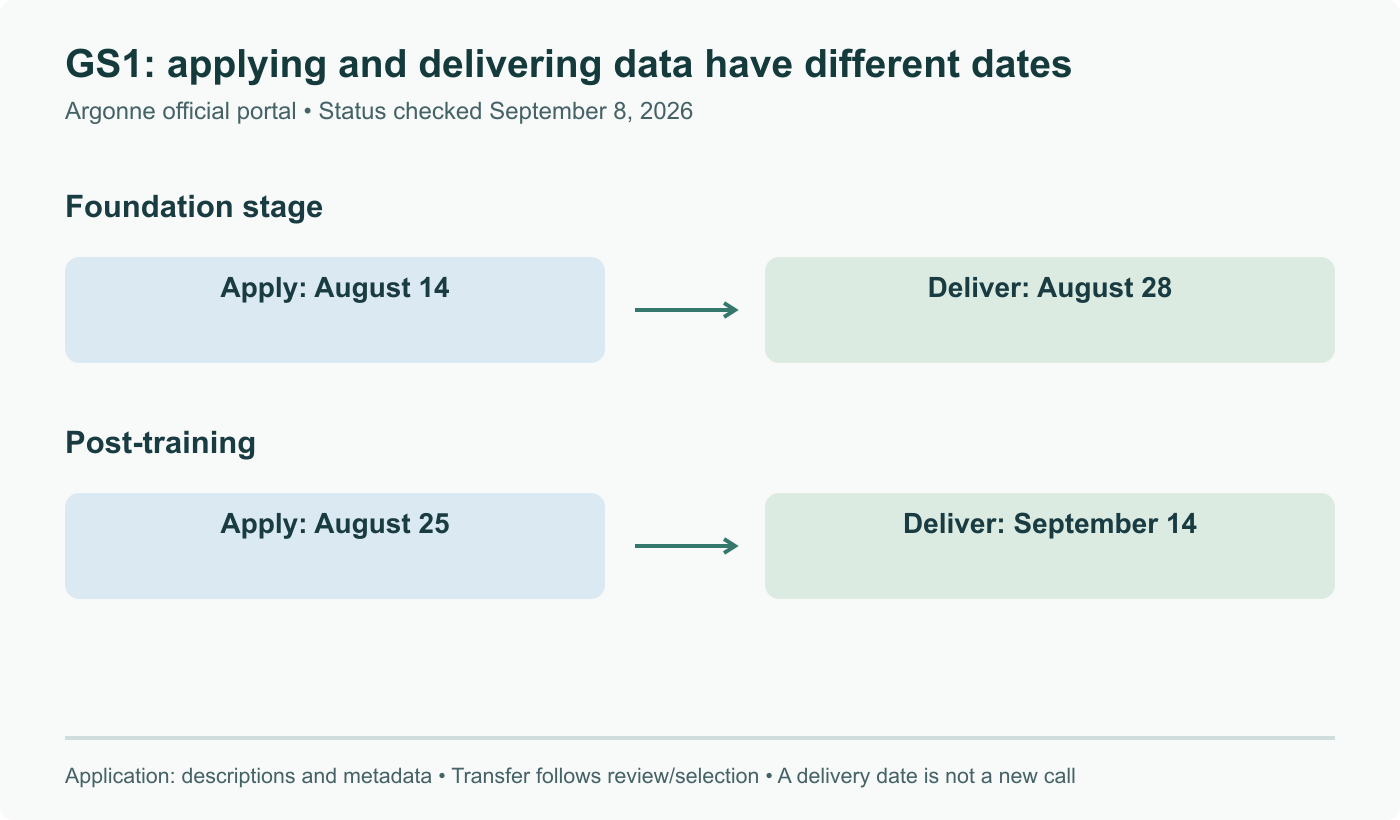
The US Department of Energy announced the Genesis Open Models Initiative on August 7, 2026, a programme to produce open weight foundation models aimed at scientific work rather than general chat. The first model is Genesis-Science-1, built with Arcee, and the plan is to ship the weights alongside a technical report and public demonstration artifacts. What makes this worth acting on rather than bookmarking is the calendar: the call for pretraining data contributions closes on August 14, 2026, and the call for fine-tuning efforts on August 25, with further rounds expected roughly every three months. We read the announcement and pulled out what is committed and what is not.

The short answer

The US Department of Energy announced the Genesis Open Models Initiative on August 7, 2026, a programme to build open weight foundation models for scientific work. The first is Genesis-Science-1, developed with Arcee, and the release is promised to include weights, a technical report and public demonstration artifacts. Applications to contribute pretraining data close August 14, 2026, and fine-tuning applications close August 25, with further rounds expected roughly every three months. The parameter count, architecture and licence have not been disclosed. Target domains include materials discovery, energy systems, earth system modelling, fusion, biology and high energy physics.

Aug 14closing date for pretraining data contributions, 2026
Nov 2025executive order that created the Genesis Mission
3 tracksopen weight models, pretraining data, fine-tuning teams
Answer card titled open weight models for science, explaining that the US Department of Energy launched the Genesis Open Models Initiative on August 7, 2026, that the first model is Genesis-Science-1 built with Arcee, and highlighting August 14 as the closing date for pretraining data contributions.
The initiative in one card. Source: the Department of Energy announcement, August 7, 2026. PNG

Government AI announcements usually give you a strategy document and a website. This one gives you a deadline a week out, which is a rarer and more useful thing.

What was announced

On August 7, 2026, the Department of Energy's Office of the Under Secretary for Science launched the Genesis Open Models Initiative. The framing is shared infrastructure: rather than commissioning one system for internal use, DOE intends to produce a class of open weight foundation models that researchers, national laboratories, industry partners and the wider open science community can all build on.

The first model in that class is Genesis-Science-1, developed in partnership with Arcee. The stated deliverable is not just a checkpoint but a package, described as the model weights, a technical report, and public workbench and demonstration artifacts.

This sits under the Genesis Mission, a DOE led national programme established by executive order in November 2025, whose headline objective is to double the productivity and impact of American science and engineering within a decade. The initiative's website runs on Argonne National Laboratory infrastructure, at genesisopenmodels.anl.gov.

The three ways to take part

The call for contributions is split into three tracks, and they suit very different organisations.

The first is open weight models. DOE is asking organisations to contribute existing checkpoints, either as base models that others can fine-tune or as models ready for immediate deployment. That is a narrow door, open mostly to labs and companies that have already trained something worth donating.

The second is data, and it is the track with the most specific description. The announcement names scientific text, code, documentation and structured technical collections as the general categories, then gets concrete: experimental and observational data from user facilities, simulation outputs and run logs from supercomputing campaigns, materials and chemistry collections, and research software. If you have watched a supercomputing campaign generate terabytes of run logs that nobody ever looked at again, that sentence is aimed at you.

The third is fine-tuning. Teams can propose domain adapted versions of Genesis-Science-1 for a specific field, application or mission need. This is the widest door and the one most readers of this site could realistically walk through.

Checklist card listing what the Department of Energy has committed to for Genesis-Science-1, namely open weights, a technical report and public demonstration artifacts, alongside what remains undisclosed, namely the parameter count, the architecture, the context length, the licence and the release date.
What the announcement commits to, and what it leaves open. PNG

What is not in the announcement

It is worth being blunt about the gaps, because the enthusiasm around the launch has been filling them in with guesswork.

The announcement does not state Genesis-Science-1's parameter count. It does not state the architecture. It does not state the context length. It does not name a licence, which is a notable omission for an initiative whose entire identity is openness, since open weight covers everything from Apache 2.0 to a restrictive community licence. And it does not give a release date.

Arcee's own page on the model adds detail about intent rather than specification. It describes the target as scientific computing workflows, with an emphasis on runs that carry a task from planning through to a written report, adjust when the evidence changes, and recover when a tool call fails. That is an agentic framing rather than a benchmark one, and it tells you what the team is optimising for even without numbers.

The reference point people keep reaching for is Arcee's earlier Trinity Large, a 400 billion parameter sparse mixture of experts model. That is a fair signal about the team's capability. It is not a specification for this model, and it should not be quoted as one.

Why open weights, for a science agency

The case for open weights is stronger in science than almost anywhere else, and it rests on reproducibility more than on cost.

A result that depends on a model you cannot inspect, cannot pin to a specific version, and might lose access to when a vendor deprecates an endpoint is a result that cannot be checked later. Open weights turn that into a solvable problem: the checkpoint that produced the claim is archivable, and a reviewer in five years can run it without a commercial relationship.

The access argument is the second half. Frontier scale capability behind a paid API is available to organisations that can pay for it at volume, which is not a description of most university groups or of every national laboratory budget line. Publishing weights changes who can participate at all.

The timing also lands in a period when open weight releases from Chinese labs have been resetting expectations about who publishes frontier scale models, and the announcement's insistence on describing this as an American open weight model is not accidental.

What to do this week

If any of your organisation's data fits the pretraining description, the August 14 deadline is the binding one and it is close. Pretraining contributions shape what the base model knows, and no amount of downstream fine-tuning fully substitutes for that.

If you want to build a domain adapted version instead, August 25 is your date, and that track is likely to remain the most accessible one across future rounds.

And if neither fits this cycle, the useful fact is that rolling deadlines are expected roughly quarterly. This is a recurring intake, not a single window, which means the reasonable move is to get on the list and watch what the first cycle produces before committing anything substantial.

Sources and further reading

Frequently asked questions

What is the Genesis Mission, and how does this fit into it?

The Genesis Mission is a Department of Energy led national programme created by executive order in November 2025, with a stated goal of doubling the productivity and impact of American science and engineering within a decade. The Genesis Open Models Initiative is the model building arm of that programme. Rather than commissioning a single closed system, DOE is producing a class of open weight foundation models intended as shared infrastructure for scientific work, in the same way that a national laboratory operates a beamline or a supercomputer that many groups use. The domains named in the announcement give a sense of the intended scope: materials discovery, energy systems, earth system modelling, fusion, biology and high energy physics. The programme website is hosted at genesisopenmodels.anl.gov, on Argonne National Laboratory infrastructure.

What do we actually know about Genesis-Science-1?

Less than the announcement's confidence implies, and it is worth being precise about the gap. What is stated: it is the first model in the class, it is being developed in partnership with Arcee, it is described as an American open weight model aimed at scientific computing workflows, and the release will include the model weights, a technical report, and public workbench and demonstration artifacts. What is not stated anywhere in the announcement or in Arcee's accompanying page: the parameter count, the architecture, the context length, the licence, benchmark results, or a release date. Arcee's own prior work is a useful reference point rather than a specification, since the company previously built Trinity Large, a 400 billion parameter sparse mixture of experts model. Treat that as context on the team, not as a preview of Genesis-Science-1.

Who can contribute, and to what exactly?

The initiative is soliciting three distinct things and they suit different kinds of organisation. First, open weight models, either as base models for downstream fine-tuning or for immediate deployment, which is aimed at labs and companies that already have trained checkpoints to donate. Second, high quality domain specific scientific data for future pretraining cycles, aimed at anyone sitting on experimental or observational data. Third, teams willing to build domain adapted versions of Genesis-Science-1 for a particular scientific field or mission need, which is the track with the widest door. The data track is more concrete than it sounds: the announcement names experimental and observational data from user facilities, simulation outputs and run logs from supercomputing campaigns, materials and chemistry collections, and research software, alongside scientific text, code and documentation.

What are the deadlines, and what happens if I miss them?

Per the Department of Energy announcement, applications to contribute to pretraining close on August 14, 2026, and applications for fine-tuning efforts close on August 25, 2026. Missing them is not fatal. The announcement says additional rolling deadlines are expected roughly every three months, so the structure is a recurring intake rather than a one time window. That said, the first cycle is the one that shapes what the base model learns, and later cycles inherit those decisions. If you have data that belongs in the pretraining mix rather than in a downstream fine-tune, the August 14 date is the one that matters, and it is close enough that the practical answer is to look at the application today rather than next week.

Why would a government build open weight models rather than buy access?

The reasons given are reproducibility and access, and they are the ones that make sense for a science agency specifically. A published result that depends on a model you cannot inspect, cannot pin to a version, and may lose access to is a reproducibility problem, not just a procurement one. Open weights let a reviewer run the same checkpoint that produced the claim, in five years, without a vendor relationship. The access argument is about who gets to use frontier scale models at all: national laboratories, universities and smaller industry partners do not all have the budgets that closed frontier access implies. There is also an explicit sovereignty framing in how the model is described, arriving in a period when open weight releases from Chinese labs have been reshaping expectations about who publishes what.