SysadminNews

Emerald AI Raises $150M to Make Data Centres Flex on Demand

On this page
  1. The queue nobody can buy their way past
  2. What Emerald sells
  3. The investor list is the story
  4. The part that makes it more than a pitch
  5. What to watch, and what to be sceptical about
  6. Sources and further reading

Emerald AI announced a hundred and fifty million dollar Series A on Tuesday, August twenty fifth, 2026, at a valuation of one point zero five billion dollars, co led by Energize Capital and DCVC. The company sells software that makes a data centre's power draw negotiable. Its Emerald Conductor platform schedules AI workloads against on site batteries and generation so a facility can cut what it pulls from the grid during stress events without stalling the jobs that actually matter. The claim behind the round is that flexibility of this kind could unlock more than a hundred gigawatts of capacity on the existing United States grid, years before new construction could deliver it.

The short answer

Emerald AI announced a 150 million dollar Series A on August 25, 2026 at a 1.05 billion dollar valuation, co led by Energize Capital and DCVC, taking total funding above 220 million dollars. Its Emerald Conductor software schedules AI workloads against on site batteries and generation so a facility can cut grid draw during stress events without stalling critical work. Nvidia, Siemens, GE Vernova, RWE and Samsung Ventures are among the strategic investors. A nearly 100 megawatt site in Manassas, Virginia, built with Digital Realty and Nvidia, is due online later in 2026.

$150MSeries A at a $1.05 billion valuation
100+ GWcapacity the company says flexibility could unlock
~100 MWthe Manassas facility due online later in 2026
Answer card summarising the Emerald AI funding round announced on August 25, 2026: a 150 million dollar Series A at a 1.05 billion dollar valuation, co led by Energize Capital and DCVC, more than 220 million dollars raised in total, and a claim that flexible data centre power draw could unlock over 100 gigawatts on the existing United States grid.
The round, the backers, and the claim underneath it. PNG

For twenty years the operational goal of a data centre has been to draw exactly what it needs, exactly when it needs it, and never to be interrupted. Emerald AI raised a hundred and fifty million dollars this week on the argument that this goal is now the problem.

The queue nobody can buy their way past

The scarcity in AI infrastructure has moved. It was chips, then it was capital, and now it is a grid connection. Large facilities routinely wait years for one, and the reason is structural rather than bureaucratic.

Utilities size a connection around the peak a customer might draw, not the average it will actually draw. A three hundred megawatt facility gets planned as three hundred megawatts of firm capacity even if it only approaches that number for a few hours a year. Multiply that across every announced AI build and the queue is full of reserved headroom that mostly sits unused.

We have written about the downstream effects of this repeatedly: Microsoft describing a gap between the chips it owns and the power to run them, European operators siting facilities 175 kilometres from the hubs they would prefer, and New York imposing a data centre moratorium. The common thread is that power, not silicon, decides where and whether capacity gets built.

What Emerald sells

Emerald Conductor is a scheduler that treats a facility's power draw as something to be managed rather than something fixed by whatever the racks happen to be doing.

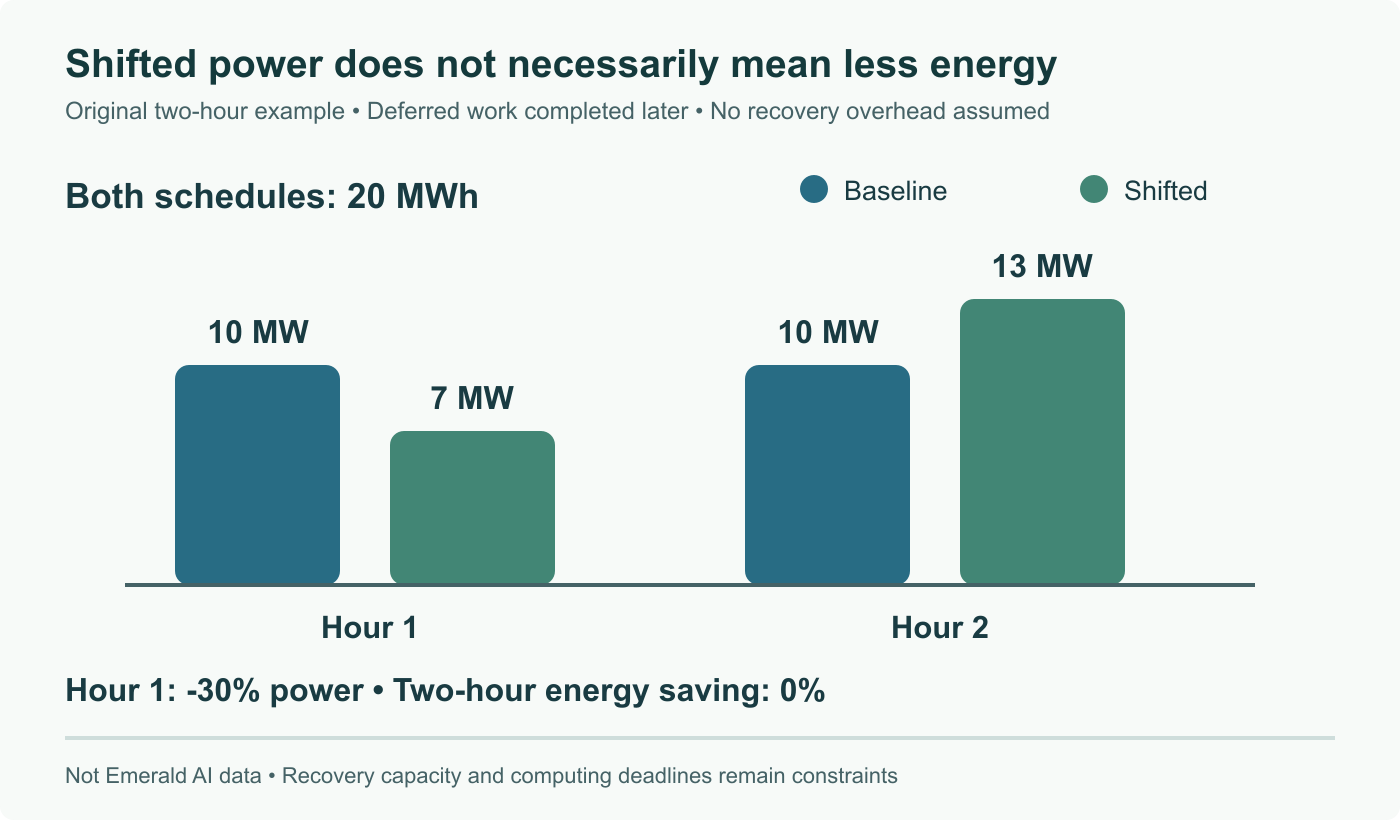
It works because AI workloads are unusually flexible in time. A training run cares about finishing, not about which particular hour it consumed. Batch inference and data preparation are similar. Latency sensitive serving is not flexible at all, which is precisely why the scheduling has to be selective rather than a blunt facility wide throttle.

Conductor orchestrates across three levers: shifting flexible work in time, drawing from on site batteries and generation so the work continues while the grid stops supplying it, and reducing load outright when the first two are insufficient. Chief executive Varun Sivaram frames the result as data centres adjusting their power use precisely when the grid needs relief, without compromising critical computing workloads.

The commercial value is not the electricity saved. It is that a facility able to guarantee reduction during stress hours can be interconnected against a smaller firm peak, and therefore connected sooner.

Checklist card listing what Emerald AI announced on August 25, 2026: a 150 million dollar Series A co led by Energize Capital and DCVC at a 1.05 billion dollar valuation, total funding above 220 million dollars, strategic investors including Nvidia, Siemens, GE Vernova, RWE and Samsung Ventures, the Emerald Conductor scheduling platform, the nearly 100 megawatt Manassas facility with Digital Realty and Nvidia validated with EPRI, Dominion and PJM, and the Silicon Valley Power flexible load interconnection programme.
Everything in the announcement, in one place. PNG

The investor list is the story

Rounds are usually less interesting than the companies that take them, but this cap table is worth reading properly.

Energize Capital and DCVC co led. The strategic names are Nvidia, Samsung Ventures, Siemens, GE Vernova, RWE, Aramco Ventures, Salesforce Ventures, JERA Ventures, In-Q-Tel, Radical Ventures, Energy Impact Partners, Lowercarbon Capital, Emerson Collective and Earthshot Ventures, with John Doerr and Tom Steyer participating individually. Emerald says twelve Fortune Global 500 companies sit on its strategic advisory board.

Chip vendors, grid equipment manufacturers and electricity utilities do not normally share a cap table. For flexible interconnection to work, all three have to agree on it: the compute vendor has to tolerate scheduled reduction, the equipment supplier has to build for it, and the utility has to offer a tariff that rewards it. Having them all invested is not proof the model works, but it is a reasonable signal that nobody involved considers it obviously unworkable.

The part that makes it more than a pitch

The Manassas deployment is where the claims meet a regulator.

Emerald is working with Digital Realty and Nvidia on the Vera Rubin AI Research Factory in Manassas, Virginia, a facility of nearly 100 megawatts described as the first power flexible AI factory, due online later in 2026. It is being tested in collaboration with the Electric Power Research Institute, Dominion Energy and the PJM Interconnection.

That combination matters. Dominion is the utility, PJM is the regional transmission organisation that runs the market this facility would flex into, and EPRI is the research body whose measurements utilities actually accept. A flexibility claim validated by the parties who would have to honour it is a different artefact from a vendor benchmark.

Separately, Silicon Valley Power has set up a Flexible Load Interconnection Program with Emerald, offering faster interconnection to data centres that agree to be flexible. That is the business model stated plainly: flexibility exchanged for queue position.

What to watch, and what to be sceptical about

The hundred gigawatt figure is a company estimate of a theoretical maximum, and it should be read as one. It assumes broad adoption, cooperative tariffs across many jurisdictions, and that flexibility genuinely holds during the hours that matter rather than the hours that are convenient. Any of those could disappoint.

The mechanism underneath it is sound, though, and it does not depend on the headline number being right. Utilities plan for peaks. A load that can credibly promise not to hit its peak when the system is stressed is worth connecting sooner than one that cannot. That is true at a hundred gigawatts and at one.

The thing to watch over the next year is not funding announcements. It is whether more utilities follow Silicon Valley Power in publishing a flexible interconnection tariff, because a programme you can read the terms of is what turns this from a promising idea into an option an operator can actually choose.

Sources and further reading

Frequently asked questions

What does power flexible actually mean for a data centre?

It means the facility can lower what it draws from the grid on request, for a bounded period, without the operator treating that as an outage. The mechanism has three parts. Some load gets shifted in time, because not every job is urgent and training checkpoints, batch inference and data preparation can wait an hour. Some load gets shifted to on site resources, batteries or local generation, so the work continues while the grid stops supplying it. And some load gets shed outright if the first two are not enough. Emerald's Conductor platform is the scheduler that decides which of the three applies to which workload, and the selling point is that latency sensitive inference keeps running while the flexible work absorbs the reduction.

Why is this worth a billion dollar valuation?

Because the binding constraint on AI capacity is grid interconnection, not chips or capital. A new large facility can wait years for a connection because utilities plan for the peak a customer might draw, not the average it actually draws. If a data centre can contractually guarantee it will reduce its draw during the handful of stress hours a year that drive that planning, the utility can connect it against a smaller reserved peak and connect it sooner. Emerald's estimate is that this could unlock more than 100 gigawatts on the existing US system. Whether the true figure is a hundred gigawatts or a fraction of it, the business is selling access to interconnection queues, which is currently among the scarcest things in the industry.

Who is backing it, and does the investor list tell you anything?

The round was co led by Energize Capital and DCVC and brings total funding above 220 million dollars. The strategic list is the informative part: Nvidia, Samsung Ventures, Siemens, GE Vernova, RWE, Aramco Ventures, Salesforce Ventures, JERA Ventures, In-Q-Tel, Radical Ventures, Energy Impact Partners, Lowercarbon Capital, Emerson Collective and Earthshot Ventures, with John Doerr and Tom Steyer investing individually. That is chip vendors, grid equipment manufacturers and utilities on the same cap table, which is a reasonable signal that the parties who would have to cooperate for this to work are at least interested in it working. Emerald also says twelve Fortune Global 500 companies sit on its strategic advisory board.

Is any of this deployed, or is it still a pitch?

There is at least one substantial deployment underway. Emerald is working with Digital Realty and Nvidia on the Vera Rubin AI Research Factory in Manassas, Virginia, a facility of nearly 100 megawatts described as the first power flexible AI factory, due online later in 2026 and tested in collaboration with the Electric Power Research Institute, Dominion Energy and the PJM Interconnection. Separately, Silicon Valley Power has established a Flexible Load Interconnection Program with Emerald that offers faster interconnection to data centres willing to be flexible. Having a utility, a regional transmission organisation and a research institute involved in the validation is what distinguishes this from a demonstration.

Does this matter if I run a normal data centre rather than an AI factory?

The technique is not new to you: demand response programmes have existed for decades and plenty of colocation facilities already participate. What is new is the scale of the load and how amenable AI work is to being moved. A training run is unusually forgiving about when it happens compared with, say, a transaction processing system, which makes AI capacity a much better demand response participant than most industrial load. If you operate anything with a meaningful batch component and a utility that offers flexible interconnection or demand response tariffs, the underlying question is worth asking locally, because the economics that funded this round are not exclusive to hyperscale.