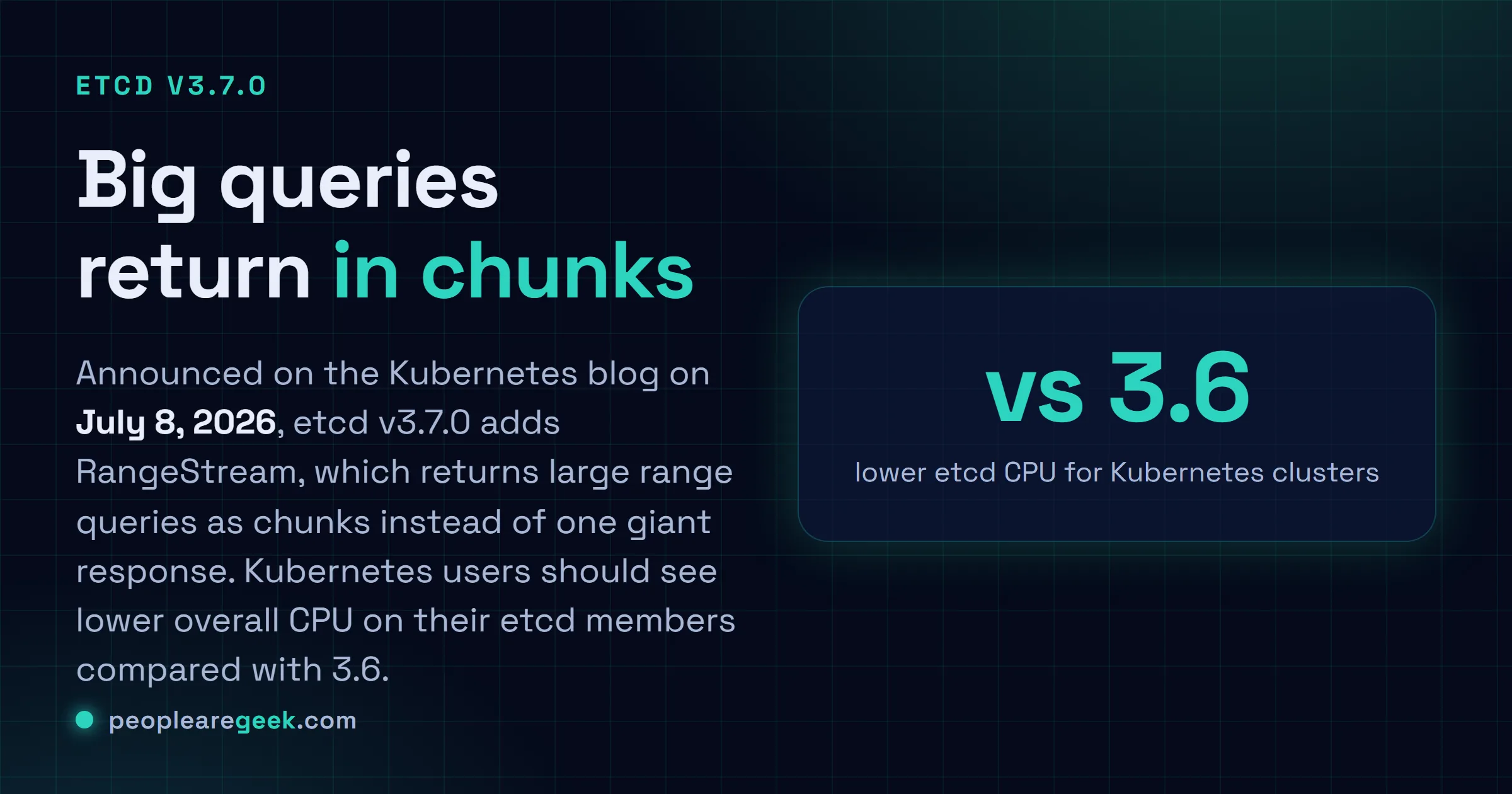
etcd v3.7.0 shipped in early July 2026, announced on the Kubernetes blog on July 8, and it is the kind of release that matters more to the people running clusters than to anyone reading a changelog for fun. The headline feature, RangeStream, lets the store hand back large query results in chunks instead of one enormous response, which is exactly the pattern that makes a busy control plane spike. Kubernetes users should see lower overall CPU on their etcd members compared with 3.6. There is a catch worth stating up front, so nobody upgrades expecting a free lunch: the biggest win needs a Kubernetes version that is not out yet.
The short answer
etcd v3.7.0 shipped in early July 2026, announced on the Kubernetes blog on July 8. Its headline feature, RangeStream, returns large range queries as chunks instead of one giant response, which eases the memory and CPU spikes those queries cause. Kubernetes users should see lower overall CPU on their etcd members compared with 3.6. The release also adds keys only range requests, faster lease renewal, a v3 only startup path and Unix socket endpoints. The full RangeStream benefit needs the upcoming Kubernetes v1.37 with the EtcdRangeStream feature gate.
etcd rarely makes headlines, which is a sign it is doing its job. It is the quiet store under every Kubernetes cluster, holding the whole desired state, and it only becomes visible when a control plane starts to strain. That is what makes this release worth your attention: the changes target the exact moments when etcd stops being invisible.
What shipped
etcd v3.7.0 was released in early July 2026 and announced on the Kubernetes blog on July 8, following beta and release candidate builds through the spring. It is a minor release in name and a meaningful one in effect, because most of the work goes to how etcd behaves under the load a large cluster actually generates.
The marquee feature is RangeStream. A range query asks etcd for a span of keys, and in a big cluster that span can be enormous, think of listing every pod or every secret in a namespace with thousands of objects. Traditionally etcd assembles that whole answer and hands it back in one response, which spikes memory and pushes latency up for everything else at the same instant. RangeStream instead returns the result as a series of smaller chunks. Peak memory stays flatter, and the load those large lists create gets spread out rather than concentrated.
Alongside it, etcd now supports keys only range requests, so a caller that needs the keys but not their values can skip transferring the values entirely. Both features attack the same underlying problem, which is that large reads are the most expensive thing a control plane does routinely.
The other, quieter improvements
The rest of the release is the sort of maintenance that pays off for years. FastLeaseKeepAlive speeds up lease renewal by skipping the wait for the applied index, which helps the many short lived leases a cluster churns through. The server now bootstraps entirely from the v3 store and no longer depends on the legacy v2 store at startup, removing a long standing piece of historical baggage. There is support for Unix socket endpoints, so local components can talk to etcd without a TCP port at all. And a round of dependency cleanup replaces several outdated protobuf libraries with maintained ones, which is invisible day to day but matters the next time a security fix has to land upstream.
Taken together, Kubernetes users should see a decrease in overall CPU usage by their etcd members compared with 3.6, before any single feature is even switched on.

The catch, and what to do about it
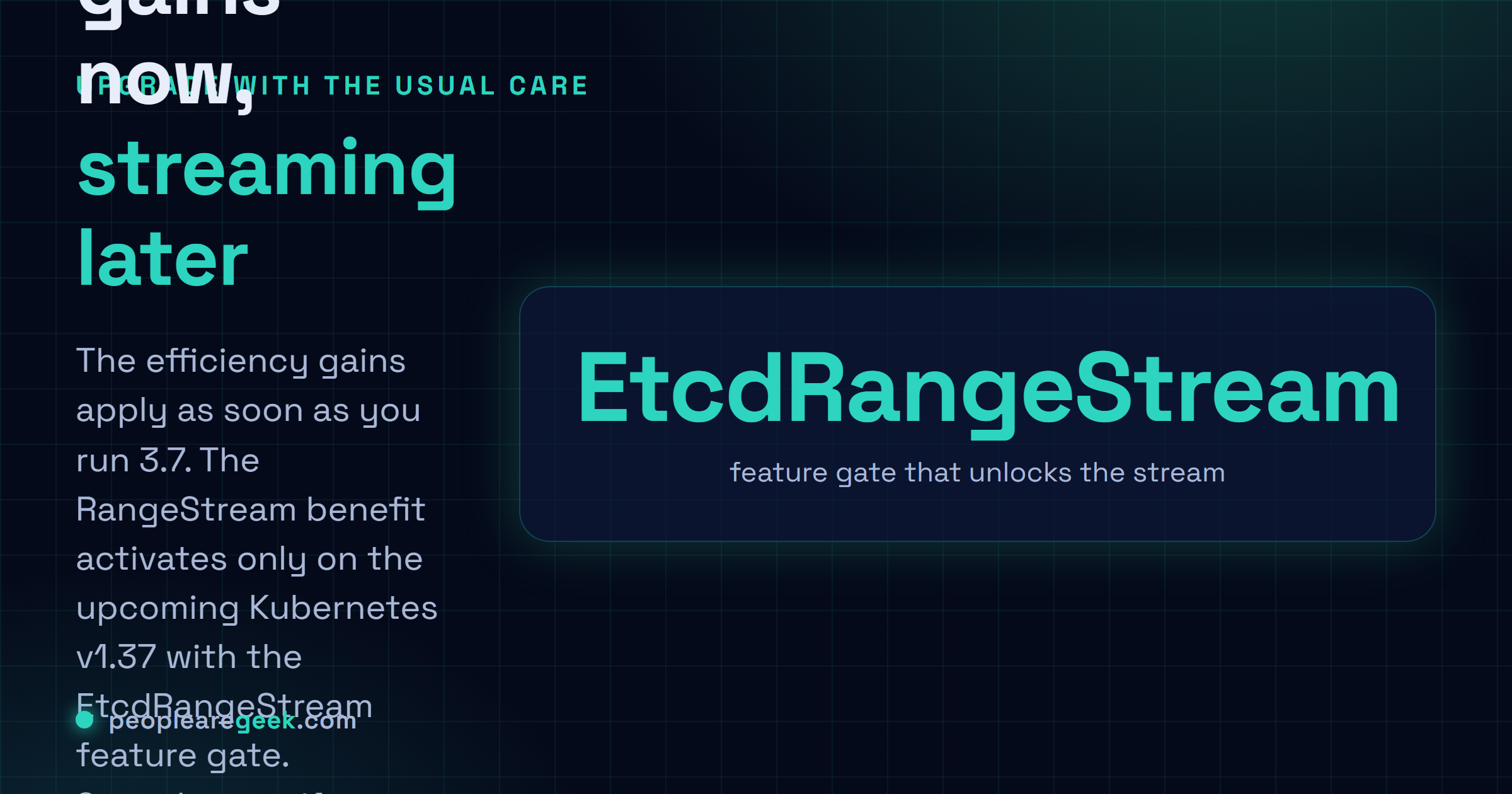
Here is the part to hold in mind before anyone files a change request promising instant relief. The general efficiency gains land as soon as you run 3.7. The RangeStream benefit, specifically, only shows up once the API server asks for streamed ranges, and that support arrives in the upcoming Kubernetes v1.37 behind the EtcdRangeStream feature gate. On today's Kubernetes, you get the broad improvements but not the streaming path. That is not a reason to wait, but it is a reason to be accurate about what changes and when.
The upgrade discipline is the usual etcd discipline, only more so, because etcd sits underneath everything else you run. Read the release notes for your exact version jump. Take a verified snapshot and confirm you can actually restore it. Move a non production cluster to 3.7 first and let it carry real traffic for a while. Re run your backup and restore drill against 3.7 specifically, since a restore procedure that worked on 3.6 is an assumption until you prove it again. Only then does production make sense.
None of that is exciting, and that is the point. etcd is the one component where the correct posture is patient and boring, and this release rewards operators who treat it that way while quietly making a busy control plane cheaper to run.
Sources and further reading
- Kubernetes blog: Announcing etcd v3.7.0
- etcd blog: etcd v3.7.0-rc.0 now available for testing
- etcd releases on GitHub
Frequently asked questions
What is etcd and why does the version matter?
etcd is a distributed key value store that holds the entire desired state of a Kubernetes cluster, so every object you create passes through it. It is the most latency sensitive and CPU sensitive component in a control plane. A new etcd release changes how much load your control plane can take before it struggles, which is why cluster operators track these versions closely.
What is RangeStream and why does it help?
RangeStream lets etcd return a large range query as a stream of smaller chunks rather than assembling one huge response in memory. Big list requests, such as listing every pod in a large cluster, are a classic cause of memory spikes and latency on the API server and etcd. Streaming the result keeps peak memory flatter and smooths out the load that those requests create.
Will upgrading to 3.7 immediately cut my CPU use?
Partly. etcd v3.7.0 brings general efficiency gains that Kubernetes users should feel as lower overall CPU on their etcd members compared with 3.6. The RangeStream benefit specifically becomes available only when you run the upcoming Kubernetes v1.37 with the EtcdRangeStream feature gate enabled, since the API server has to ask for streamed ranges. Until then you get the other improvements but not that one.
What else changed in etcd 3.7?
Several quieter but useful items. Keys only range requests let you fetch just the keys without their values. FastLeaseKeepAlive speeds up lease renewal by skipping the wait for the applied index. The server now bootstraps entirely from the v3 store, dropping its dependency on the legacy v2 store at startup. There is also support for Unix socket endpoints for local communication without a TCP port, and a cleanup that replaces outdated protobuf libraries with maintained ones.
Should I rush this upgrade into production?
Treat it like any etcd upgrade, which is to say carefully. etcd sits under everything, so the sensible path is to read the release notes, take a verified snapshot, upgrade a non production cluster first, and confirm your backup and restore drill still works on 3.7 before touching production. The gains are real, but etcd is the last place to move fast and hope.