For years the fastest path to a good AI assistant on a phone ran through the platform owner, and on Android that owner is Google. The European Commission has just moved to change that. On July 16, 2026, it issued two sets of binding specification measures to Google under the Digital Markets Act. The first tells Google to open eleven feature areas on Android so competing AI assistants can reach the same system level capabilities as Gemini, including voice activation. The second tells Google to share anonymized search data, the ranking, query, click, and view signals it collects at scale, with rival search engines and AI chatbots that have search features. The changes phase in through 2027, so nothing flips overnight, but the direction is clear and it reshapes the ground under anyone building an assistant or a search product. Here is what the order actually requires.
The short answer
On July 16, 2026 the European Commission issued two sets of binding measures to Google under the Digital Markets Act. The first orders Google to open eleven Android feature areas so rival AI assistants can reach the same system level access as Gemini, including voice activation. The second orders Google to share anonymized search signals, ranking, query, click, and view data, with competing search engines and AI chatbots. Search-data sharing starts January 2027 and Android interoperability is due by July 2027, so the openings arrive across next year.
Platform access is one of those things that decides which products can exist, and it usually gets settled quietly in the details of an operating system. The European Commission just made it loud. Two binding orders under the Digital Markets Act aim to pry open the parts of Android and Google Search that competitors have not been able to reach, and if you build assistants or search tools, this is the kind of structural change that matters more than most feature launches.
The two orders
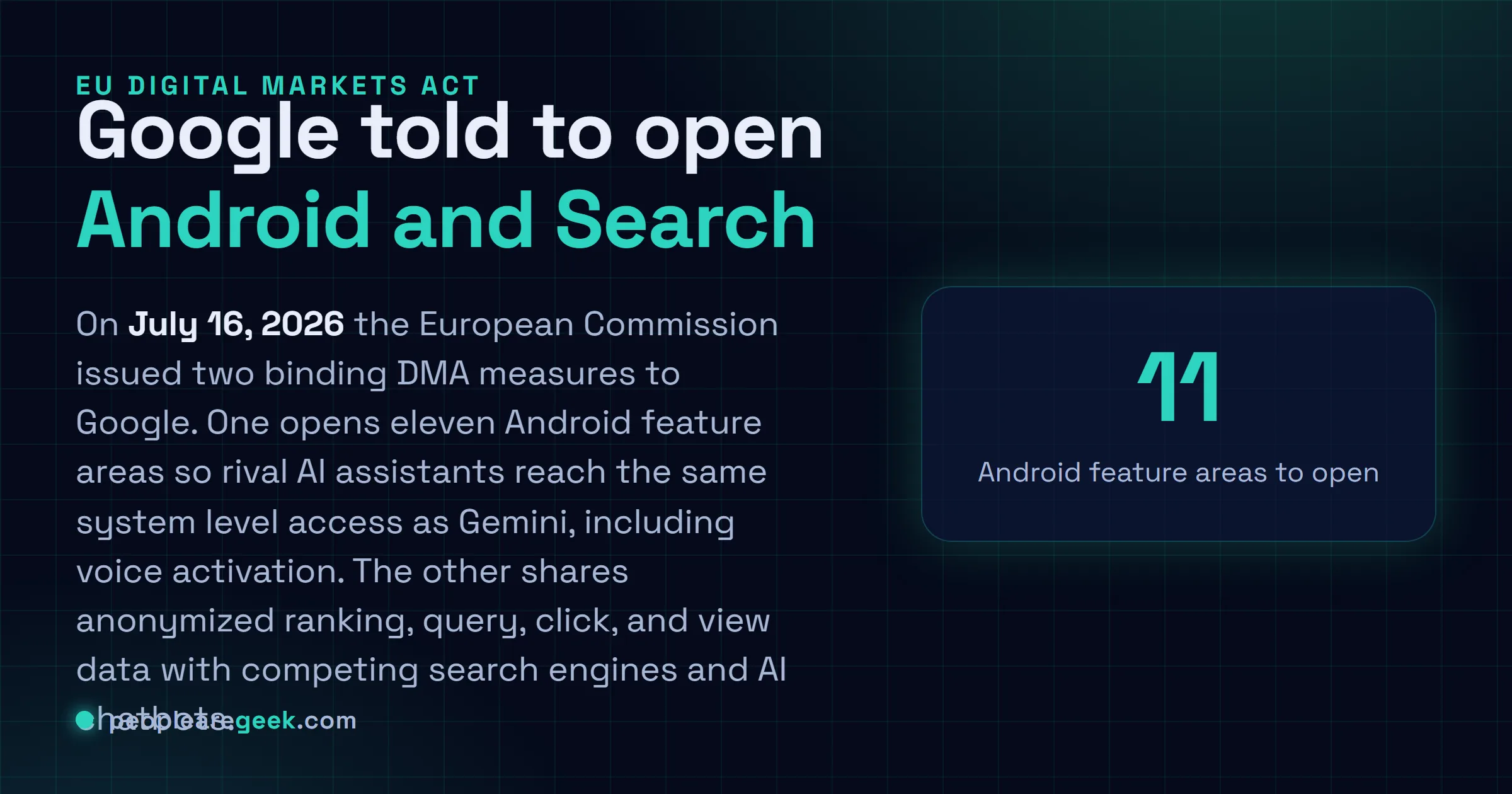
On July 16, 2026, the Commission issued two sets of binding specification measures to Google under the Digital Markets Act. The first concerns Android. Google is required to open eleven feature areas so competing AI services can access the same functionality as its own Gemini assistant. The Commission's stated aim is that rivals can compete on equal access to features on Google's Android devices rather than being locked out of capabilities reserved for Gemini.
The second concerns Search. Google is required to share anonymized search data, described as the ranking, query, click, and view signals it collects at scale, with third-party search engines, including AI chatbots that have search features. The logic is that the incumbent gathers signals no competitor can match on its own, so sharing an anonymized slice rebalances the field.
What opens on Android
The Android measures are the ones most likely to change what an assistant can do. The Commission describes concrete capabilities: activating a preferred AI assistant by voice, similar to the Hey Google command, using a third-party assistant to perform actions in apps such as booking a taxi, receiving relevant reply suggestions in chat apps, and asking an assistant about a recently visited place.
Read together, these describe system level integration that has been Gemini's advantage. A competing assistant that can be summoned by voice and act inside apps is a very different product from one confined to its own window. For developers who have watched a preinstalled default win by convenience, the order is meant to lower that structural barrier rather than hand anyone a finished feature.

The search data question
The search measure is quieter but arguably deeper. Search quality compounds with scale, because more queries produce more signal about what people actually want, and that signal improves ranking, which draws more queries. That loop has been very hard to break into. By requiring Google to share anonymized ranking, query, click, and view data, the Commission is trying to give competitors a version of the signal they could never gather alone.
For an AI product with search features, that data could improve result quality without your own enormous query volume. The important qualifier is anonymized and the important unknown is how rich the shared data turns out to be in practice. A generous share meaningfully lowers the barrier, a thin one changes little, and the detail will only become clear as Google implements the measure.
Timing and what to do now
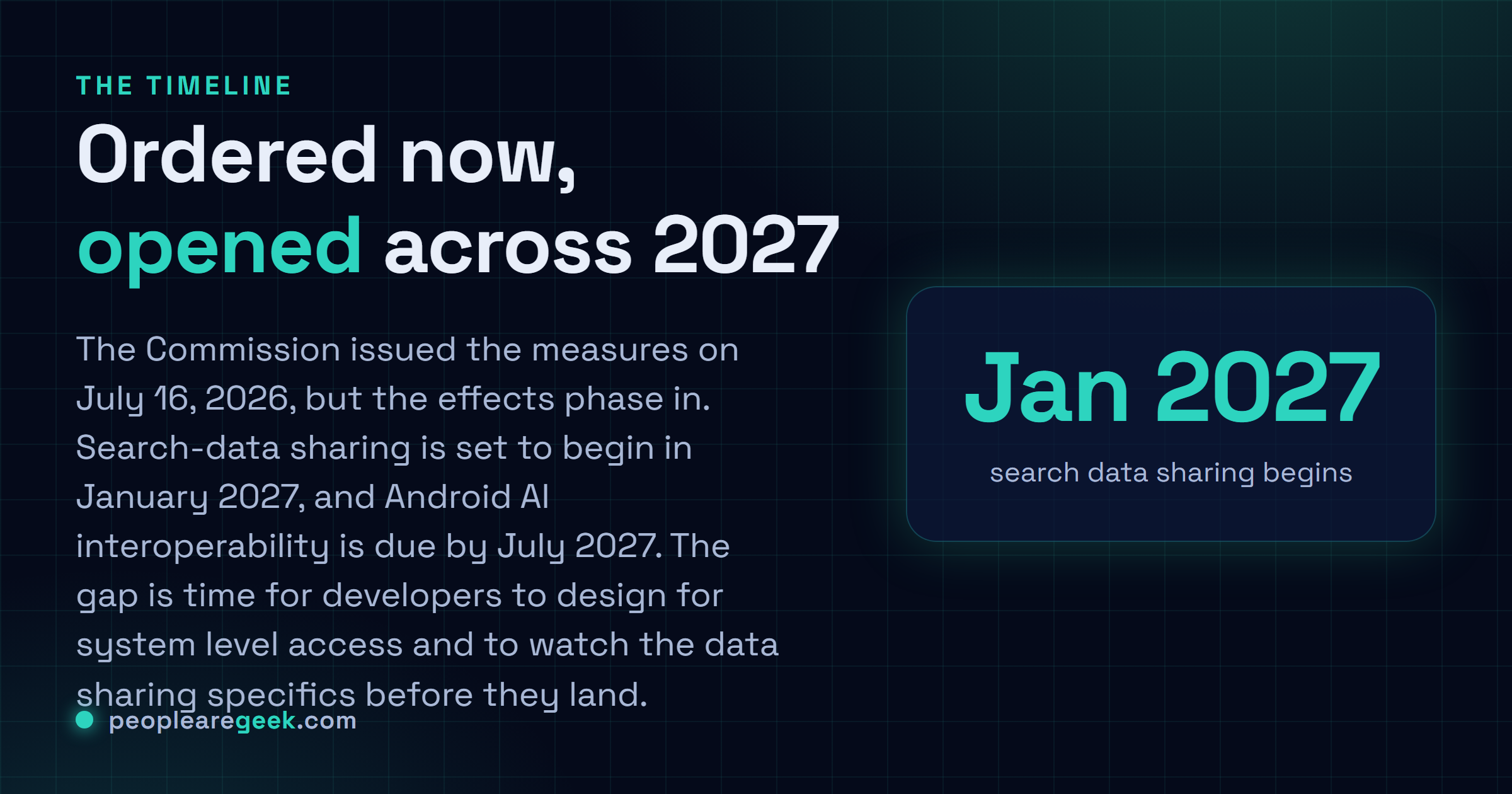
Nothing changes today. The Commission issued the orders on July 16, 2026, but the effects phase in: search-data sharing is set to begin in January 2027, and Android AI interoperability is due by July 2027. The gap is time to prepare rather than time to wait.
If you build an Android assistant, this is the moment to design for system level access and voice activation you have not been able to rely on before, so you are ready when the interoperability lands. If you build search or a search backed AI product, watch the specifics of the data sharing program closely as they are published, because the value hinges entirely on what the anonymized signal contains. Either way, the platform is being opened by regulation, and the teams that plan around the timeline will be first through the door.
Sources and further reading
- European Commission: guidance to Google for AI interoperability on Android and sharing of Search data under the DMA
- CNBC: Google required to open up to AI, search engine rivals under EU-mandated changes
- TechTimes: EU gives rival AI assistants system level Android access Google reserved for Gemini
Frequently asked questions
What did the European Commission actually order?
On July 16, 2026, the Commission issued two sets of binding specification measures to Google under the Digital Markets Act. The first requires Google to open eleven feature areas on Android so rival AI services can access the same functionality as Gemini, including activation by voice. The second requires Google to share anonymized search data, the ranking, query, click, and view signals it collects at scale, with third-party search engines and AI chatbots that offer search. These are binding measures, not suggestions, aimed at letting competitors compete on equal footing.
What changes for Android AI assistants specifically?
Rival assistants are meant to reach system level capabilities that Google has reserved for Gemini. The Commission describes users being able to activate a preferred AI assistant by voice, similar to the Hey Google command, use a third-party assistant to perform actions in apps such as booking a taxi, receive relevant reply suggestions in chat apps, and ask an assistant about a recently visited place. In short, a competing assistant should be able to plug into Android at the level Gemini already does.
What search data is Google required to share?
The measures target the search signals that only Google Search can gather at scale. Competing search engines, including AI chatbots with search features, should be able to receive anonymized data that Google uses to improve its own search products, described as ranking, query, click, and view data. The stated goal is to rebalance a playing field where the incumbent has a data advantage that rivals cannot replicate on their own.
When do these changes take effect?
They phase in rather than landing at once. According to the Commission, search-data sharing is set to begin in January 2027, and the Android AI interoperability changes are due by July 2027. So the order was issued on July 16, 2026, but the practical effects for developers and competing services arrive across 2027 as Google implements each set of measures.
Why does this matter to developers and smaller companies?
Two reasons. If you build an AI assistant, system level Android access and voice activation have been hard to match against a preinstalled default, and the order is meant to lower that barrier. If you build search or an AI product with search features, access to anonymized signals that were previously exclusive to Google could improve result quality without your own massive query volume. Both are structural openings rather than immediate features, so the value depends on how the measures are implemented.