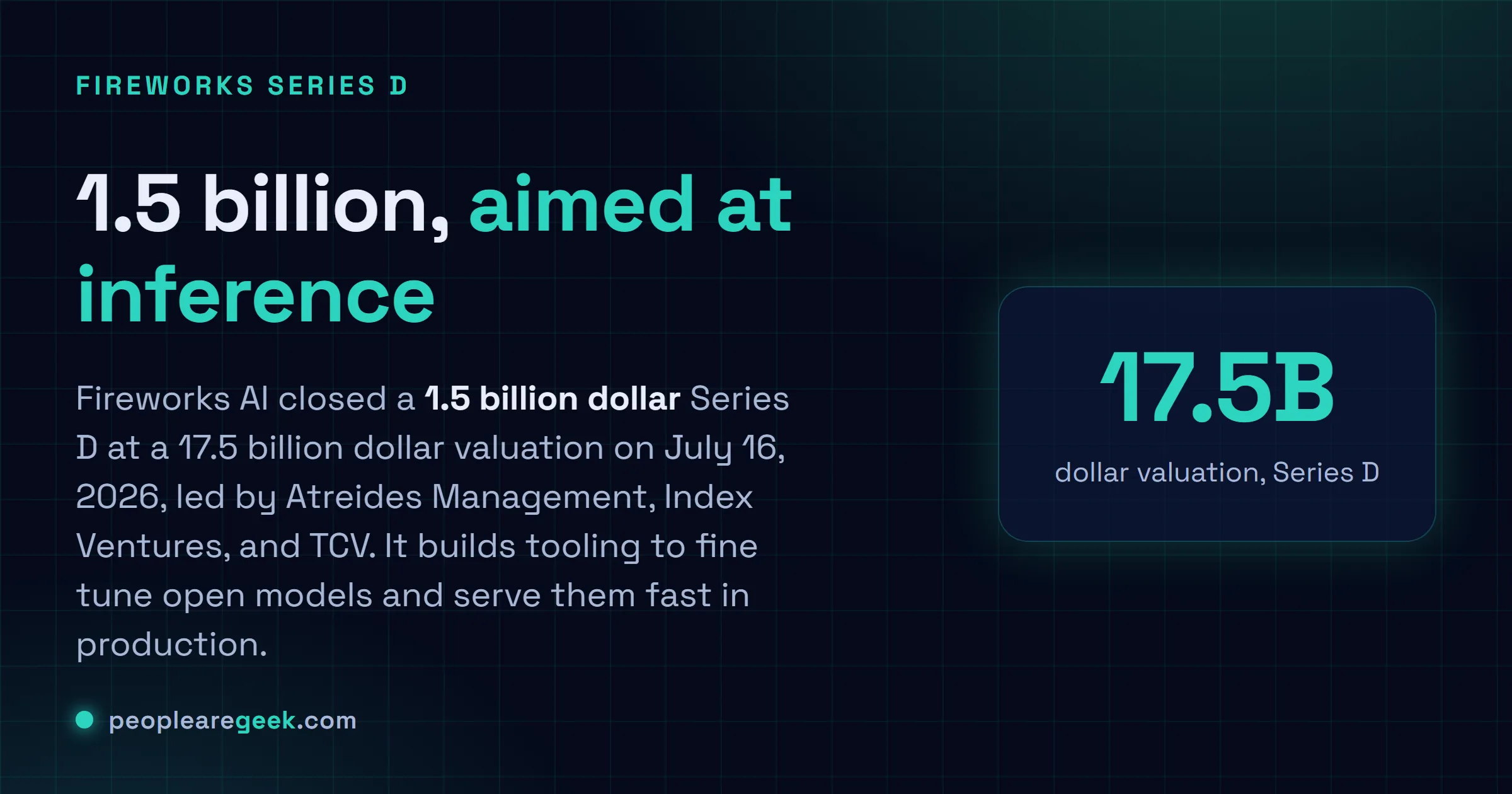
Fireworks AI has closed a Series D of just over 1.5 billion dollars at a 17.5 billion dollar valuation, announced on July 16, 2026, and led by Atreides Management, Index Ventures, and TCV. The round is large, but the number that tells the real story is the traffic: the platform now serves more than 40 trillion tokens a day, up from about 15 trillion a year ago, and 95 percent of those tokens come from models that customers have specialized on their own data. Fireworks does not build frontier models. It builds the tooling to fine tune open models and then run them fast and cheap in production, and enterprises are paying for it at a run rate above 1 billion dollars a year. For developers deciding how to deploy open models, this is a signal about where serious inference is heading.
The short answer
Fireworks AI closed a Series D of just over 1.5 billion dollars at a 17.5 billion dollar valuation on July 16, 2026, led by Atreides Management, Index Ventures, and TCV. The platform now serves more than 40 trillion tokens a day, nearly triple a year ago, and 95 percent of them come from open models that customers have specialized on their own data. Fireworks does not make frontier models. It makes the tooling to fine tune open ones and run them fast in production, and enterprises are paying for it above a 1 billion dollar run rate.
There are two ways to build an AI business. One is to train a frontier model and rent access to it. The other is to sit underneath that choice and help everyone else run models well, whichever ones they pick. Fireworks took the second path, and on July 16 it raised a billion and a half dollars to keep going. The interesting part is not the size of the round. It is what the round is a bet on: that most production AI will run on open models that companies have tuned for their own work, not on the largest closed model available.
What Fireworks raised
Fireworks announced a Series D of about 1.505 billion dollars at a 17.5 billion dollar valuation. Atreides Management, Index Ventures, and TCV led the round, with existing investors including Evantic, Lightspeed Venture Partners, and NVIDIA taking part. The company says it will spend the money expanding its engineering team and its global compute capacity, and deepening partnerships with cloud and hardware partners such as Microsoft and NVIDIA.
The raise sits on top of real growth. Fireworks reports an annualized revenue run rate above 1 billion dollars, up roughly fivefold from its previous round a year earlier. When a company raises at a much higher valuation only a year later and can point to revenue rising at that pace, the round is usually catching up to demand rather than getting ahead of it.
The bet: specialized open models, not the biggest closed one
Fireworks does not build its own frontier model. It provides the tooling to take an open model, fine tune it on a customer own data, and then serve it in production quickly and at lower cost than a large general purpose closed model would charge. The company calls the result specialized intelligence, and the pitch is straightforward: a smaller open model that has been tuned for one job can match or beat a big general model on that job, while running faster and costing less per token.
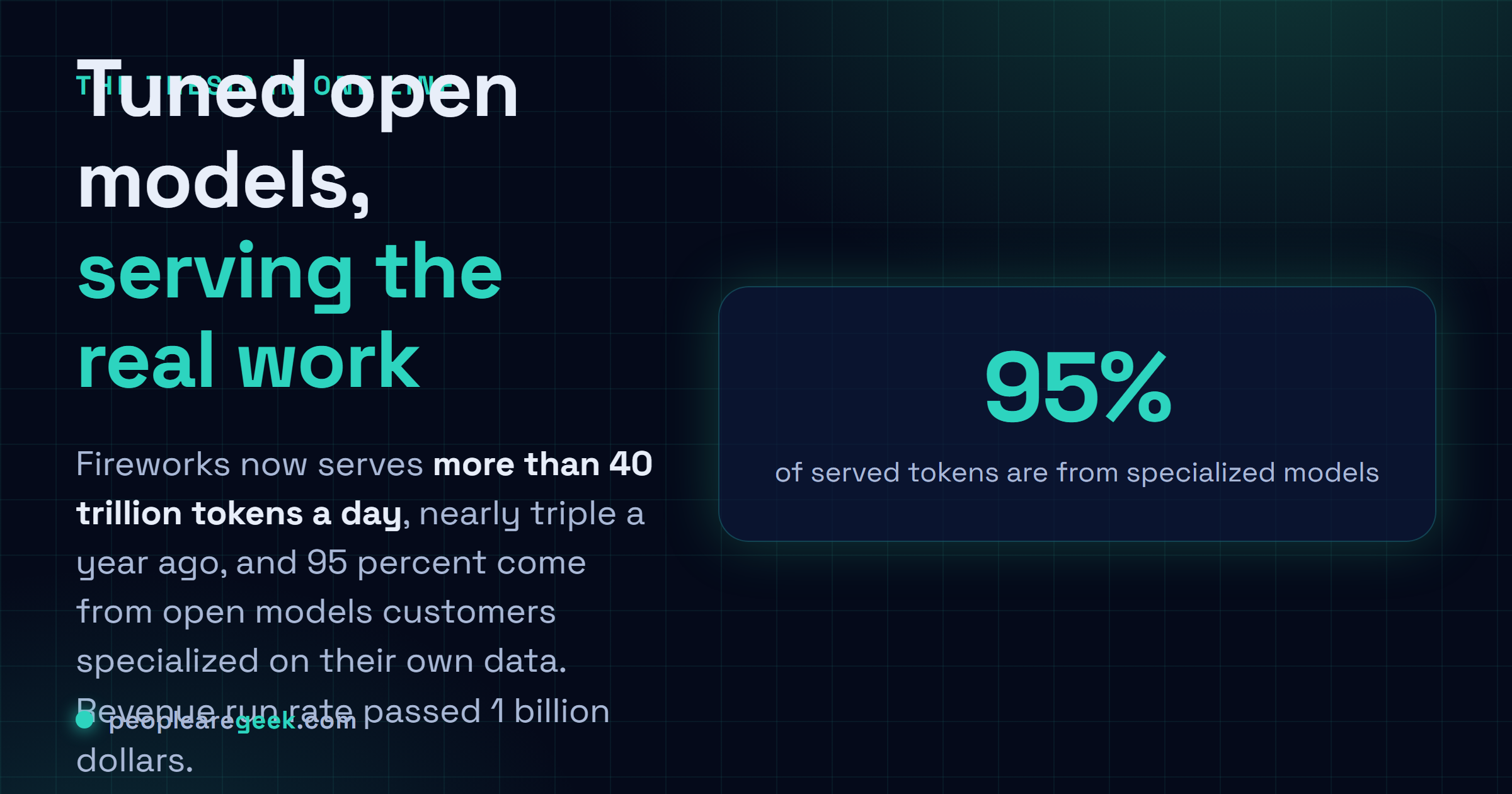
The proof is in how the platform is used. Fireworks says about 95 percent of the tokens it serves come from specialized models rather than off the shelf ones. That is the whole thesis in a single figure. Customers are not just running open models as cheaper drop in replacements, they are tuning them, and the tuned versions are doing the real work.

Why the token numbers matter more than the valuation
Valuations move on sentiment. Token volume moves on usage, which is why the traffic figures are the ones worth anchoring on. Fireworks says the daily volume of tokens served nearly tripled over the past year, from around 15 trillion to more than 40 trillion a day. Tokens served is about as direct a measure of real production usage as you get, because a token is only served when an application actually calls a model to do something.
Tripling that in a year, with revenue rising about fivefold alongside it, says workloads are genuinely migrating onto this kind of platform. It is not a story about demos or signups. It is a story about applications in production choosing to run inference on tuned open models, at a scale that is now measured in tens of trillions of tokens every single day.
What this means for developers
You do not need to change your stack because a startup raised money. But the pattern underneath the round is a practical one worth testing.
- Specializing an open model is now a mainstream strategy. The default reflex of reaching for the largest closed model on every task is no longer the only serious option. If a tuned open model clears your quality bar for a specific job, it usually runs faster and costs less per token, and that gap compounds at production scale.
- Your evaluation is the hard part, not the tuning. The reason specialization works is that a narrow task has a narrow definition of good, and a smaller model can be pushed to hit it. That only holds if you have a solid, task specific evaluation to measure against. Build the eval before you chase the model.
- Measure cost per token at your real traffic. The economic case for open models lives or dies on inference cost at your actual volume, not on a headline benchmark. Before committing, test what serving costs at the traffic you expect, including the tuned model quality on your own data.
Fireworks raising a billion and a half dollars does not settle the open versus closed debate. Frontier closed models still lead on the hardest general tasks. But the traffic on this one platform, tens of trillions of specialized tokens a day, is hard evidence that for a large and growing share of real production work, a tuned open model is already the sensible default.
Sources and further reading
- Fireworks: Fireworks secures 1.5 billion dollars in Series D funding
- SiliconANGLE: AI infrastructure startup Fireworks closes 1.5 billion round at 17.5 billion valuation
- BigDATAwire: Fireworks raises 1.5 billion to expand enterprise AI model platform
- Quartz: Fireworks AI raises 1.5 billion Series D at 17.5 billion valuation
Frequently asked questions
How much did Fireworks raise and who led the round?
Fireworks announced a Series D of about 1.505 billion dollars at a 17.5 billion dollar valuation on July 16, 2026. The round was led by Atreides Management, Index Ventures, and TCV, with participation from existing investors including Evantic, Lightspeed Venture Partners, and NVIDIA. It follows a period of fast growth, with the company reporting an annualized revenue run rate above 1 billion dollars.
What does Fireworks actually do?
Fireworks provides tooling to customize open models on a customer proprietary data, then run inference on those models quickly and at lower cost than general purpose closed models. The pitch is specialized intelligence: a smaller open model fine tuned for a specific task can match or beat a large general model on that task, while running faster and cheaper. About 95 percent of tokens served through Fireworks come from specialized models rather than stock ones.
Why is the token growth number important?
Fireworks says daily token volume nearly tripled over the past year, from around 15 trillion to more than 40 trillion tokens a day. Tokens served is a direct measure of real production usage, not just signups, so tripling it in a year suggests genuine workloads are moving onto the platform. Revenue rose roughly fivefold over the same period, which points the same direction.
What should developers take from this?
The practical takeaway is that specializing an open model, rather than always reaching for the biggest closed model, is becoming a mainstream production strategy. If a fine tuned open model can hit your quality bar on your specific task, it often runs faster and costs less per token. The engineering questions to test are how good your task specific evaluation is, how much your data improves a smaller model, and what inference actually costs at your traffic.